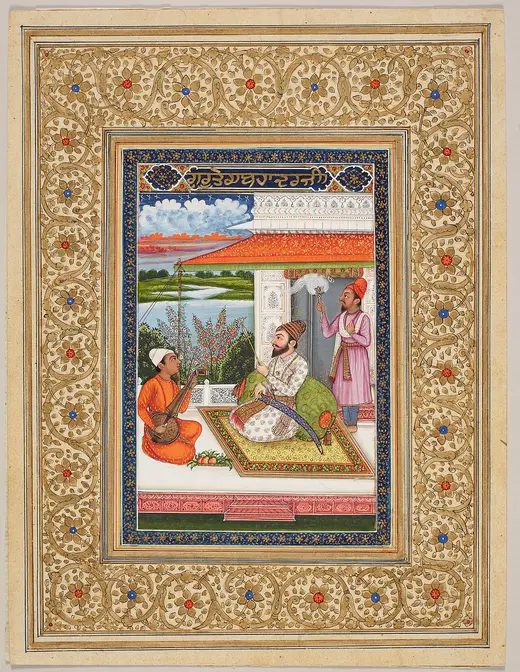
The claimants at Bakala
Makkhan Shah finds Guru Ji
A trader who had vowed five hundred gold coins offered two to each claimant, until one man asked about the rest.
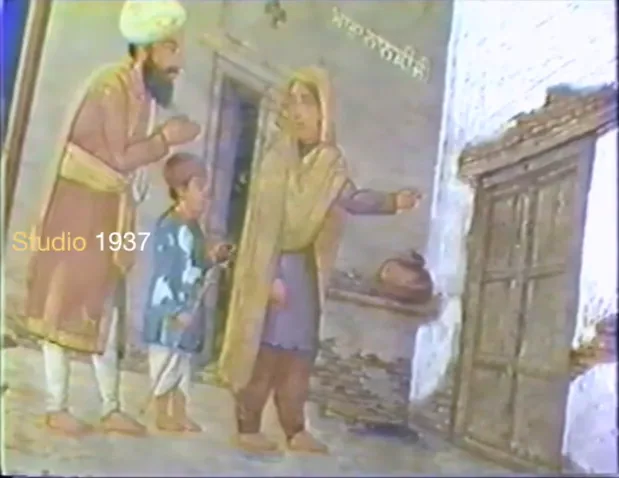
According to the tradition, Makkhan Shah was a wealthy Lubana trader whose cargo was in danger at sea. He vowed that if it reached port he would give five hundred gold mohars to whoever was then Guru. The boat came through, and he set out to keep his word.
At Bakala he found twenty-two men each claiming to be Guru. He decided on a test. Visiting them one by one, he offered each just two coins, as a devotee might, and said nothing of his vow. Macauliffe says each one praised himself and ran down the others, and none knew of the promise.
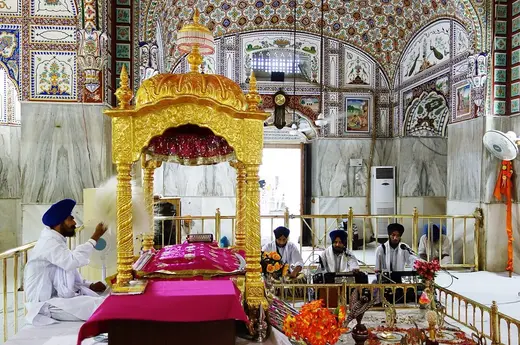
Then he heard, one telling says from a young boy, of a holy man living quietly in the village who made no claim. He found Sri Guru Tegh Bahadur Ji in a secluded room and placed two coins before him. Guru Ji blessed him and remarked that this fell well short of the five hundred promised.
Makkhan Shah gave the rest with delight, ran up to the roof and shouted that he had found Guru Ji. Sri Gur Pratap Suraj Granth says the strings of his cloak burst with joy.
How do we know?
Several traditional accounts tell this story, without close independent support.
The Encyclopaedia's Makkhan Shah comes from Tanda in the Muzaffarabad area, while Macauliffe has him from Gujarat in the Deccan. The Encyclopaedia also says he had a boat that went aground in one entry and one caught in a storm in another. If Guru Ji was anointed on 11 August, the October date means the story cannot be what first settled the matter, although that is its usual role. Of the claimants, only Dhir Mall is named in the sources consulted for this page, and no list of all twenty-two has been found. Two Encyclopaedia entries say only that there were several.
- Later traditionTells the full story, dates the arrival to Diwali, 9 October 1664, and counts twenty-two claimants.[EoS]
- Later traditionTells the same story, including the shout from the rooftop.[EoS]
- Later traditionRetells it with twenty-two Sodhis, the offering of two gold muhars each, and the trader's doubts drawn from the Sukhmani. (pp. 331-332)[Macauliffe]