Historic gurdwara
Gurdwara Sachcha Sauda
The gurdwara near Chuharkana that marks the story of the true bargain, in which Sri Guru Nanak Dev Ji spent his trading money on feeding hungry ascetics. The story comes from the Bala Janamsakhis alone.
History
The story of the good bargain
According to the Bala Janamsakhi, Mehta Kalu gave Guru Ji twenty rupees to trade with, and sent Bhai Bala along. On the road they came on a large party of ascetics who had gone without food for days. Guru Ji spent all the money on feeding them and went home with no goods. When his father rebuked him, he answered that no better bargain could be made. The story's name comes from the Punjabi words for a true or sound deal.[EoS][McLeod]
How well it is supported
W. H. McLeod points out that this episode is found only in the Bala Janamsakhis. He does not call it impossible, but he thinks the Miharban and Puratan accounts would hardly have left out so interesting a story had it been in circulation when they took shape. The gurdwara therefore commemorates a tradition that cannot be traced to the oldest narrative sources.[McLeod]
- Sikh period
The building
The Encyclopaedia of Sikhism says devotees first built a simple structure close to the place, and that it drew growing numbers of pilgrims. Land of over 100 acres was given during Sikh rule. The 1962 survey by Pakistan's Department of Archaeology and Iqbal Qaisar's 1998 survey both credit Maharaja Ranjit Singh with the gurdwara. Qaisar describes it as spacious and fort-like, and says fairs were once held there in Magh, Vaisakh and Kattak.[EoS][Khan][Qaisar]
- 30 December 1920
Reform
Udasi priests ran the gurdwara until 30 December 1920, when Jathedar Kartar Singh Jhabbar took possession for the Shiromani Gurdwara Parbandhak Committee. By 1947 it was a large three-storey building with domed towers.[EoS]
- Since 1947
Closure and reopening
After Partition the gurdwara came under Pakistan's Waqf Board. Qaisar says it stayed locked after 1947 and reopened to visitors at Vaisakhi 1993. The Encyclopaedia dates renovation to 1993-94, and Qaisar says Sikhs in England helped to pay for the repairs, along with a new dining hall and water tank.
Qaisar reports the local belief that a van tree beside the prakash asthan grew from a twig Guru Ji planted after cleaning his teeth. He also describes Gurdwara Sach Khand, about a kilometre away, where a story of a merchant's sugar is remembered, and says its building was in poor condition.[EoS][Qaisar]
What the sources disagree on
- Details of the story
The Encyclopaedia and McLeod's text of the Bala story give twenty rupees, and Qaisar agrees. The 1962 survey says fifty. The Encyclopaedia and the survey name Bhai Bala as the companion, McLeod's translation says a servant, and Qaisar names Baba Mardana. The Bala text as McLeod gives it says the money was meant to buy fine yarn.[EoS][McLeod][Khan][Qaisar]
- The land grant
The Encyclopaedia gives over 100 acres. Qaisar gives 250 bighas. The two units are not directly comparable and the figures have not been reconciled.[EoS][Qaisar]
Images
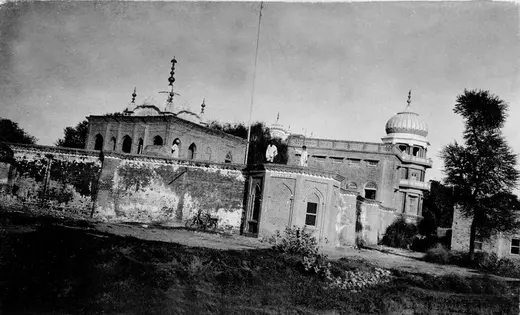
Gurdwara Sachcha Sauda, also called Khara Sauda, at Chuhar Kana in Sheikhupura district. Photographed by Dhanna Singh Chahal 'Patialvi' on 21 October 1933.
Dhanna Singh Chahal 'Patialvi', 1933. Panjab Digital Library (as credited on Commons). Public domain. Source
