First Guru, founder of the Sikh faith
Sri Guru Nanak Dev Ji
Born in 1469 near Lahore, Sri Guru Nanak Dev Ji taught that there is one creator open to every person regardless of caste, sex or creed, travelled widely for two decades, then settled at Kartarpur to show what a community built on honest work, sharing and remembrance of the divine looks like. His 974 compositions open Sri Guru Granth Sahib Ji.
Read the full life and times →Sources disagree
- 1469-11: The Bala Janamsakhi places the birth on the full moon of Kartik (October-November), and that is the day on which the birthday is celebrated worldwide. The older Janamsakhis and modern scholarship favour Vaisakh.[McLeod]
Sources disagree
Early life
Sri Guru Nanak Dev Ji was born in the village of Rai Bhoi di Talwandi, now Nankana Sahib in Pakistan, to Kalu, a Khatri who kept accounts for the local landholder Rai Bular, and his wife Tripta. He had an elder sister, Nanaki, to whom he stayed close all his life. The Janamsakhis, the traditional life-stories written down from the late sixteenth century onward, describe a thoughtful child who learned the scripts and arithmetic available to him and who unsettled his teachers with questions about what their learning was for.
The same stories record that he declined the sacred thread at his investiture, preferring, in his own later words, a thread spun from compassion and contentment. His father tried him at herding, farming and trade. One episode has him spending the money meant for a business deal on feeding wandering ascetics, calling it the true bargain. Whatever the historicity of individual stories, the pattern they draw is consistent: a young man drawn to religious questions and impatient with ritual.
In his late teens he married Sulakhni of Batala and later had two sons, Sri Chand and Lakhmi Das. Through Nanaki's husband he found work at Sultanpur Lodhi as storekeeper for the provincial governor, a job he seems to have done well for several years while gathering a circle of friends who sang with him at night, among them the Muslim musician Mardana.[EoS][EoS][EoS][Macauliffe]
Revelation and travels
The Janamsakhis say that around 1499, bathing in the Kali Bein stream at Sultanpur, Sri Guru Nanak Dev Ji disappeared for three days and returned with a single message: there is no Hindu and no Muslim. Whatever lies behind the story, from this point he gave up his post and spent roughly twenty years travelling with Mardana.
The traditional accounts group the journeys into four long tours (udasis): east through the Gangetic plain to Bengal and Assam, south to Sri Lanka, north into the Himalaya, and west through Multan to Mecca, Medina and Baghdad before returning through Afghanistan. Historians treat the precise routes with caution, since the stories were written down decades after the events and grew in the telling, but the broad picture of extensive travel and debate with Nath yogis, Sufis, Brahmins and Jains is not doubted.
Sri Guru Nanak Dev Ji's method on these journeys, as the stories and his own hymns show it, was to go to the centres of other traditions and argue in their own terms: that bathing at pilgrimage sites does not wash the mind, that fasting and penance do not reach the divine, that God is not confined to any direction, and that caste has no standing before the creator.[EoS][EoS][McLeod]
Kartarpur
Around 1522 Sri Guru Nanak Dev Ji bought land on the right bank of the Ravi and founded Kartarpur, the town of the creator. Here he put on the dress of a householder, farmed his fields, and lived with his family for his last seventeen years. People who came to hear him were expected to work alongside him.
Daily life at Kartarpur set the template for Sikh practice: rising early to recite his compositions, gathering to sing them (kirtan), eating together from a common kitchen (langar) in which rank was ignored, and working for a living. Three principles later summarised this: honest work, sharing what you earn, and keeping the divine name in mind.
It was also at Kartarpur that Sri Guru Nanak Dev Ji composed or finalised many of his longer works, including the Japji that opens Sri Guru Granth Sahib Ji, and gathered his hymns into a collection which his successors preserved and expanded.[EoS][EoS][Mann]
Teaching
Sri Guru Nanak Dev Ji's hymns describe one formless creator, true before time and after it, who is reached not by ritual or renunciation but by living truthfully within the world and keeping the divine name in mind. He rejected the authority of caste, of priests and of pilgrimage, insisted that women are not to be called inferior since rulers themselves are born of them, and condemned rulers and officials who preyed on the people, including, in the Babur-vani hymns, the invading Mughal army.
He wrote in the language of ordinary Punjabis, set to the folk and classical melodies they knew, and he sang rather than preached. The central practices he left behind, remembrance of the name, singing of hymns, the shared meal and the self-supporting community, all follow from the idea that liberation happens inside ordinary life rather than outside it.[EoS][EoS][EoS][Grewal]
Passing and succession
Passing over his two sons, Sri Guru Nanak Dev Ji chose Lehna, a devoted follower from Khadur who had shown himself willing to do whatever was asked, and renamed him Sri Guru Angad Dev Ji, a limb of his own body. The Janamsakhis describe tests of obedience that Sri Guru Angad Dev Ji passed and the sons failed. The decision established the principle that the Guruship was an office passed on merit, not a family inheritance, though in practice it returned to the family line from the fourth Guru on.
Sri Guru Nanak Dev Ji passed away at Kartarpur on 7 September 1539 by the Encyclopaedia of Sikhism's reckoning; 22 September is also widely given. A well-known story tells of Hindu and Muslim followers each claiming his body, and finding only flowers under the sheet. Gurdwaras on both banks of the Ravi, at Kartarpur and Dera Baba Nanak, mark his memory.[EoS][EoS][Macauliffe]
Legacy
Sri Guru Nanak Dev Ji's 974 compositions, more than any other author except Sri Guru Arjun Dev Ji, form the first and defining voice of Sri Guru Granth Sahib Ji. The Sikh community, the institutions of langar and sangat, and the line of nine successors all descend directly from him. The successors whose hymns are in Sri Guru Granth Sahib Ji signed them with his name.
Outside the Sikh tradition he is honoured by Nanakpanthi Hindus and by Sufi-influenced Muslims in Punjab and Sindh, and his birthday remains a shared festival across the religious divide of the region.[EoS][EoS]
What the sources disagree on
- Date of birth
The earlier Janamsakhis (Puratan, Miharban) and the Encyclopaedia of Sikhism give Vaisakh 1469, equivalent to 15 April. The Bala Janamsakhi gives Kartik, and that date entered the festival calendar in the nineteenth century. The site shows 15 April 1469 and notes the Kartik tradition.[EoS][McLeod]
- Historicity of the travel stories
The Janamsakhis were composed decades to centuries after Sri Guru Nanak Dev Ji's passing and contain miracle stories and anachronisms. Scholars accept the broad fact of long journeys and of debates at Haridwar, Mecca and elsewhere, while treating individual episodes as tradition. Macauliffe's narrative, used here for colour, follows the Janamsakhis closely.[McLeod][EoS][Macauliffe]
- Bhai Bala
The companion Bala, who appears alongside Mardana in later tradition, is absent from the oldest Janamsakhis and from Bhai Gurdas's account, and most historians treat him as a later addition.[EoS][McLeod]
Images
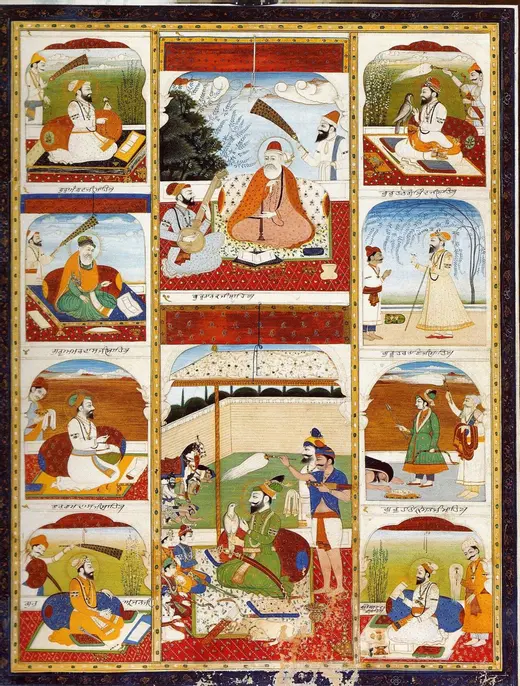
A later artist's imagining of the ten Gurus, from Sri Guru Nanak Dev Ji to Sri Guru Gobind Singh Ji, from the workshop of Purkhu of Kangra. No portrait from any Guru's lifetime is established.
Purkhu of Kangra, Early 19th century. Kapany Collection (as credited on Commons). Public domain. Source
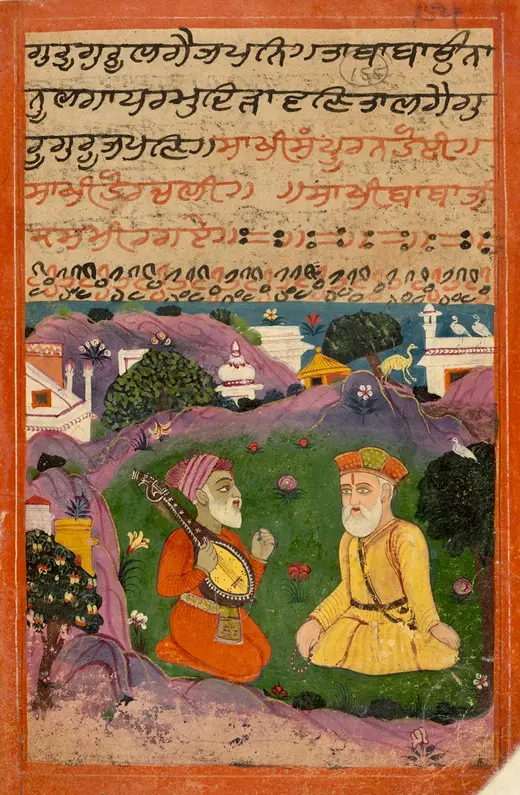
Illustrated page. From the B-40 Janamsakhi of 1733, written by Daya Ram Abrol and painted by Alam Chand. It is one of 57 paintings in a manuscript made long after Sri Guru Nanak Dev Ji's time, so the figure is an artist's imagining.
Alam Chand, painter. Image: Ms Sarah Welch, 1733. British Library, MS Panj B40.CC BY-SA 4.0. Source
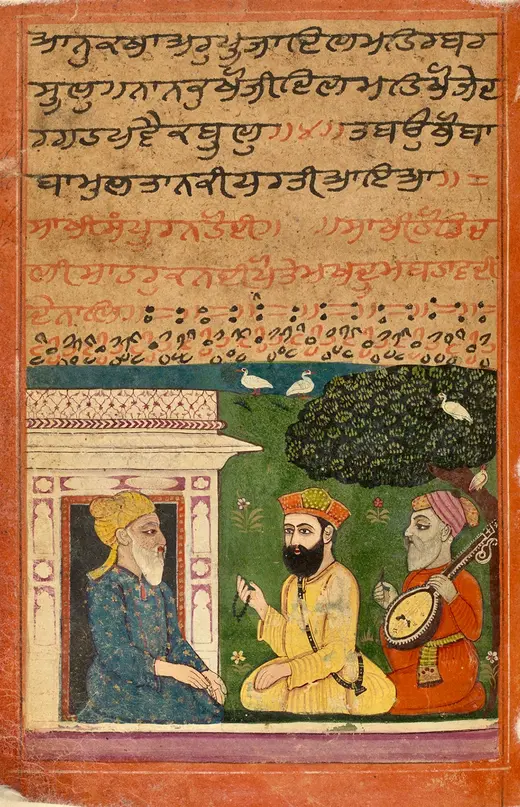
Illustrated page. From the B-40 Janamsakhi of 1733, written by Daya Ram Abrol and painted by Alam Chand. It is one of 57 paintings in a manuscript made long after Sri Guru Nanak Dev Ji's time, so the figure is an artist's imagining.
Alam Chand, painter. Image: Ms Sarah Welch, 1733. British Library, MS Panj B40.CC BY-SA 4.0. Source
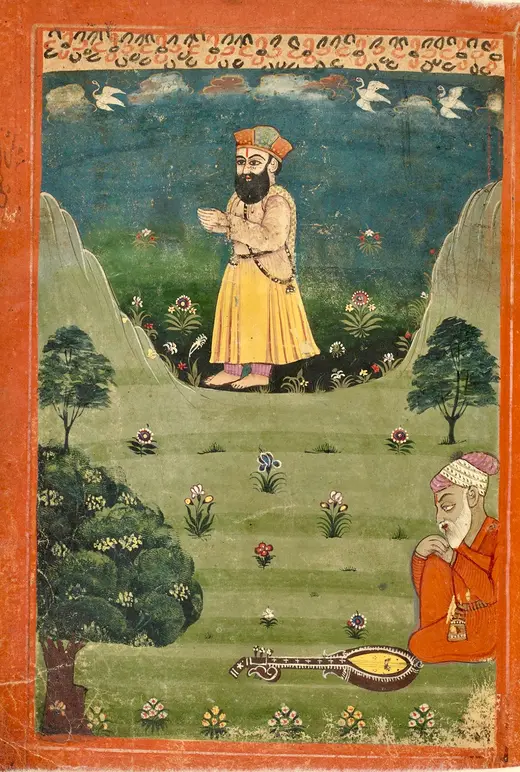
Illustrated page. From the B-40 Janamsakhi of 1733, written by Daya Ram Abrol and painted by Alam Chand. It is one of 57 paintings in a manuscript made long after Sri Guru Nanak Dev Ji's time, so the figure is an artist's imagining.
Alam Chand, painter. Image: Ms Sarah Welch, 1733. British Library, MS Panj B40.CC BY-SA 4.0. Source
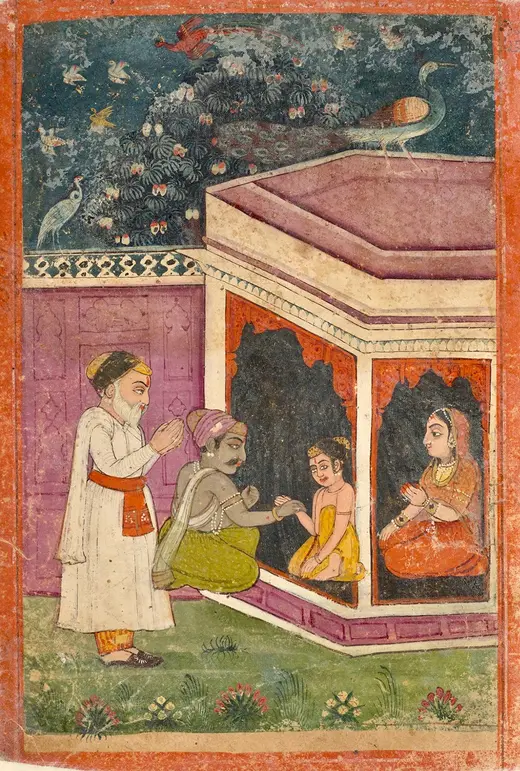
Illustrated page. From the B-40 Janamsakhi of 1733, written by Daya Ram Abrol and painted by Alam Chand. It is one of 57 paintings in a manuscript made long after Sri Guru Nanak Dev Ji's time, so the figure is an artist's imagining.
Alam Chand, painter. Image: Ms Sarah Welch, 1733. British Library, MS Panj B40.CC BY-SA 4.0. Source
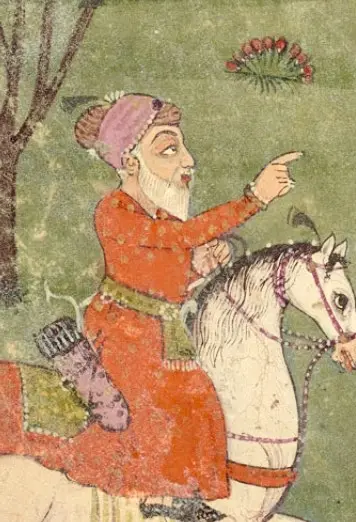
Detail said on Commons to show Rai Bular Bhatti, from the B-40 Janamsakhi of 1733. The identification comes from the file's title and was not checked against the manuscript.
Alam Chand, painter. Image: Ms Sarah Welch, 1733. British Library, MS Panj B40.CC BY-SA 4.0. Source
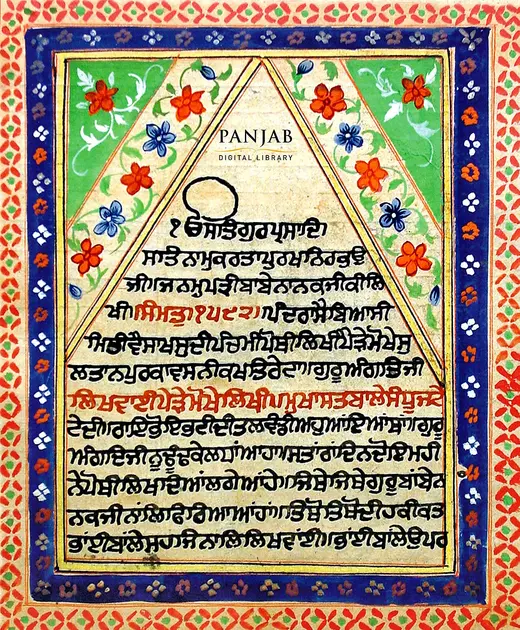
Decorated opening page of a Bhai Bala Janamsakhi manuscript. Commons credits the Government Museum, Chandigarh, and gives only a broad date range.
Unknown, 17th to 19th century, uncertain. Government Museum and Art Gallery, Chandigarh (as credited on Commons). Public domain. Source
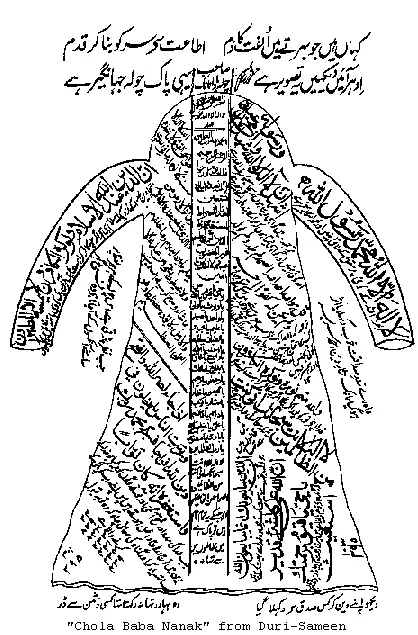
A sketch of the writing on the robe at Dera Baba Nanak said to have belonged to Sri Guru Nanak Dev Ji. The date is uncertain and the source is a web article.
Unknown, Early to mid 20th century, uncertain. Public domain. Source
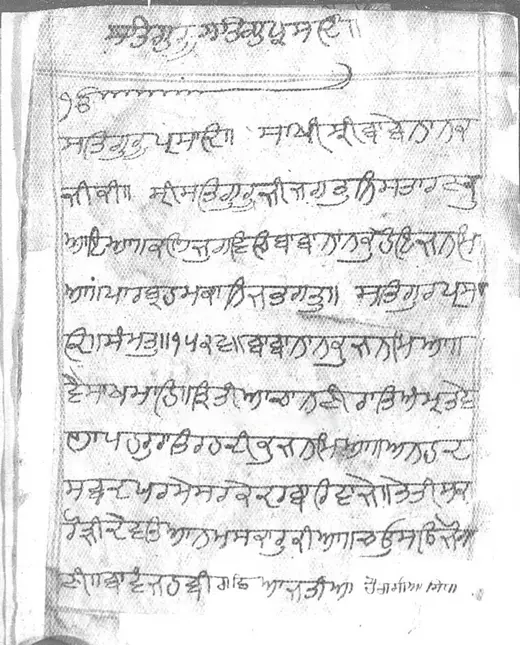
A page labelled on Commons as the Colebrooke Janamsakhi, the Puratan manuscript in London. Commons gives 1634, but the manuscript itself is undated and scholars disagree.
Unknown, Undated. 1634 on Commons. British Library, MS Panj B6. Public domain. Source
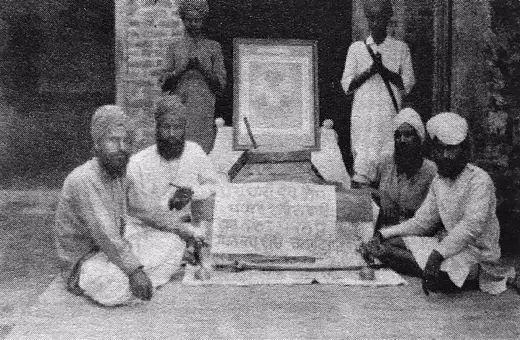
The hand-millstone revered as the one Sri Guru Nanak Dev Ji was made to turn, at Gurdwara Chakki Sahib, a related site in Eminabad. Photographed by Dhanna Singh Chahal 'Patialvi' on 4 October 1932. This does not show Gurdwara Rori Sahib itself.
Dhanna Singh Chahal 'Patialvi', 1932. Public domain. Source
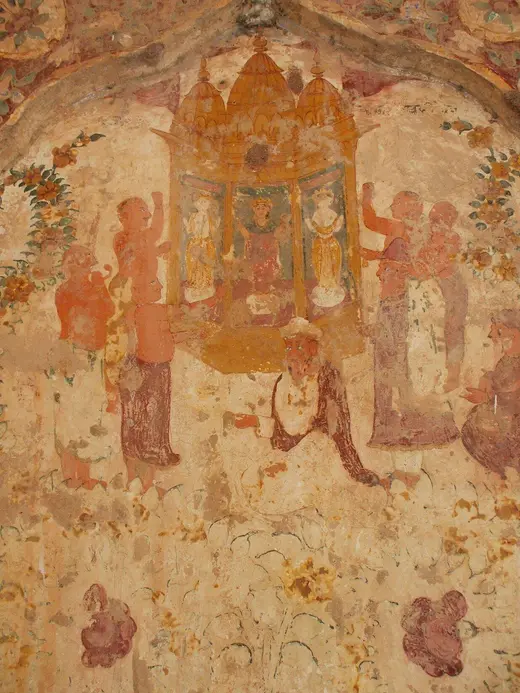
A later fresco at Gurdwara Baba Atal, Amritsar, which Commons reads as Sri Guru Nanak Dev Ji at a Hindu religious event, perhaps Puri. The identification is an inference from the figure of Bhai Bala.
Gian Singh Naqqash, Jaimal Singh Naqqash, Mehtab Singh Naqqash and Hukum Singh, 19th century. Gurdwara Baba Atal, Amritsar. Public domain. Source
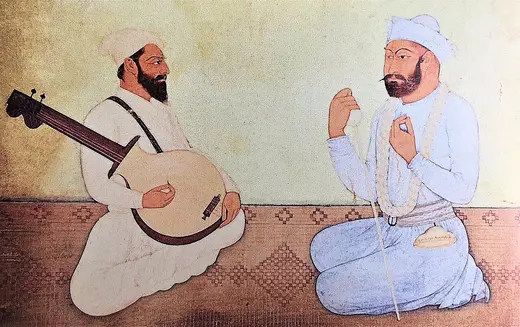
A later artist's imagining of Sri Guru Nanak Dev Ji with Bhai Mardana and his rabab, dated on Commons to about 1740. The source is a social media post, so treat the date with caution.
Unknown, c. 1740, weakly sourced. Bhai Suchet Singh Collection, Bhai Rupa (as credited on Commons). Public domain. Source
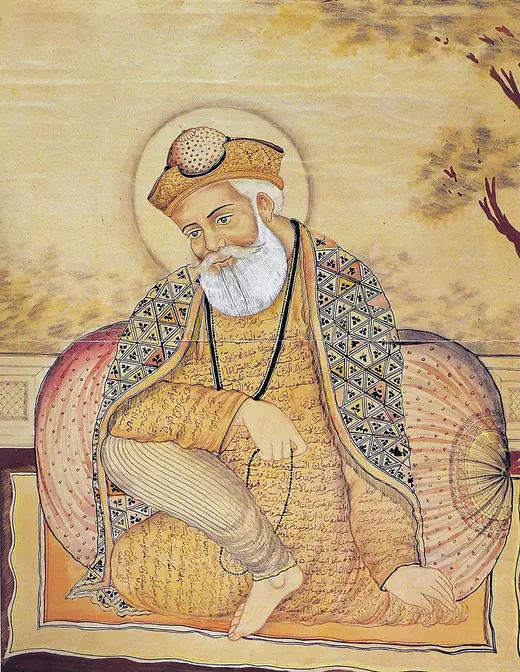
A later artist's imagining of Sri Guru Nanak Dev Ji in a robe with Arabic-script writing and Japji verses. The Sikh Museum site suggests the Chola Sahib may have inspired it.
Unknown, 19th century. Government Museum and Art Gallery, Chandigarh (as credited on the Sikh Museum site). Public domain. Source
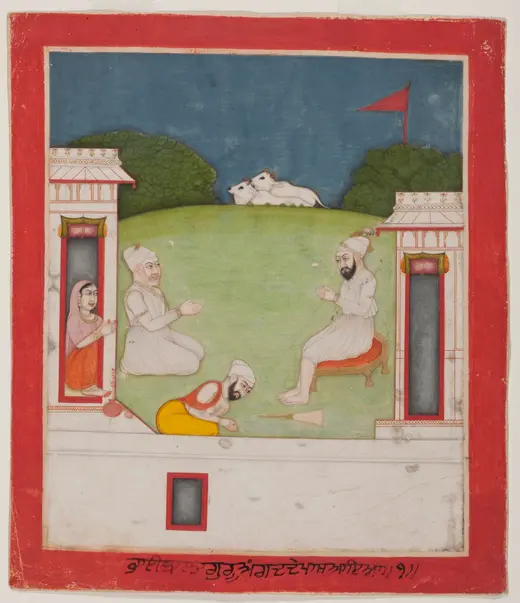
Bhai Bala reciting the life of Sri Guru Nanak Dev Ji before Sri Guru Angad Dev Ji, as the Bala tradition presents itself. A later artist's imagining, from the Unbound set of Janamsakhi paintings.
Unknown, c. 1775-1800. Asian Art Museum, San Francisco, 1998.58.1 (as credited on Commons). Public domain. Source
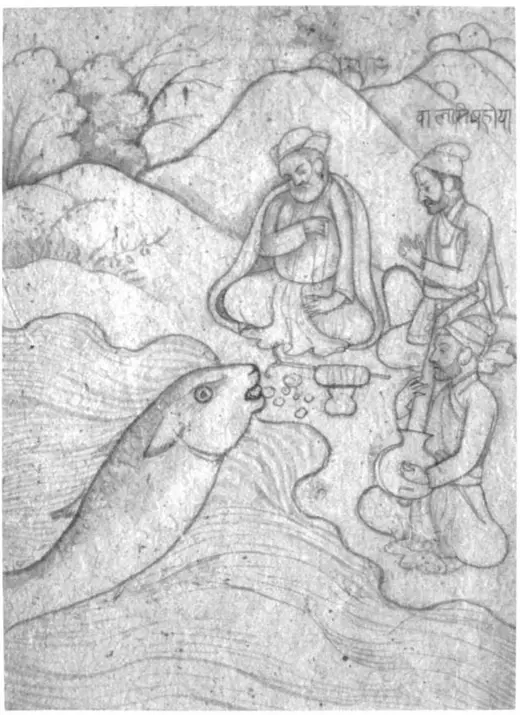
A later artist's imagining of a Janamsakhi story in which a great fish offers treasures of the sea to Sri Guru Nanak Dev Ji. A brush drawing from the Pahari workshop of the family of Nainsukh of Guler, late 1700s.
Unknown, c. 1775-1800. Government Museum and Art Gallery, Chandigarh (as credited on Commons). Public domain. Source
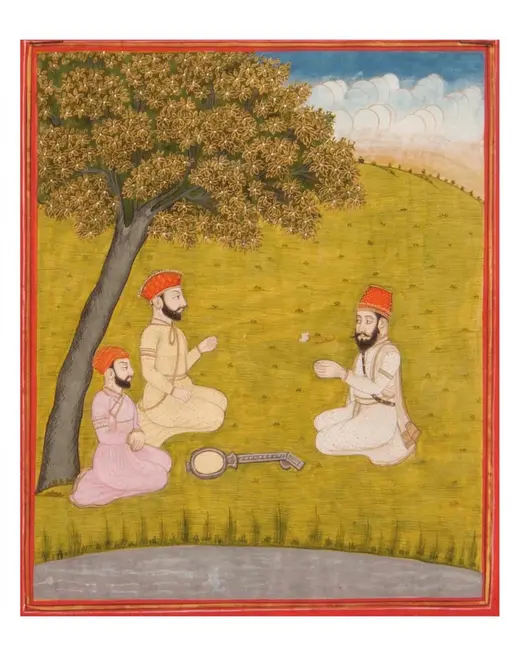
A later artist's imagining of Sri Guru Nanak Dev Ji and Bhai Mardana meeting Bhagat Kabir, from the Punjab Hills in the late 1700s. Whether such a meeting took place is not established.
Unknown, Late 18th century. Public domain. Source
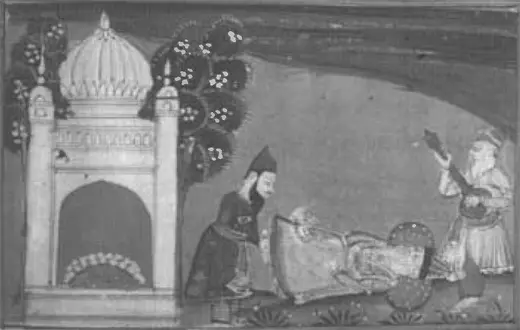
A later artist's imagining of the Janamsakhi story of Sri Guru Nanak Dev Ji lying with his feet towards Mecca. The date is uncertain. No portrait from Guru Ji's lifetime is established.
Unknown, 18th or 19th century, uncertain. Kapany Collection (as credited on Commons). Public domain. Source
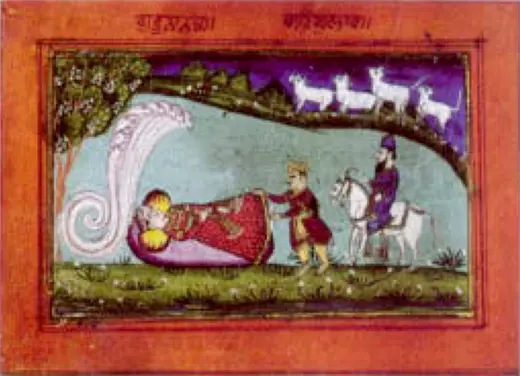
A later artist's imagining of Sri Guru Nanak Dev Ji with Rai Bular, from a Kashmiri Janamsakhi manuscript of about the early 1800s. No portrait from Guru Ji's lifetime is established.
Unknown, Early 19th century. Kapany Collection (as credited on Commons). Public domain. Source
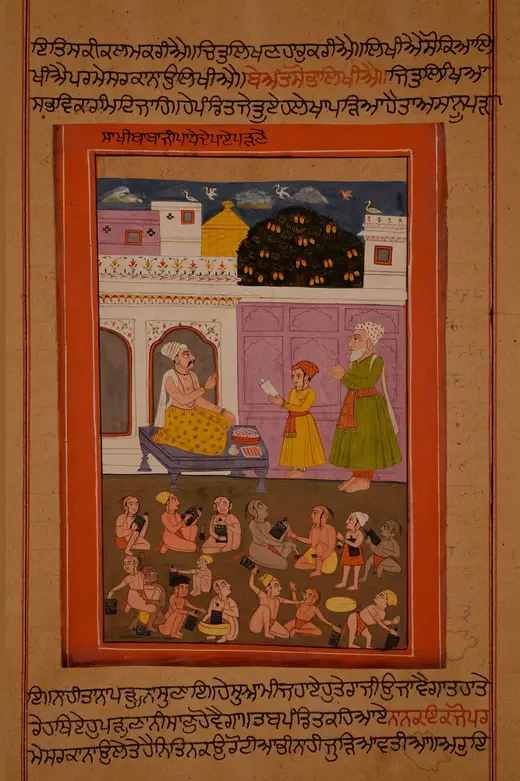
A later artist's imagining of Sri Guru Nanak Dev Ji at school with Pandit Gopal Das, from a Janamsakhi manuscript. Commons gives only a broad date range. No portrait from Guru Ji's lifetime is established.
Unknown, 17th to 19th century, uncertain. Government Museum and Art Gallery, Chandigarh (as credited on Commons). Public domain. Source
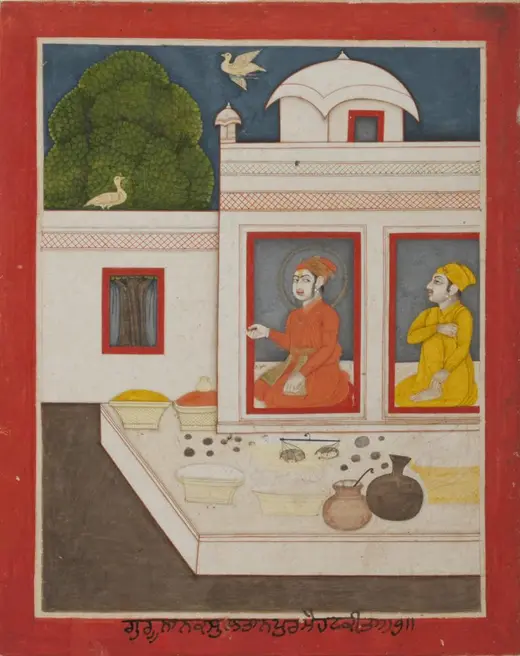
A later artist's imagining of Sri Guru Nanak Dev Ji in the provisions store at Sultanpur Lodhi, from a Janamsakhi set. Commons gives two dates, the later being 1800-1900.
Unknown, c. 1755-1800 or 19th century. Asian Art Museum, San Francisco, 1998.58.6 (as credited on Commons). Public domain. Source


- Married Jai Ram. An official at the Sultanpur court of Nawab Daulat Khan Lodhi.
Five years older than her brother, and remembered as the first to recognise his spiritual standing. She had no children, and she arranged his marriage.
2 children in the full tree
Words
- Japji, first stanza: how does one become true?ਸੋਚੈ ਸੋਚਿ ਨ ਹੋਵਈ ਜੇ ਸੋਚੀ ਲਖ ਵਾਰ ॥You cannot wash or think your way to purity, even if you try a hundred thousand times.Ang 1 · Jap
- Mool Mantar: the opening statementੴ ਸਤਿ ਨਾਮੁ ਕਰਤਾ ਪੁਰਖੁ ਨਿਰਭਉ ਨਿਰਵੈਰੁ ਅਕਾਲ ਮੂਰਤਿ ਅਜੂਨੀ ਸੈਭੰ ਗੁਰ ਪ੍ਰਸਾਦਿ ॥There is one God, and the Name is Truth. God made everything and is present in everything. God has nothing to fear and no one to hate. God is untouched by time, never born, and exists of itself. You come to know God through the Guru's grace.Ang 1 · Jap
- Japji, closing salok: air the teacher, water the fatherਪਵਣੁ ਗੁਰੂ ਪਾਣੀ ਪਿਤਾ ਮਾਤਾ ਧਰਤਿ ਮਹਤੁ ॥Air is our teacher, water our father, and the vast earth our mother.Ang 8 · Jap
- Rehras: So Dar, the door where all creation singsਸੋ ਦਰੁ ਤੇਰਾ ਕੇਹਾ ਸੋ ਘਰੁ ਕੇਹਾ ਜਿਤੁ ਬਹਿ ਸਰਬ ਸਮਾਲੇ ॥What kind of door is yours, and what kind of house, from which you watch over everyone?Ang 8 · Asa
- Kirtan Sohila: the song of the Fearless Oneਜੈ ਘਰਿ ਕੀਰਤਿ ਆਖੀਐ ਕਰਤੇ ਕਾ ਹੋਇ ਬੀਚਾਰੋ ॥The house where the Creator's praise is spoken and the Creator is pondered:Ang 12 · Gauri Dipaki
- Babarvani: did you feel no pain?ਖੁਰਾਸਾਨ ਖਸਮਾਨਾ ਕੀਆ ਹਿੰਦੁਸਤਾਨੁ ਡਰਾਇਆ ॥Khurasan was taken in hand, and Hindustan was put in terror.Ang 360 · Asa
- Asa di Var: why call her lesser?ਭੰਡਿ ਜੰਮੀਐ ਭੰਡਿ ਨਿੰਮੀਐ ਭੰਡਿ ਮੰਗਣੁ ਵੀਆਹੁ ॥We are conceived in a woman and born of a woman, and to a woman we are engaged and married.Ang 473 · Asa
- Siddh Gosht: the opening exchange with the Siddhasਸਿਧ ਸਭਾ ਕਰਿ ਆਸਣਿ ਬੈਠੇ ਸੰਤ ਸਭਾ ਜੈਕਾਰੋ ॥The Siddhas have made their assembly and sit in their places. A greeting to this company of the holy.Ang 938 · Ramkali