Second Guru
Sri Guru Angad Dev Ji
A trader's son and devotee of the goddess Durga who became Sri Guru Nanak Dev Ji's most devoted follower and his chosen successor. In thirteen years at Khadur he gave the community a script of its own, a centre, a working kitchen and a collection of Sri Guru Nanak Dev Ji's hymns.
Read the full life and times →Early life
Lehna was born in 1504 at Matte di Sarai in the Malwa, the son of Pheru, a Trehan Khatri trader. The family moved to Khadur on the Beas after the Mughal invasions unsettled the area. He married Khivi, who would later run the community kitchen, and had two sons and two daughters.
He was a devout worshipper of Durga and led an annual pilgrimage to the goddess's shrine at Jwalamukhi in the hills. By tradition it was hearing a Sikh in Khadur recite Sri Guru Nanak Dev Ji's hymns that drew him, on his way to the hills around 1532, to turn aside to Kartarpur instead. He did not go back.[EoS][Macauliffe]
Service at Kartarpur
The stories about Lehna at Kartarpur are stories of unquestioning service: carrying a muddy bundle of grass on his head in his good clothes, eating from a corpse when told to, wading into cold water at night to recover a cup. Sri Guru Nanak Dev Ji's sons declined the same tasks. The point of the stories is why Sri Guru Nanak Dev Ji chose a follower over a son, and their answer is that the Guruship went to whoever had wholly absorbed the teaching.
Sri Guru Nanak Dev Ji renamed him Sri Guru Angad Dev Ji, from ang, a limb, and in 1539 formally installed him as successor, placing before him the collection of hymns and a few coins and bowing to him. Sri Guru Angad Dev Ji was then sent back to Khadur, partly to avoid friction with Sri Guru Nanak Dev Ji's family.[EoS][EoS]
Guruship at Khadur
Sri Guru Angad Dev Ji's thirteen years as Guru consolidated what Sri Guru Nanak Dev Ji had begun. He adopted and regularised the Gurmukhi script, a Punjabi alphabet derived from the local Landa scripts, and used it to write out Sri Guru Nanak Dev Ji's compositions, giving the community a written scripture that did not depend on the Brahmin's Sanskrit or the clerk's Persian. He taught children to read and write in it.
He kept the daily pattern of Kartarpur: early prayer, kirtan, and the langar, which Mata Khivi managed and which became famous enough to be praised in a hymn included in Sri Guru Granth Sahib Ji. He is also remembered for wrestling grounds and physical training for the young, and for continuing the practice of earning his own living.
He composed 63 short saloks, pithy couplets on the inevitability of death, the emptiness of outward display and the value of Guru Ji's word, which Sri Guru Arjun Dev Ji later wove into the longer vars of the Adi Granth.[EoS][EoS][EoS]
Relations with the Mughals and the Udasis
Tradition records a visit from Humayun, the Mughal emperor in flight from Sher Shah Suri around 1540, who was kept waiting while Sri Guru Angad Dev Ji sat absorbed in kirtan and who left with a rebuke for drawing his sword on a man of religion. The story may be embroidered, but it reflects a community already visible to rulers.
A more lasting issue was the Udasi order founded by Sri Guru Nanak Dev Ji's elder son Sri Chand, which followed a celibate, renunciant path. Sri Guru Angad Dev Ji kept a courteous distance, affirming that Sri Guru Nanak Dev Ji's way was the householder's, a line his successors would hold.[EoS][EoS]
Passing and succession
Sri Guru Angad Dev Ji chose Sri Guru Amar Das Ji, a man twenty-five years his senior who had served him for twelve years, over his own sons, and installed him in March 1552 shortly before passing away at Khadur. His son Datu's resentment of the choice would trouble the third Guru for some time.[EoS][EoS]
Images
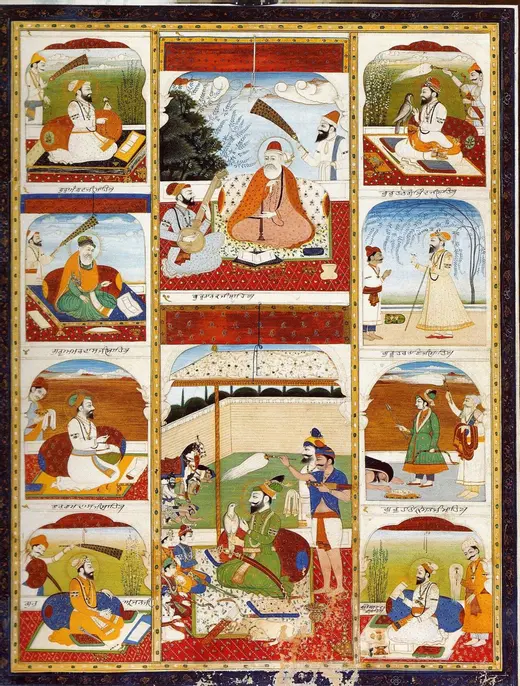
A later artist's imagining of the ten Gurus, from Sri Guru Nanak Dev Ji to Sri Guru Gobind Singh Ji, from the workshop of Purkhu of Kangra. No portrait from any Guru's lifetime is established.
Purkhu of Kangra, Early 19th century. Kapany Collection (as credited on Commons). Public domain. Source
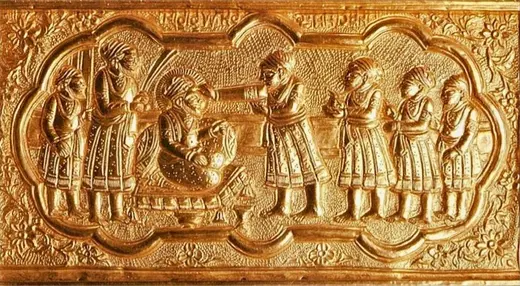
A gilded panel from doors given to the Harmandir Sahib by Maharaja Ranjit Singh, now in the treasury according to Commons. It imagines Baba Buddha anointing Sri Guru Amar Das Ji under Sri Guru Angad Dev Ji's command.
Unknown, c. 1801-1839. Toshakhana, Harmandir Sahib (as stated on Commons). Public domain. Source
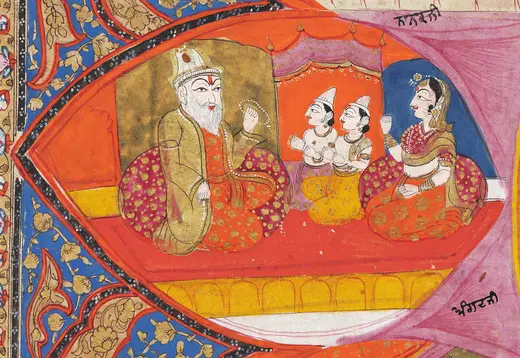
Sri Guru Angad Dev Ji with Mata Khivi and their sons Baba Dasu and Baba Dattu, as identified on Commons. From a manuscript of about 1839 to 1843, nearly three centuries after their time, so the figures are an artist's imagining.
Miha Singh, illustrator; Misar Prakash, scribe, About 1839 to 1843. Public domain. Source
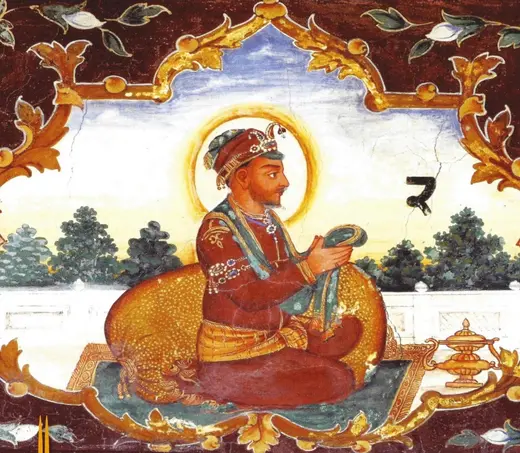
A later fresco of Sri Guru Angad Dev Ji above the entrance to the Baoli Sahib, Goindwal, numbered with the Gurmukhi numeral two. Probably 19th century. No portrait from Guru Ji's lifetime is established.
Unknown, Probably 19th century. Baoli Sahib, Goindwal. Public domain. Source
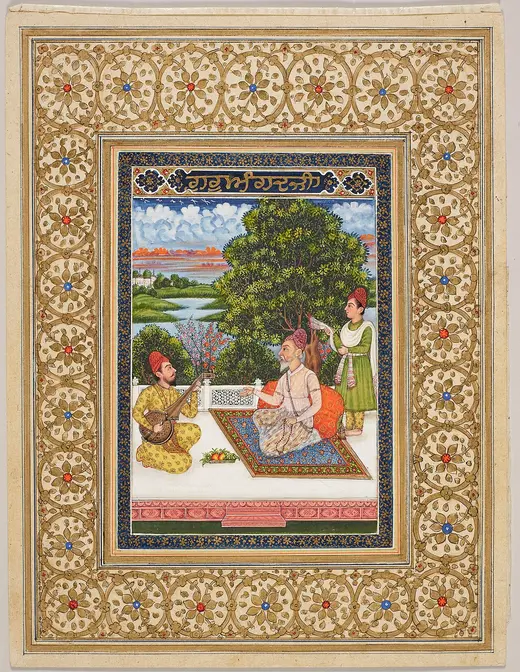
A later artist's imagining of Sri Guru Angad Dev Ji, from a set of the first nine Gurus painted about 1800-1840. No portrait from Guru Ji's lifetime is established.
Unknown, c. 1800-1840. Royal Collection Trust, RCIN 925203 (as credited on Commons).CC BY-SA 4.0. Source
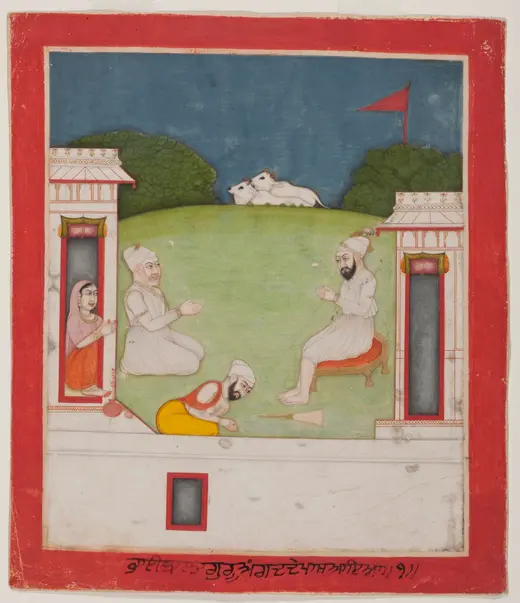
Bhai Bala reciting the life of Sri Guru Nanak Dev Ji before Sri Guru Angad Dev Ji, as the Bala tradition presents itself. A later artist's imagining, from the Unbound set of Janamsakhi paintings.
Unknown, c. 1775-1800. Asian Art Museum, San Francisco, 1998.58.1 (as credited on Commons). Public domain. Source


A Trehan Khatri trader of modest means. His wife's name is given variously as Sabhirai, Ramo, Daya Kaur and Mansa Devi.
4 children in the full tree