Third Guru
Sri Guru Amar Das Ji
A Vaishnava pilgrim who found the Sikh path in his sixties and became Guru at seventy-three. Over twenty-two years at Goindwal he organised the growing community into districts, made the shared meal a condition of meeting him, campaigned against sati and the veil, and compiled the first collected scripture.
Read the full life and times →Early life
Sri Guru Amar Das Ji was born in 1479 at Basarke near Amritsar into a Bhalla Khatri farming family. For most of his adult life he was a conventional devout Hindu who made some twenty annual pilgrimages on foot to Haridwar on the Ganges. The turning point, according to tradition, came in his early sixties when a returning pilgrim told him that a journey without a guru was wasted, and soon afterwards he heard his nephew's wife, a daughter of Sri Guru Angad Dev Ji, singing Sri Guru Nanak Dev Ji's hymns.
He walked to Khadur and attached himself to Sri Guru Angad Dev Ji around 1540. For the next twelve years he fetched water from the Beas for Guru Ji's bath before dawn each day and served in the kitchen, an old man doing a servant's work. Sri Guru Angad Dev Ji's choice of him in 1552 followed the pattern Sri Guru Nanak Dev Ji had set: the office went to the one who had served most completely.[EoS][Macauliffe]
Goindwal
Sri Guru Angad Dev Ji had earlier sent Sri Guru Amar Das Ji to establish a new settlement at Goindwal on the Beas, a ferry crossing on the Lahore-Delhi road. After his installation he made it his seat, partly to avoid Sri Guru Angad Dev Ji's son Datu, who tried to assert a claim at Khadur. Goindwal grew into the first Sikh town built as such.
Its defining structure was a stepped well of eighty-four steps completed in 1559, which gave the community a pilgrimage site of its own in place of Haridwar and the Ganges. Fairs at Vaisakhi and Diwali drew Sikhs to Goindwal from across Punjab and gave the scattered congregations a shared calendar.[EoS][EoS]
Organising the community
Sri Guru Amar Das Ji divided the Sikh territory into twenty-two manjis, districts each under a trusted Sikh responsible for teaching, collecting offerings and keeping contact with Goindwal. Women were appointed to some of these roles. The system turned a following into an organisation.
He made eating in the langar a prerequisite for an audience with him, which the Mughal emperor Akbar is said to have accepted when he visited around 1567. He discouraged the Hindu practice of burning widows, spoke against purdah, allowed widow remarriage, and composed the Anand, the hymn of bliss that is now sung at every Sikh wedding and ceremony.[EoS][EoS][Grewal]
Scripture
Sri Guru Amar Das Ji collected the hymns of Sri Guru Nanak Dev Ji and Sri Guru Angad Dev Ji with his own 907 compositions, and added the compositions of the bhagats, medieval saints such as Kabir, Namdev and Ravidas whose teaching he judged in harmony with Sri Guru Nanak Dev Ji's. The resulting volumes, the Goindwal pothis, were kept by his family and became a principal source for Sri Guru Arjun Dev Ji's Adi Granth of 1604. Portions survive in private hands.
His own writing includes long works set to the var form and many hymns on the nature of the mind, the Shabad, and the self-willed manmukh contrasted with the gurmukh, who turns towards Guru Ji.[EoS][Mann]
Passing and succession
Before his passing in September 1574 at the age of ninety-five, Sri Guru Amar Das Ji installed his son-in-law Sri Guru Ram Das Ji, who had served him for years at Goindwal and whom he had already sent to found a new town at the site of Amritsar. He instructed his followers not to mourn with ritual but with the singing of hymns.[EoS][EoS]
Images
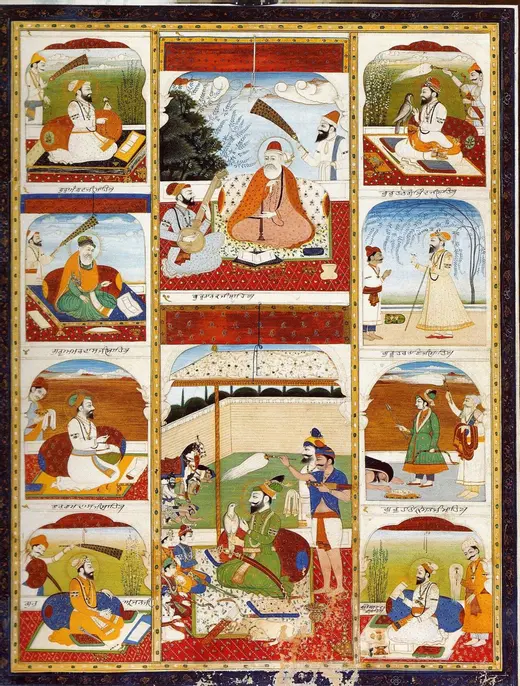
A later artist's imagining of the ten Gurus, from Sri Guru Nanak Dev Ji to Sri Guru Gobind Singh Ji, from the workshop of Purkhu of Kangra. No portrait from any Guru's lifetime is established.
Purkhu of Kangra, Early 19th century. Kapany Collection (as credited on Commons). Public domain. Source
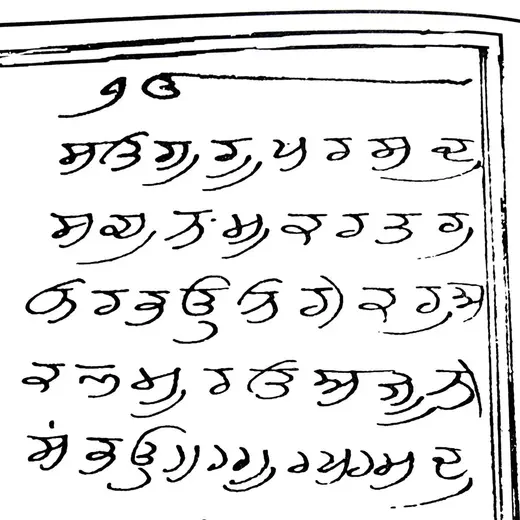
An early form of the Mul Mantar, labelled on Commons as from the Ahiapur Wali volume of the Goindwal Pothis, about 1570-1572. The source link is informal. The Encyclopaedia of Sikhism calls this the Darapur or Yahyapur volume.
Sahansar Ram, scribe, per the Encyclopaedia of Sikhism, c. 1570-1572. Public domain. Source
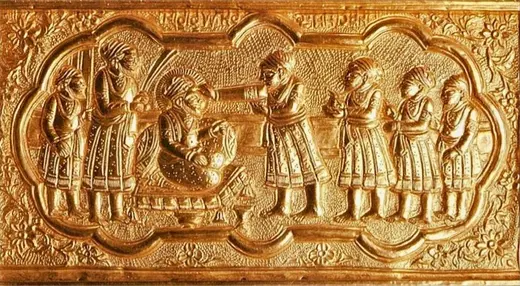
A gilded panel from doors given to the Harmandir Sahib by Maharaja Ranjit Singh, now in the treasury according to Commons. It imagines Baba Buddha anointing Sri Guru Amar Das Ji under Sri Guru Angad Dev Ji's command.
Unknown, c. 1801-1839. Toshakhana, Harmandir Sahib (as stated on Commons). Public domain. Source
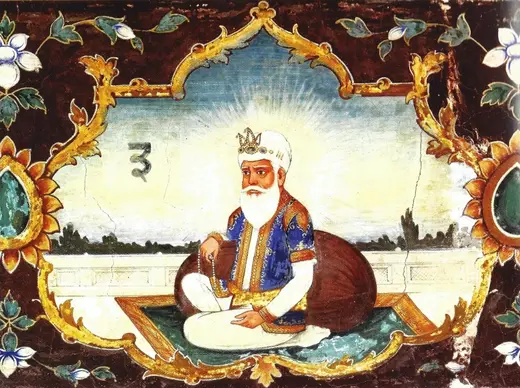
A later fresco of Sri Guru Amar Das Ji above the entrance to the Baoli Sahib, Goindwal, numbered with the Gurmukhi numeral three. Probably 19th century. No portrait from Guru Ji's lifetime is established.
Unknown, Probably 19th century. Baoli Sahib, Goindwal. Public domain. Source
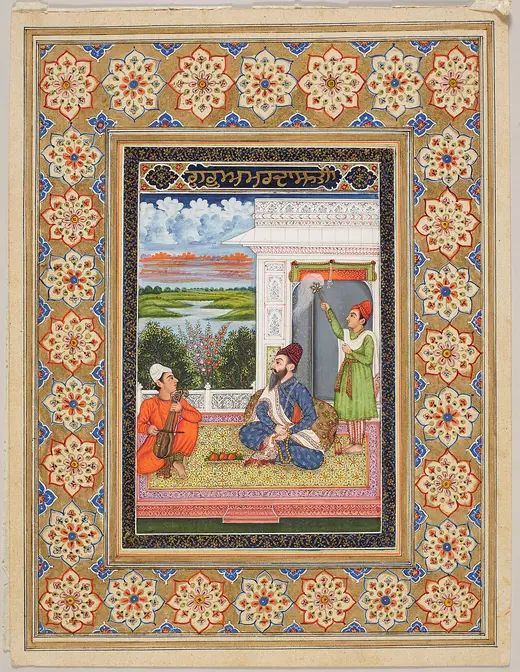
A later artist's imagining of Sri Guru Amar Das Ji, from a set of the first nine Gurus painted about 1800-1840. No portrait from Guru Ji's lifetime is established.
Unknown, c. 1800-1840. Royal Collection Trust, RCIN 925204 (as credited on Commons). Public domain. Source


