Leather-worker and poet of Varanasi; bhagat of Sri Guru Granth Sahib Ji
Bhagat Ravidas
A worker in hides from Varanasi whose forty hymns in Sri Guru Granth Sahib Ji speak of a God who lifts the lowest and of a city without sorrow where no one is taxed or ranked. The most revered figure for Dalit communities in Punjab, and a direct precedent for Sri Guru Nanak Dev Ji's rejection of caste.
Life and place in the scripture
Ravidas lived in Varanasi and worked at his hereditary trade, making and mending shoes, which placed him among the untouchables. Tradition makes him a disciple of Ramanand alongside Kabir and gives him royal patrons, including the Rajput princess Mira Bai, but the hard evidence is his verse. In it he names his caste without shame, describes the contempt he met, and insists that devotion, not birth, is what counts.
His hymn Begampura, the city without grief, imagines a place with no second class, no taxes, no fear and freedom to go anywhere, and has been read by modern Dalit movements as a political vision. Sri Guru Arjun Dev Ji included forty of his hymns in the Adi Granth, across sixteen raags.
In Punjab his followers, the Ravidasias, overlap with and have in part separated from the Sikh community; a shrine in Varanasi and the town of Ballan near Jalandhar are their centres.[EoS][EoS]
What the sources disagree on
- Dates
The Encyclopaedia records no dates for his life, and says little biographical information about him is available.[EoS]
Images
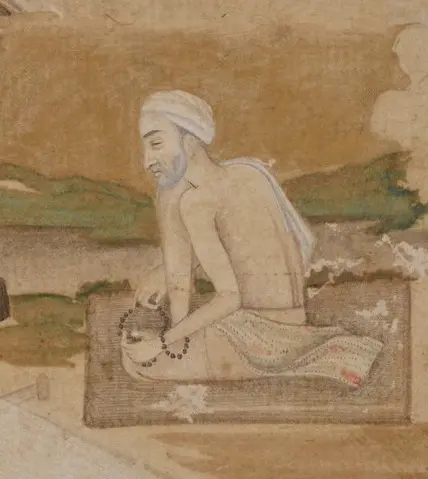
A detail showing Bhagat Ravidas beside Bhagat Kabir, from a Mughal painting dated 1625 and catalogued at the National Museum, New Delhi.
Unknown, 1625. National Museum, New Delhi, 79.444 (as credited on Commons). Public domain. Source
