Fifth Guru, compiler of the Adi Granth, first martyr
Sri Guru Arjun Dev Ji
Guru for twenty-five years, Sri Guru Arjun Dev Ji built the Harmandir at Amritsar, founded Tarn Taran and Kartarpur, compiled the Sikh scripture in 1604 and wrote more of it than anyone else. His martyrdom in Mughal custody at Lahore in 1606 is the first martyrdom in Sikh history and changed the community's relationship with the state.
Read the full life and times →Early life
Sri Guru Arjun Dev Ji was born at Goindwal in 1563, the youngest son of Sri Guru Ram Das Ji and Bhani and grandson of Sri Guru Amar Das Ji. He grew up in Guru Ji's household, learned Gurmukhi and the hymns, and was sent to Lahore in his late teens to represent his father at a family wedding, from where by tradition he wrote the letters of longing that are now part of the scripture.
His father installed him as Guru in 1581 when he was eighteen. His eldest brother Prithi Chand disputed the succession, diverted offerings, and set up as a rival; Sri Guru Arjun Dev Ji's supporters called his line the Minas, the deceivers, a name that stuck for a century.[EoS][Macauliffe]
Building
Sri Guru Arjun Dev Ji completed the pool his father had begun and in 1588 laid the foundation of the Harmandir in its centre, a temple with doors on all four sides and set lower than the surrounding ground, which Sikhs have always read as a statement about openness and humility. The building was finished in 1601. Tradition says the Sufi Mian Mir of Lahore laid the foundation stone; the earliest sources do not mention this.
He founded Kartarpur in the Jalandhar Doab in 1594 and Tarn Taran in 1596, the latter with one of the largest pools in Punjab and, by tradition, provision for lepers, and had a well dug at Lahore. Amritsar under him became a market town as well as a religious centre.[EoS][EoS][EoS][EoS]
The Adi Granth
Between about 1601 and 1604 Sri Guru Arjun Dev Ji, with Bhai Gurdas as scribe, gathered the hymns of the first four Gurus from the Goindwal pothis and other collections, added his own 2,218 compositions, and included the work of fifteen bhagats and several bards, among them the Muslim Shaikh Farid and the low-caste Ravidas. Compositions circulating under Sri Guru Nanak Dev Ji's name that he judged spurious, including ones put about by Prithi Chand's party, were excluded.
The volume was arranged by musical mode rather than by author or theme, each raag section running through the Gurus in order and then the bhagats. It was installed in the Harmandir in 1604 with Baba Buddha as its first custodian. The manuscript held by the Sodhi family at Kartarpur is regarded as that original. Fixing the text in this way gave the community an authoritative scripture about a century before the Guruship passed to the scripture in 1708.[EoS][EoS][EoS][Mann]
Writing
Sri Guru Arjun Dev Ji is the largest single author in Sri Guru Granth Sahib Ji. His Sukhmani, the psalm of peace, twenty-four sections on the nature of the divine name and the character of the saint, is among the most recited Sikh texts. His hymns range across every mode of the book and include the Barah Maha calendar poem and a large body of short, direct lyrics of thanks and surrender.[EoS][EoS]
Martyrdom
In 1606 the new emperor Jahangir, who had just suppressed a rebellion by his son Khusrau, had Sri Guru Arjun Dev Ji arrested at Lahore. Jahangir's own memoir records that he had long wanted to end what he called a shop of falsehood and that Guru Ji had blessed the rebel prince; he ordered Guru Ji's property confiscated and the man handed over for punishment. Sikh sources add the enmity of the Lahore financier Chandu Shah and a demand that Guru Ji alter the scripture.
Sri Guru Arjun Dev Ji passed away in custody on 30 May 1606 after torture by heat, by the Sikh accounts, and his body was consigned to the Ravi. Sikh tradition holds that he accepted the ordeal as the will of God, a stance summarised in his own line, your doing seems sweet to me. His martyrdom convinced his son and successor Sri Guru Hargobind Ji that the community needed arms as well as hymns.[EoS][EoS][Grewal]
What the sources disagree on
- Why Jahangir acted
Jahangir's memoir gives religious hostility and the blessing of Khusrau as reasons. Sikh sources emphasise Chandu Shah's grudge and a demand to change the scripture. Historians generally take Jahangir's statement as decisive and treat the other elements as context.[EoS][EoS][Grewal]
- Mian Mir and the foundation stone
The tradition that the Lahore Sufi laid the foundation of the Harmandir appears in later sources and is not in the earliest accounts; it is widely repeated and symbolically important but not securely attested.[EoS]
Images
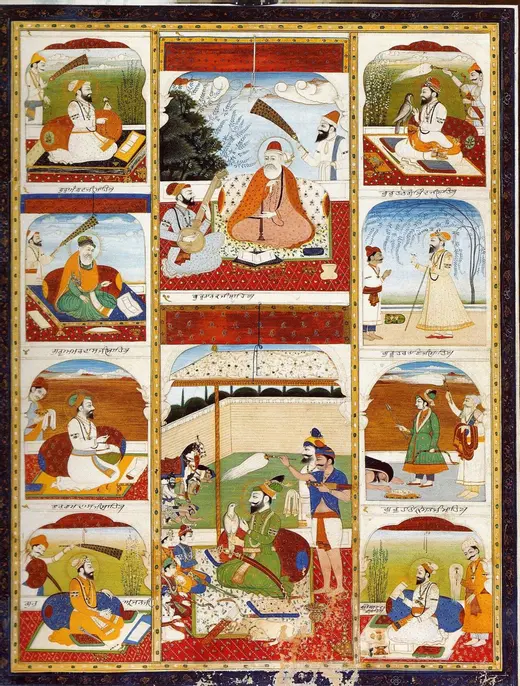
A later artist's imagining of the ten Gurus, from Sri Guru Nanak Dev Ji to Sri Guru Gobind Singh Ji, from the workshop of Purkhu of Kangra. No portrait from any Guru's lifetime is established.
Purkhu of Kangra, Early 19th century. Kapany Collection (as credited on Commons). Public domain. Source
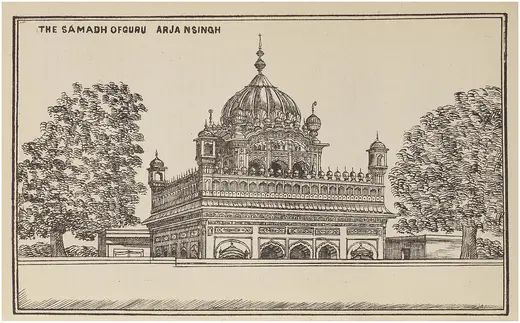
Gurdwara Dera Sahib, Lahore, marked as the samadh of Sri Guru Arjun Dev Ji. From Syad Muhammad Latif's book on Lahore, 1892.
Syad Muhammad Latif, 1892. Public domain. Source
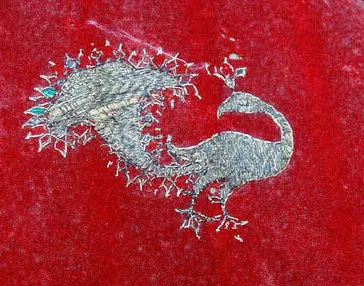
Embroidery from the palanquin that, by tradition, carried the Goindwal Pothis to Amritsar and back. Kept at Gurdwara Chaubara Sahib, Goindwal. The date on Commons is a suggestion.
Unknown, Late 16th or early 17th century, by tradition. Gurdwara Chaubara Sahib, Goindwal. Public domain. Source
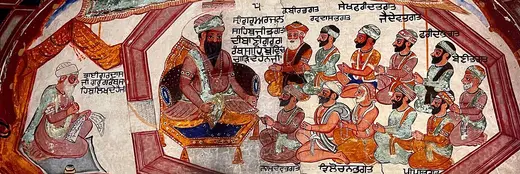
A mid-1800s fresco at Gurdwara Baba Bir Singh imagining Sri Guru Arjun Dev Ji compiling the Adi Granth with Bhai Gurdas, with the Bhagats present. The Bhagats lived in earlier centuries, so the gathering is symbolic.
Unknown, c. mid 19th century. Gurdwara Baba Bir Singh (as stated on Commons). Public domain. Source
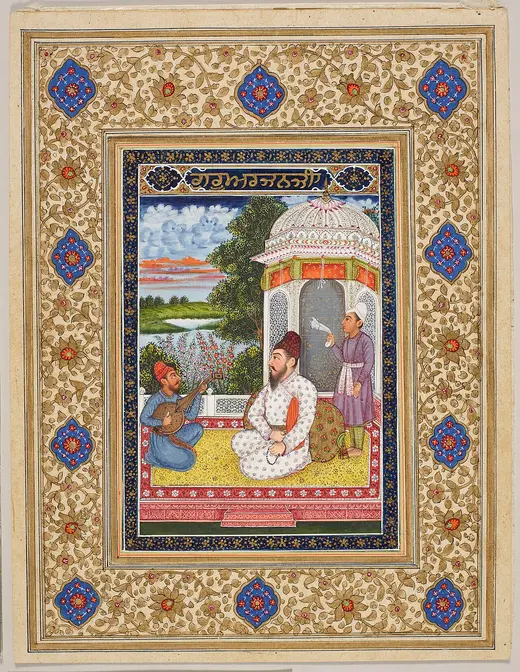
A later artist's imagining of Sri Guru Arjun Dev Ji, from a set of the first nine Gurus painted about 1800-1840. No portrait from Guru Ji's lifetime is established.
Unknown, c. 1800-1840. Royal Collection Trust, RCIN 925206 (as credited on Commons). Public domain. Source
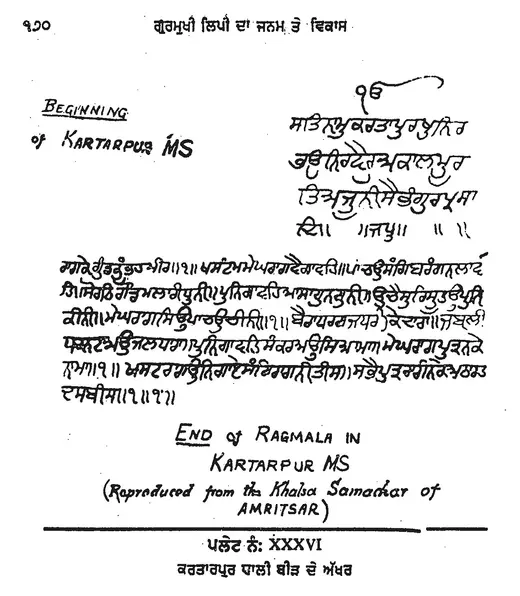
The Mul Mantar and end of the Ragamala from the Kartarpur manuscript, as reproduced by G.B. Singh in a book of 1950.
Reproduced by G.B. Singh (Gurbaksh Singh, 1877–1950) from the Khalsa Samadar of Amritsar, c. 1604. Reproduced 1950. Sodhi family, Kartarpur. Public domain. Source
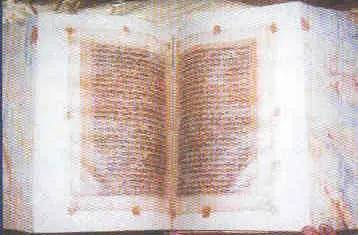
A small photograph of the Kartarpur manuscript. Commons gives no photographer. Access to this volume has been restricted, so few images exist.
Bhai Gurdas, scribe, under Sri Guru Arjun Dev Ji, c. 1604. Sodhi family, Kartarpur. Public domain. Source


For a time he sided with Prithi Chand against Sri Guru Arjun Dev Ji.
1 child in the full tree
Words
- Barah Maha in Raag Majh: the opening and the month of Chetਕਿਰਤਿ ਕਰਮ ਕੇ ਵੀਛੁੜੇ ਕਰਿ ਕਿਰਪਾ ਮੇਲਹੁ ਰਾਮ ॥Our own deeds have parted us from you. Be kind, Lord, and bring us back.Ang 133 · Majh
- Sukhmani: the invocation and the first lineਆਦਿ ਗੁਰਏ ਨਮਹ ॥I bow to the Guru who was there at the beginning.Ang 262 · Gauri Sukhmani
- Sri Guru Arjun Dev Ji: whatever you do seems sweet to meਤੇਰਾ ਕੀਆ ਮੀਠਾ ਲਾਗੈ ॥Whatever you send, I find it sweet.Ang 394 · Asa