Sri Harmandir Sahib
Sri Harmandir Sahib
The central gurdwara of the Sikh faith, known in English as the Golden Temple and also as Sri Darbar Sahib. Sri Guru Arjun Dev Ji designed it with a door on each of its four sides, as a sign that it is open to everyone.
History
- 1577
The pool
Work on the pool at Amritsar began in 1577 under Sri Guru Ram Das Ji. Sources differ on how the land was acquired. Some say it was bought from the people of nearby Tung village in the time of Sri Guru Amar Das Ji. Others say the Emperor Akbar gave it to Bibi Bhani, wife of Sri Guru Ram Das Ji.
The settlement that grew around the pool was first called Ramdaspur, or Chakk Guru.[EoS]
- 1588 to 1604
Building Sri Harmandir Sahib
Sri Guru Arjun Dev Ji finished and lined the pool and raised Sri Harmandir Sahib at its centre, with Sikhs giving their own labour. Among those named as helping are Baba Buddha and Bhai Gurdas.
The work reached completion on 16 August 1604, when the Adi Granth, compiled by Sri Guru Arjun Dev Ji, was installed inside. Baba Buddha was named its first granthi.[EoS]
- 1635 to 1699
Control by a rival line
After Sri Guru Hargobind Ji left Amritsar for Kiratpur in 1635, control passed to the Mina line descended from Prithi Chand. Baba Miharban and then his son Harji managed Sri Harmandir Sahib. In 1664 Sri Guru Tegh Bahadur Ji was refused entry on visiting.
Soon after the Khalsa was created in 1699, Sri Guru Gobind Singh Ji sent Bhai Mani Singh to take charge of Sri Harmandir Sahib and the Akal Takht on behalf of the Khalsa.[EoS][EoS]
- 1709 to 1762
Attacks and desecration
Through the 18th century Sri Harmandir Sahib was a main target of Mughal and Afghan power, and Sikhs kept coming on festival days despite the danger. Bhai Mani Singh was martyred in 1737.
Massa Khan, the kotwal of Amritsar, desecrated Sri Harmandir Sahib and was killed there by Bhai Matab Singh and Bhai Sukkha Singh on 11 August 1740. In 1746 the Lahore official Lakhpat Rai had the pool filled with sand.
Ahmad Shah Durrani attacked Amritsar and defiled the pool in 1757. Baba Deep Singh fell fighting that November as Sikhs fought to retake it. During his sixth invasion, in 1762, Durrani blew up Sri Harmandir Sahib with gunpowder.[EoS]
- 1764 to 1784
Rebuilding
After Sikh forces took Sirhind in January 1764, Jassa Singh Ahluwalia called for funds to rebuild, and the misl leaders set aside part of their spoils. Bhai Des Raj oversaw the work.
Sri Harmandir Sahib, its causeway and the main gateway were complete by 1776, and the terrace around the pool by 1784. Misl chiefs also built rest houses, called bungas, around the pool.[EoS]
- 1780 to 1839
The present appearance
Sri Harmandir Sahib took on its present look during the reign of Maharaja Ranjit Singh, when the decorative work on its walls and ceilings was carried out. The basic design stayed the same.
The exterior above the marble ground floor is covered in gilded copper plates, which gave it the English name of the Golden Temple.[EoS]
- 1920 to 1925
Panthic management
The Shiromani Gurdwara Parbandhak Committee took control of the Amritsar gurdwaras in 1920. After the gurdwara legislation of 1925, the Committee became their formal managing body.[EoS]
- June 1984
Operation Blue Star
The Indian Army entered the complex in June 1984. See the timeline for this event, and the disputes over its casualties and the loss of the Sikh Reference Library.[Web]
What the sources disagree on
- Who laid the foundation
Current tradition says the Muslim saint Mian Mir laid the cornerstone on 28 December 1588. Bute Shah says he placed four bricks around the pool and one in the middle, Sohan Lal Suri has Guru Ji seeking his help at Lahore, and Giani Gian Singh says plainly that he laid the foundation. These accounts differ in detail, and all are from long after the event.[EoS]
- How the land was acquired
Sources differ between a purchase from Tung village and a gift from the Emperor Akbar.[EoS]
Images
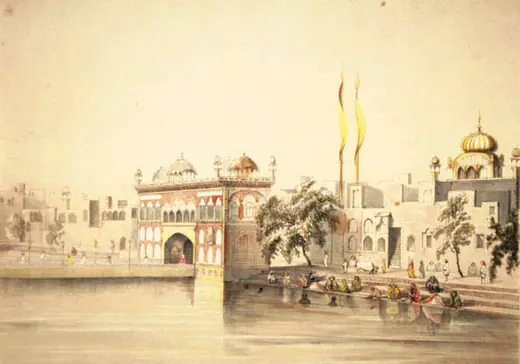
A 19th-century painting of the Akal Takht and Darshani Deori at the Harmandir Sahib complex, with Sikh flags. Its source is a personal blog.
Unknown, 19th century. Public domain. Source
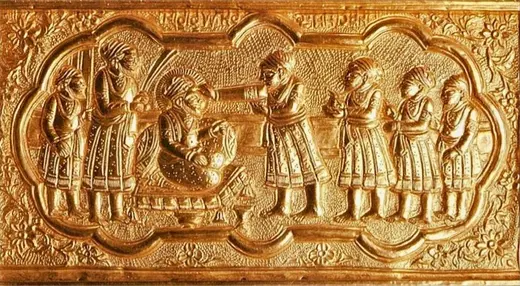
A gilded panel from doors given to the Harmandir Sahib by Maharaja Ranjit Singh, now in the treasury according to Commons. It imagines Baba Buddha anointing Sri Guru Amar Das Ji under Sri Guru Angad Dev Ji's command.
Unknown, c. 1801-1839. Toshakhana, Harmandir Sahib (as stated on Commons). Public domain. Source
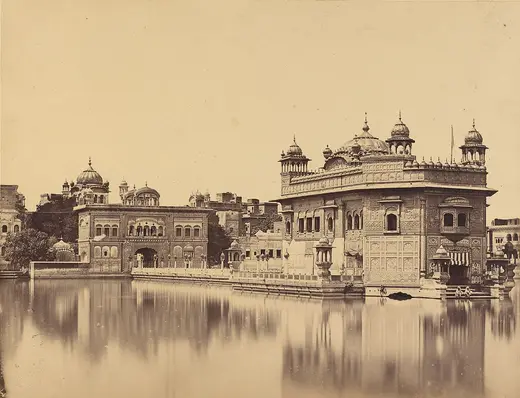
The Harmandir Sahib photographed by Felice Beato in 1858-1859, one of the earliest photographs of the gurdwara in this set.
Felice Beato, 1858-1859. J. Paul Getty Museum, 2007.26.209.9.CC0. Source
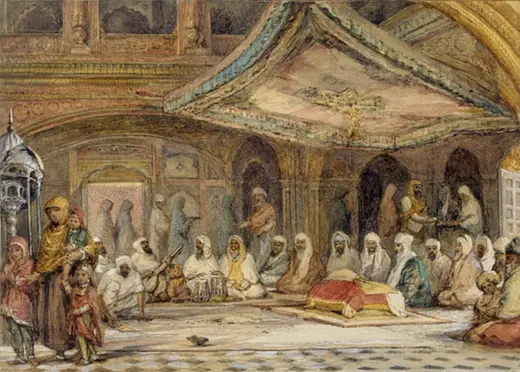
The interior of the Harmandir Sahib painted by William Carpenter, shown with a date of 1854 in the file name. Commons credits the V&A but gives no accession number.
William Carpenter (painter), c. 1854. Victoria and Albert Museum (as credited on Commons). Public domain. Source
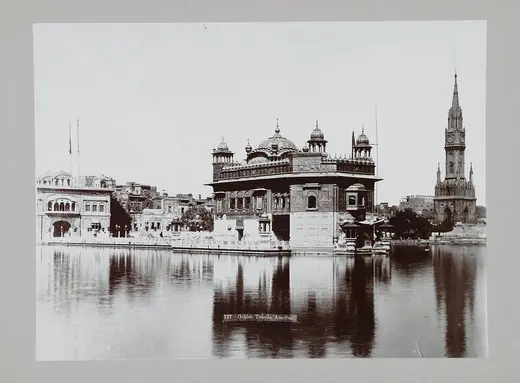
The Harmandir Sahib photographed by an unknown photographer around the turn of the 20th century.
Unknown photographer, c. 1895-1915. Rijksmuseum, RP-F-00-5347-19.CC0. Source
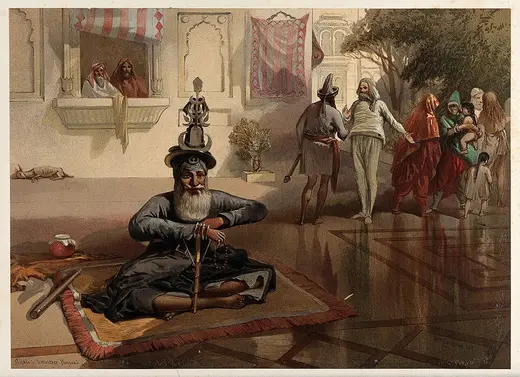
Akalis at the sacred pool in Amritsar, a chromolithograph after William Simpson. Commons gives both 1864 and about 1867.
William Simpson, c. 1864-1867. Wellcome Collection, 30292i. Public domain. Source
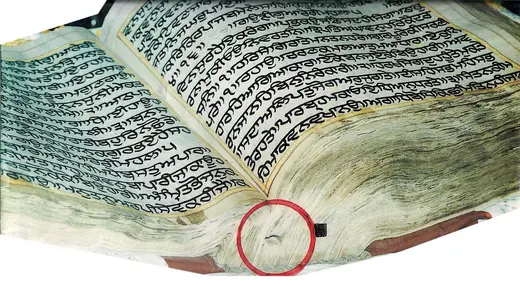
A handwritten copy of Sri Guru Granth Sahib Ji said to have been struck by a bullet in June 1984, during Operation Blue Star. The source is a Flickr post and the claim is not independently confirmed.
Unknown, Photographed after 1984. Public domain. Source
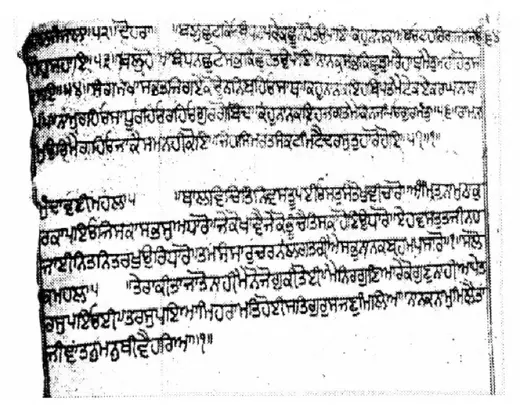
A page from a manuscript said to have been reduced to ashes in June 1984 with the Sikh Reference Library. The claim comes from a website and a 1991 book, and the fate of the collection is disputed.
Unknown, Manuscript undated. Public domain. Source


