Sixth Guru, founder of the Akal Takht
Sri Guru Hargobind Ji
Installed at eleven after his father's martyrdom in Mughal custody, Sri Guru Hargobind Ji put on two swords, one for spiritual and one for worldly authority, raised a bodyguard, built the Akal Takht facing the Harmandir, spent a period imprisoned at Gwalior, and fought several engagements with Mughal detachments before withdrawing to Kiratpur in the hills.
Read the full life and times →Early life and succession
Sri Guru Hargobind Ji was the only child of Sri Guru Arjun Dev Ji and Mata Ganga, born in 1595 at Wadali outside Amritsar. Baba Buddha oversaw his education, which by tradition included riding, hunting and the use of weapons alongside the hymns. His father's message from custody, as the Sikh sources give it, was that the boy should sit on the throne fully armed and keep an army.
At his installation in 1606 he asked Baba Buddha for two swords rather than the usual seli, the woollen cord of a holy man. He named them miri and piri, from the Persian words for a ruler and a spiritual guide. The gesture declared that Guru Ji would exercise both kinds of authority.[EoS][EoS][EoS]
The Akal Takht
In 1606 he raised a platform facing the Harmandir across the pool, the Akal Takht or throne of the timeless one. Here he heard petitions, received horses and arms as offerings, and listened to ballads of heroism rather than hymns, while the Harmandir across the way kept to kirtan. The two buildings face each other to this day as the twin poles of Sikh authority.
He also built the fort of Lohgarh in Amritsar, raised a paid retinue said to number several hundred, and began the practice of going out hawking and hunting with his men. Followers with a grievance against the Mughal state began to collect around him.[EoS][EoS]
Gwalior
Jahangir had him detained in Gwalior Fort, the state prison for political prisoners, for a period that sources put at anywhere from a few months to twelve years. The Encyclopaedia of Sikhism's estimate is a few months between 1617 and 1619. Tradition holds that when the emperor ordered his release Guru Ji refused to leave without the fifty-two princes held with him, and that he walked out with each of them holding a tassel of his cloak. Sikhs mark the event at Diwali as Bandi Chhor Divas, the day of the liberator of prisoners.
Relations with Jahangir were cordial after this. Guru Ji accompanied the emperor on a journey to Kashmir and is said to have rebuilt a mosque for Muslims at Hargobindpur. The problems began under Shah Jahan.[EoS][EoS][EoS]
Battles
Sri Guru Hargobind Ji's men fought Mughal detachments several times: twice near Ruhela on the Beas in September and October 1621, at Amritsar on 14 April 1634 after a dispute over a hunting hawk, at Lahira in the Malwa, at Kartarpur in the Jalandhar Doab on 26-27 April 1635, and at Phagwara. The forces were small and the engagements local, but a Guru's household fighting the imperial army was new. After the last of them he withdrew with his family to Kiratpur, in the territory of a friendly hill ruler, where he spent his last decade.
During the Kartarpur fighting Guru Ji's elder son Gurditta and Guru Ji's own tutor-in-arms Bidhi Chand distinguished themselves; a Pathan commander who had been Guru Ji's follower, Painda Khan, fought against him and was killed by Guru Ji's own hand.[EoS][Grewal]
Passing and succession
Of his five sons, Gurditta and Atal passed away before him, Suraj Mal and Ani Rai were passed over, and Sri Guru Tegh Bahadur Ji, the youngest, was not chosen at this stage. He named Gurditta's younger son Sri Guru Har Rai Ji, aged fourteen, as his successor and passed away at Kiratpur in March 1644. He composed no hymns for the scripture.[EoS][EoS]
What the sources disagree on
- Length of the Gwalior imprisonment
Accounts range from a few months to twelve years, and dates from about 1609 to 1620. The Encyclopaedia of Sikhism says a few months some time between 1617 and 1619, and the Dabistan-i-Mazahib says twelve years. The life and times page sets these out.[EoS]
Images
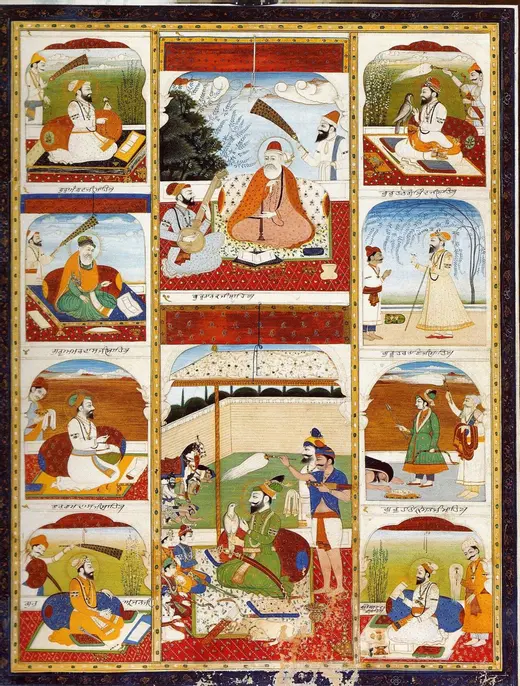
A later artist's imagining of the ten Gurus, from Sri Guru Nanak Dev Ji to Sri Guru Gobind Singh Ji, from the workshop of Purkhu of Kangra. No portrait from any Guru's lifetime is established.
Purkhu of Kangra, Early 19th century. Kapany Collection (as credited on Commons). Public domain. Source
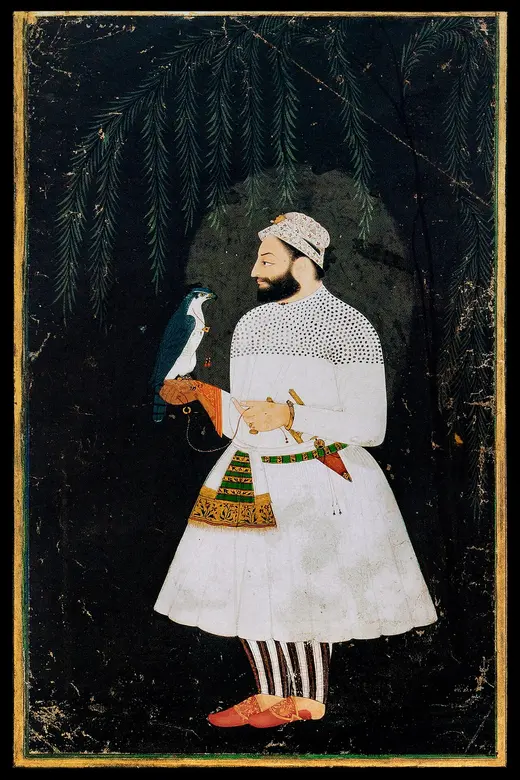
A painting of Sri Guru Hargobind Ji in a provincial Mughal style, dated to the mid 1600s, around or just after Guru Ji's lifetime. Commons calls it contemporary, but this is not established, so treat it as an artist's imagining.
Unknown, Mid 17th century. Seattle Art Museum, 44.44 (as credited on Commons). Public domain. Source
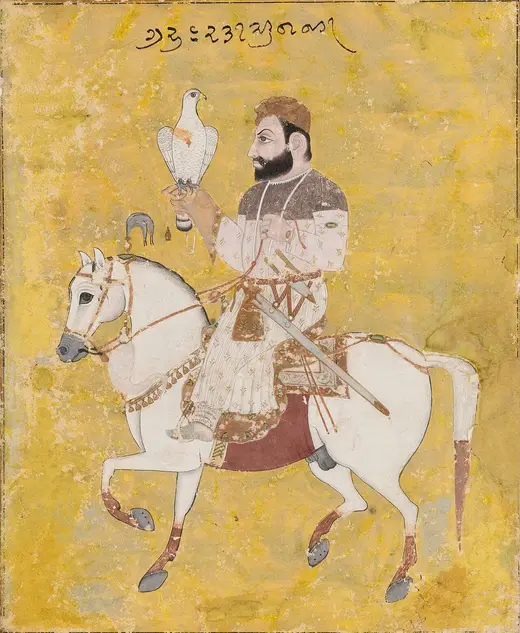
A later artist's imagining of Sri Guru Hargobind Ji on horseback, from Kishtwar in Jammu, about 1700, with an identifying inscription in Takri script. No portrait from Guru Ji's lifetime is established.
Unknown, c. 1700. Archer Collection, later sold at auction (as stated on Commons). Public domain. Source
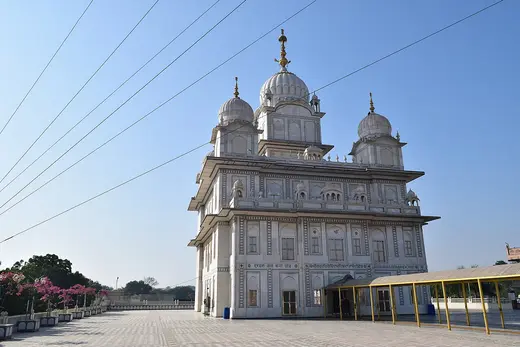
Gurdwara Data Bandi Chhor Sahib at Gwalior Fort, a modern photograph from 2017. It marks the tradition of the release of Sri Guru Hargobind Ji and 52 princes.
Kshitiz Sikka, 2017.CC BY-SA 4.0. Source
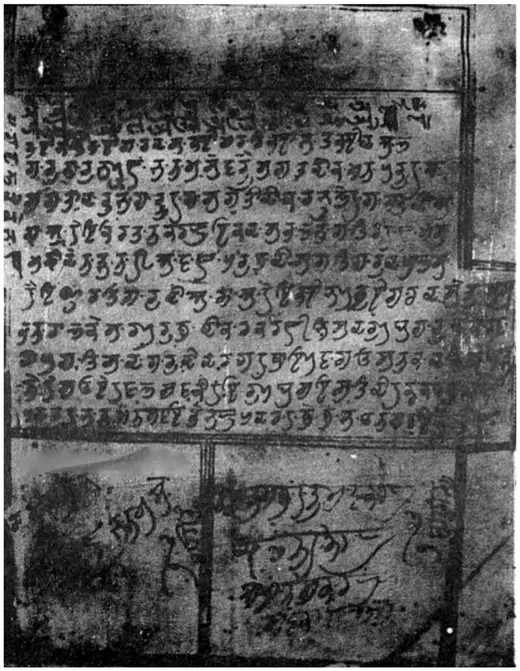
A hukamnama of Sri Guru Hargobind Ji to the eastern congregations, kept according to Commons at Takht Harmandir Sahib, Patna. The source is a social media post.
Sri Guru Hargobind Ji, 17th century. Takht Harmandir Sahib, Patna (as stated on Commons). Public domain. Source
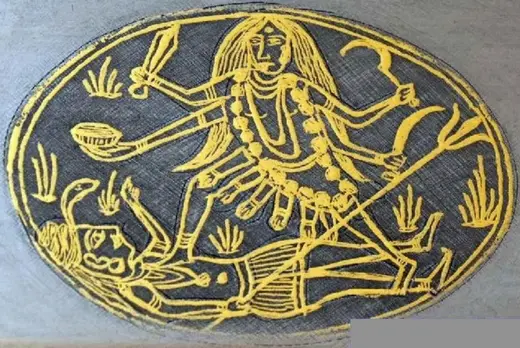
A figure on the blade of a sword attributed to Sri Guru Hargobind Ji, held according to Commons by the Bhai Bidhi Chand Nihang Dal. The attribution is reported, not established.
Unknown, 17th century, as attributed. Bhai Bidhi Chand Nihang Dal (as stated on Commons). Public domain. Source


6 children in the full tree