Takht
Sri Akal Takht Sahib
The oldest of the five Takhts and the primary seat of Sikh religious authority, facing Sri Harmandir Sahib across the courtyard. Its name means the throne of the Timeless One.
History
- 1606
A throne opposite Sri Harmandir Sahib
Sri Guru Hargobind Ji raised a platform opposite Sri Harmandir Sahib for his succession ceremonies, as a statement that the faith was concerned with both the spiritual and the worldly. The Gurbilas Chhevin Patshahi dates the structure to 15 June 1606 and the accession to 24 June 1606.
The same source says Guru Ji laid the cornerstone and that Baba Buddha and Bhai Gurdas alone completed it. Bhai Gurdas became its officiant.[EoS]
- Later
Authority
Guru Ji held court here and conducted the community's secular affairs. The first hukamnama is said to have gone out from here, asking distant Sikh centres to include weapons and horses in their offerings.
A building later raised over it was called Akal Bunga. General assemblies of the Sarbatt Khalsa have traditionally met here, and serious religious offences by prominent Sikhs are heard here.[EoS]
- June 1984
Damage
The building was badly damaged during the Indian Army's Operation Blue Star.[Web]
Images
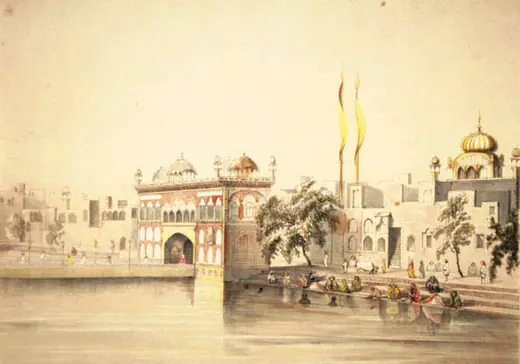
A 19th-century painting of the Akal Takht and Darshani Deori at the Harmandir Sahib complex, with Sikh flags. Its source is a personal blog.
Unknown, 19th century. Public domain. Source
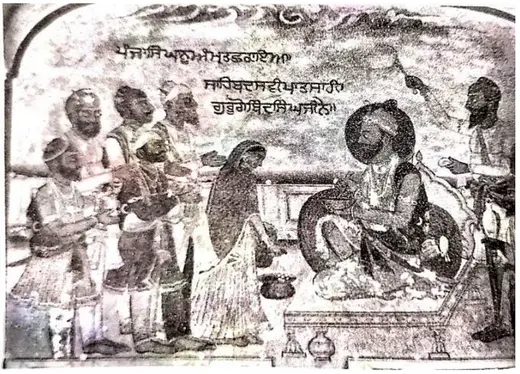
A mid-1800s fresco from the Akal Takht building that stood before 1984. It imagines Sri Guru Gobind Singh Ji and Mata Jito preparing amrit for the Panj Piare. Published by Kanwarjit Singh Kang in 1995.
Unknown, c. mid 19th century. Original Akal Takht building (no longer standing). Public domain. Source
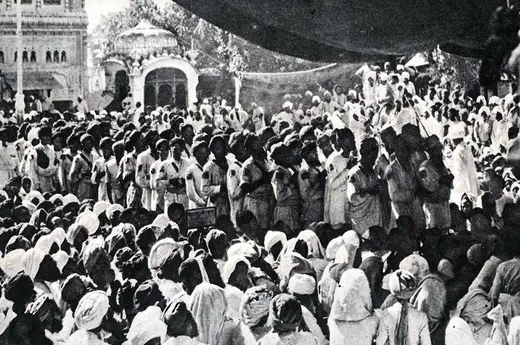
A Shahidi Jatha at the Akal Takht. Commons dates it to August-September 1923, the first months of the Jaito agitation.
Unknown, c. 1923. Public domain. Source
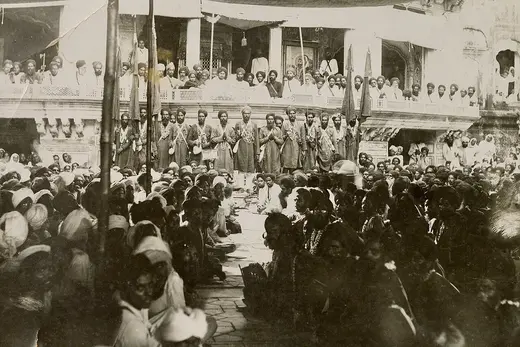
The 12th Shahidi Jatha of the Jaito Morcha at the Akal Takht about 1924, led by Sucha Singh of Moga and Kanwar Singh. A silver print by Sewa Singh and Jawahar Singh.
Sewa Singh and Jawahar Singh, c. 1924. Public domain. Source


