Scribe of the Adi Granth; poet and first theologian of the Sikhs
Bhai Gurdas
The son of a cousin of Sri Guru Amar Das Ji, he served four Gurus as preacher, envoy and scribe, wrote out the 1604 Adi Granth at Sri Guru Arjun Dev Ji's dictation, and composed the forty Vars and the Kabitts that Sikhs treat as the key to the scripture. His first Var is among the earliest surviving accounts of Sri Guru Nanak Dev Ji.
Life
Gurdas was born at Goindwal around 1551, the son of Bhai Ishar Das, a cousin of Sri Guru Amar Das Ji. Orphaned early, he grew up in Guru Ji's household and was educated in Punjabi, Braj, Sanskrit and Persian. Sri Guru Amar Das Ji sent him to preach at Agra; Sri Guru Ram Das Ji and Sri Guru Arjun Dev Ji used him as an envoy to Sikh congregations in the east and to the Mughal court at Lahore.
Between 1601 and 1604 he wrote out the Adi Granth as Sri Guru Arjun Dev Ji dictated it, the largest editorial task in the history of the community. He declined Guru Ji's suggestion that his own verse be included, and it has since held a position just outside the canon: the only non-scriptural writing approved for singing in the Harmandir.
He supervised the excavation of the Amritsar pool, was present at the Akal Takht, and supported Sri Guru Hargobind Ji through the Gwalior imprisonment and the battles. He passed away at Goindwal in 1636, and Sri Guru Hargobind Ji performed his rites.[EoS][EoS]
Writing
His forty Vars in Punjabi set out the Sikh teaching in plain narrative verse: the first describes Sri Guru Nanak Dev Ji's life, travels and debates with the yogis, and the eleventh lists the early Sikhs of each Guru by name and village, a document of unique historical value. The 556 Kabitt Savaiyye in Braj are more learned and philosophical. The Vars are quoted on this site as the earliest Sikh account of events, with the caution that they are devotional verse rather than chronicle.[EoS][EoS]
Images
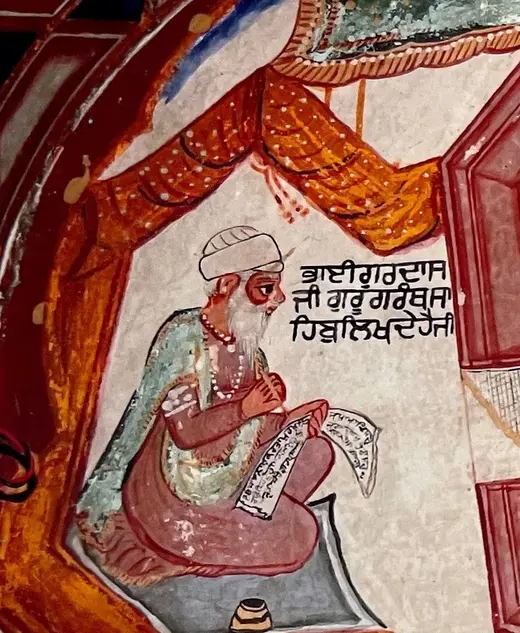
Bhai Gurdas, a detail from the mid-1800s fresco at Gurdwara Baba Bir Singh showing the compilation of the Adi Granth. An artist's imagining.
Unknown, c. mid 19th century. Gurdwara Baba Bir Singh (as stated on Commons). Public domain. Source
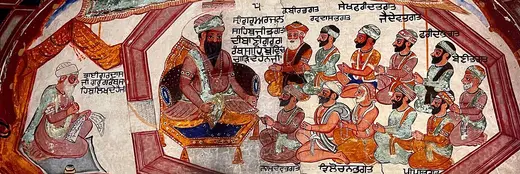
A mid-1800s fresco at Gurdwara Baba Bir Singh imagining Sri Guru Arjun Dev Ji compiling the Adi Granth with Bhai Gurdas, with the Bhagats present. The Bhagats lived in earlier centuries, so the gathering is symbolic.
Unknown, c. mid 19th century. Gurdwara Baba Bir Singh (as stated on Commons). Public domain. Source
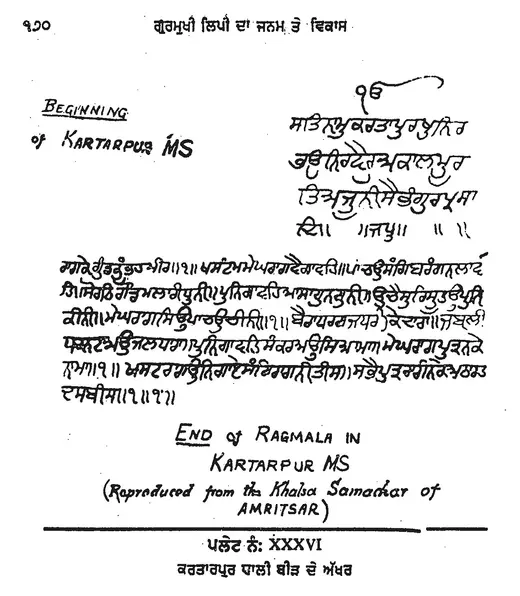
The Mul Mantar and end of the Ragamala from the Kartarpur manuscript, as reproduced by G.B. Singh in a book of 1950.
Reproduced by G.B. Singh (Gurbaksh Singh, 1877–1950) from the Khalsa Samadar of Amritsar, c. 1604. Reproduced 1950. Sodhi family, Kartarpur. Public domain. Source
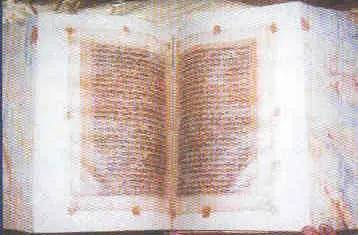
A small photograph of the Kartarpur manuscript. Commons gives no photographer. Access to this volume has been restricted, so few images exist.
Bhai Gurdas, scribe, under Sri Guru Arjun Dev Ji, c. 1604. Sodhi family, Kartarpur. Public domain. Source


