Seventh Guru
Sri Guru Har Rai Ji
Grandson of Sri Guru Hargobind Ji, Guru from fourteen to thirty-one. He kept the armed retinue but avoided fighting, sent preachers east and into the hills, and was drawn into the Mughal war of succession when he sheltered Dara Shukoh. He disowned his elder son for compromising with Aurangzeb and chose his five-year-old younger son instead.
Read the full life and times →Early life
Sri Guru Har Rai Ji was born at Kiratpur in 1630, the younger son of Baba Gurditta, Sri Guru Hargobind Ji's eldest son, who passed away in 1638. He was raised in Guru Ji's household in the hills during the quiet decade after the battles. A story in the tradition has him tearing his robe on a rosebush and resolving never again to cause needless damage, which the sources use to explain the gentleness that marked his tenure.
His grandfather installed him in March 1644, around the time of his own passing, over the heads of surviving sons and an elder grandson.[EoS]
Guruship
He kept the cavalry retinue of about two thousand that Sri Guru Hargobind Ji had built up, and kept the practice of the hunt, but there is no record of a battle during his seventeen years. Kiratpur under him was known for its dispensary and a garden of medicinal plants; tradition says a remedy from it was sent to cure Dara Shukoh, the Mughal heir apparent, of an illness.
He sent missionaries to the Malwa, to the eastern provinces and into the hills, and the conversion of the Phul family, ancestors of the Patiala, Nabha and Jind rulers, dates from his time. He confirmed the authority of the Adi Granth and, by tradition, had a Sikh who altered a word of it in recitation severely rebuked.[EoS][Grewal]
Aurangzeb and Ram Rai
In 1658 Dara Shukoh, fleeing from his brother Aurangzeb after the battle of Samugarh, passed through Punjab and received help from Guru Ji, who by one account held a river crossing to delay the pursuit. When Aurangzeb won the throne he summoned Guru Ji to Delhi to account for this. Sri Guru Har Rai Ji sent his elder son Ram Rai in his place.
At court Ram Rai, asked to explain a line in the Adi Granth that spoke of the clay of a Muslim's grave being thrown on the potter's wheel, changed the word to make it inoffensive. Aurangzeb was satisfied; Guru Ji was not. He refused to see his son again, on the ground that a Guru who altered the scripture to please a ruler was no Guru. Ram Rai stayed in Mughal favour, was given land in the Dun valley, and founded the town of Dehra Dun.[EoS][EoS]
Passing and succession
Images
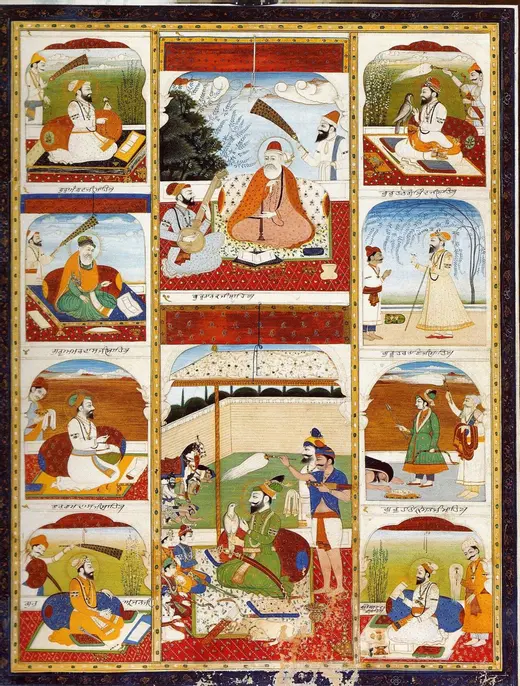
A later artist's imagining of the ten Gurus, from Sri Guru Nanak Dev Ji to Sri Guru Gobind Singh Ji, from the workshop of Purkhu of Kangra. No portrait from any Guru's lifetime is established.
Purkhu of Kangra, Early 19th century. Kapany Collection (as credited on Commons). Public domain. Source
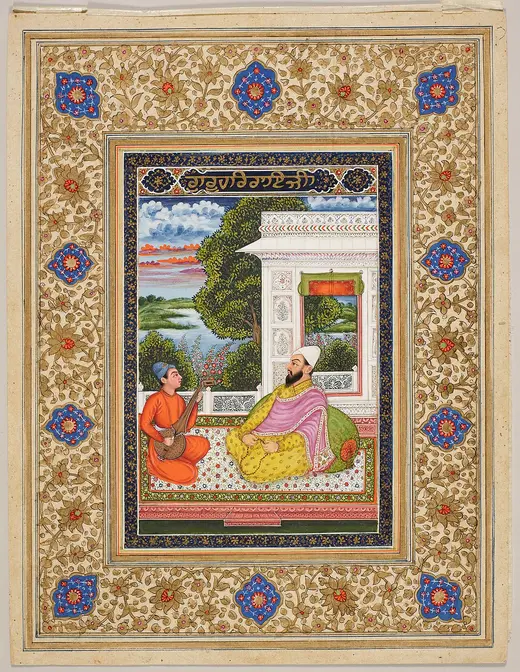
A later artist's imagining of Sri Guru Har Rai Ji, from a set of the first nine Gurus painted about 1800-1840. No portrait from Guru Ji's lifetime is established.
Unknown, c. 1800-1840. Royal Collection Trust, RCIN 925208 (as credited on Commons). Public domain. Source


Eldest son and founder of Kiratpur. Baba Sri Chand named him head of the Udasi order. He passed away before his father.
Set himself up as Guru at Kartarpur. His descendants, the Sodhis of Kartarpur, held the original volume of the Adi Granth prepared under Sri Guru Arjun Dev Ji.
2 children in the full tree