Eighth Guru
Sri Guru Har Krishan Ji
Guru at five, passed away from smallpox at seven. Summoned to Delhi by Aurangzeb at his disowned brother's instigation, he stayed in the house of the Raja of Jaipur, tended the sick during an epidemic, and with his last words pointed to his successor at Bakala.
Read the full life and times →Life
Sri Guru Har Krishan Ji was the younger son of Sri Guru Har Rai Ji and was born at Kiratpur in 1656. His father installed him in October 1661, passing over Ram Rai, who had compromised the scripture at the Mughal court. Ram Rai, who had the emperor's ear, complained, and Aurangzeb summoned the child to Delhi, partly to settle the dispute and partly, Sikh sources suggest, to see Guru Ji for himself.
He travelled to Delhi in early 1664 with his mother and a party of Sikhs under the protection of Raja Jai Singh of Amber, who lodged him in his own mansion in Raisina. The site is now Gurdwara Bangla Sahib. A story told of this stay has him picking out the raja's queen from among her maids in disguise; another, better remembered, has him explaining the Gita through an illiterate water-carrier.
Smallpox was in the city. Tradition says Guru Ji went among the sick and that the water of the well at the mansion healed them, a belief that continues at Bangla Sahib today. He caught the disease himself.[EoS][EoS]
Passing and succession
Passing away in March 1664, aged seven, he is said to have answered the question of who would follow him with the words Baba Bakale, the Baba at Bakala. That pointed to his grand-uncle Sri Guru Tegh Bahadur Ji, who had lived at Bakala for years, but it also left room for twenty-two claimants from the family to set up in the village and demand recognition. The matter was settled later that year.
His body was cremated on the bank of the Yamuna at the site of Gurdwara Bala Sahib. He left no compositions.[EoS][EoS][EoS]
Images
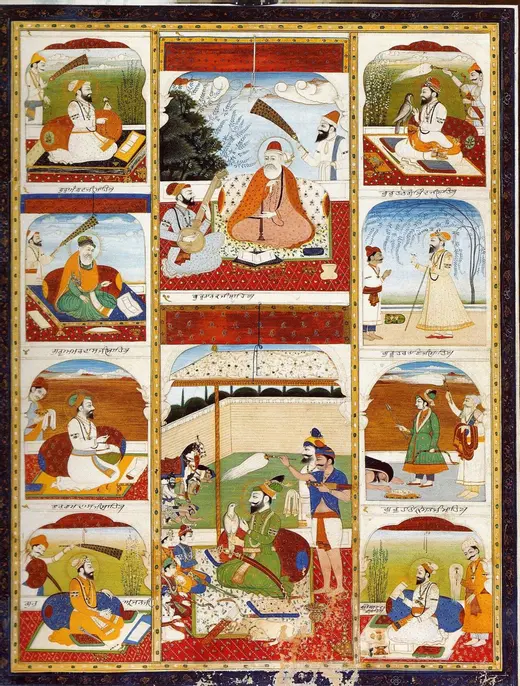
A later artist's imagining of the ten Gurus, from Sri Guru Nanak Dev Ji to Sri Guru Gobind Singh Ji, from the workshop of Purkhu of Kangra. No portrait from any Guru's lifetime is established.
Purkhu of Kangra, Early 19th century. Kapany Collection (as credited on Commons). Public domain. Source
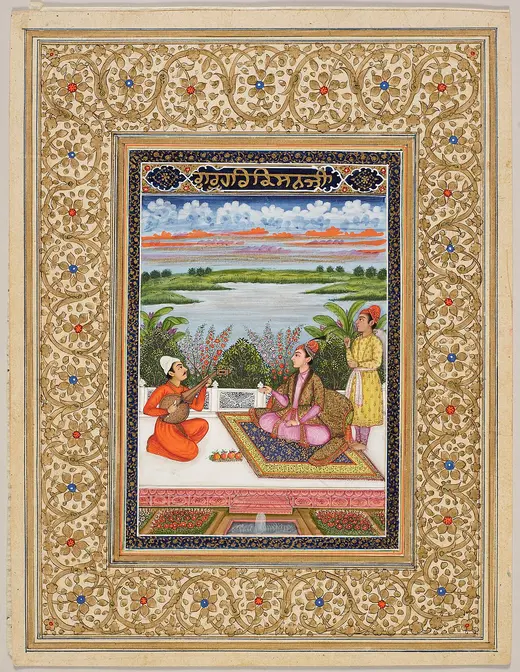
A later artist's imagining of Sri Guru Har Krishan Ji, from a set of the first nine Gurus painted about 1800-1840. No portrait from Guru Ji's lifetime is established.
Unknown, c. 1800-1840. Royal Collection Trust, RCIN 925209 (as credited on Commons). Public domain. Source
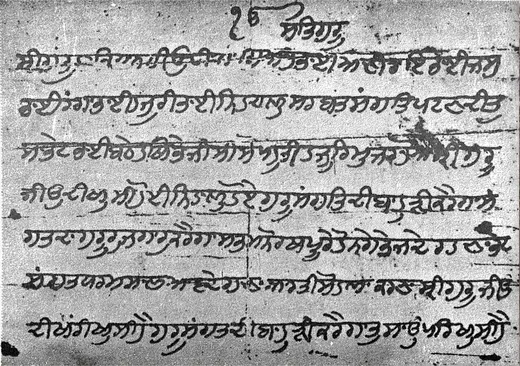
A hukamnama of Sri Guru Har Krishan Ji to the congregation of Pakpattan, dated on Commons to about 1661-1664. Its description comes from a social media page.
Sri Guru Har Krishan Ji and his scribe, c. 1661-1664. Public domain. Source


