Ninth Guru, executed at Delhi
Sri Guru Tegh Bahadur Ji
Youngest son of Sri Guru Hargobind Ji, a soldier in youth and then a near-recluse for twenty years, he became Guru in 1664, founded Anandpur, travelled through the east as far as Assam, and was martyred in Delhi in 1675 after refusing conversion, in a case that Sikh memory ties to the persecution of Kashmiri Brahmins. His 116 hymns on detachment and death were added to the scripture by his son.
Read the full life and times →Early life
Born at Amritsar in 1621 as Tyag Mal, the fifth and youngest son of Sri Guru Hargobind Ji and Mata Nanaki, he was trained in arms and scripture by Bhai Gurdas and Baba Buddha. He fought in the battle of Kartarpur in April 1635, aged fourteen. Tradition says his father renamed him Sri Guru Tegh Bahadur Ji, brave of the sword, for his part in it.
He married Mata Gujri of Kartarpur on 4 February 1633. When Sri Guru Hargobind Ji passed away in 1644, having named a grandson as Guru, Sri Guru Tegh Bahadur Ji moved with his mother and wife to the village of Bakala, where his mother's family had land, and lived there for two decades in retirement and meditation. His first biographers make much of his absorption in contemplation during these years.[EoS][EoS]
Becoming Guru
When Sri Guru Har Krishan Ji passed away in 1664 with the words Baba Bakale, nearly two dozen Sodhi relatives set themselves up in Bakala as Guru Ji. The well-known story of the trader Makkhan Shah, who had vowed five hundred gold coins to Guru Ji if his ship survived a storm, offered two to each claimant, and found only Sri Guru Tegh Bahadur Ji who remarked on the shortfall, is the tradition's account of how the matter was settled. The Sikhs recognised him in August 1664.
Dhir Mal, a grandson of Sri Guru Hargobind Ji who held the Kartarpur manuscript of the Adi Granth, had him attacked and wounded at Bakala. Guru Ji declined to retaliate and later returned goods his followers had seized from Dhir Mal. He was refused entry to the Harmandir at Amritsar by its custodians, who were allied with rival lines, and moved on.[EoS][EoS][EoS]
Anandpur and the east
In 1665 the Dowager Rani Champa of Bilaspur offered him land in the Shivalik foothills. He paid for it and founded a town he named Chakk Nanaki after his mother; it became Anandpur. Almost at once he set out eastward, through the Malwa, Delhi, Agra, Allahabad, Varanasi and Patna, teaching and gathering followers. His son Gobind was born at Patna in 1666 while he was further east.
He went on to Dhaka and into Assam with the Mughal commander Raja Ram Singh, who was campaigning against the Ahom kingdom, and is credited in the tradition with negotiating a peace. He returned to Punjab around 1670 and finally settled at Anandpur in 1672, then spent two or three years touring the Malwa, where many Jat villages took to the faith and wells were dug on his initiative.[EoS][EoS][EoS]
Arrest and execution
From about 1669 Aurangzeb's policy hardened: a 1669 order against new temples, the reimposition of the jizya tax on non-Muslims in 1679, and pressure on Hindu communities including, by Sikh accounts, forced conversions in Kashmir. In 1675 a delegation of Kashmiri Brahmins came to Anandpur for help. Tradition says Guru Ji's nine-year-old son suggested that a great man must offer himself, and that Guru Ji told the Brahmins to answer that they would convert if he did.
He set out for Delhi, was arrested on the way and brought to the capital in chains with three companions. Given the choice of conversion, a miracle or death, he chose martyrdom. His companions were killed first. Sikh tradition records Mati Das sawn in two, Sati Das burned and Dayala boiled. On 11 November 1675 Guru Ji was martyred in Chandni Chowk. Two Sikhs recovered the body: Jaita carried the head to Anandpur, and Lakhi Shah Vanjara burned his own house down around the body to cremate it. Gurdwaras Sis Ganj and Rakab Ganj in Delhi mark the two sites.
Sri Guru Gobind Singh Ji later wrote that his father had given his head rather than abandon his principle, and that in doing so he protected the sacred thread and forehead mark of Hindus, which is why Guru Ji is called the shield of India.[EoS][EoS][EoS][Grewal]
Writing and legacy
His 59 hymns and 57 saloks, in a plain Braj-inflected idiom, dwell on impermanence, fearlessness and the uselessness of a life spent without remembering the divine. Sri Guru Gobind Singh Ji added them to the scripture, which otherwise closed with Sri Guru Arjun Dev Ji, and the final saloks of Sri Guru Granth Sahib Ji are his.
His martyrdom, following Sri Guru Arjun Dev Ji's, fixed the pattern by which the Sikh community understood its relationship with the Mughal state, and his son's creation of the Khalsa twenty-four years later is usually read as its direct consequence.[EoS][EoS]
What the sources disagree on
- Grounds for the execution
Sikh tradition centres the Kashmiri Brahmins' appeal and a refusal to convert. Mughal records of the trial do not survive; some later Persian sources describe Guru Ji as a disturber of the peace who had raised armed followers. Most historians accept that religious refusal was central while noting the political dimension.[EoS][Grewal][(eds.)]
Images
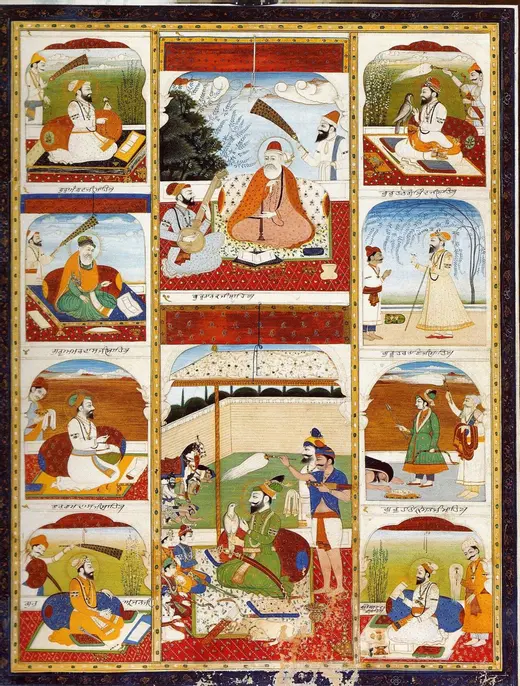
A later artist's imagining of the ten Gurus, from Sri Guru Nanak Dev Ji to Sri Guru Gobind Singh Ji, from the workshop of Purkhu of Kangra. No portrait from any Guru's lifetime is established.
Purkhu of Kangra, Early 19th century. Kapany Collection (as credited on Commons). Public domain. Source
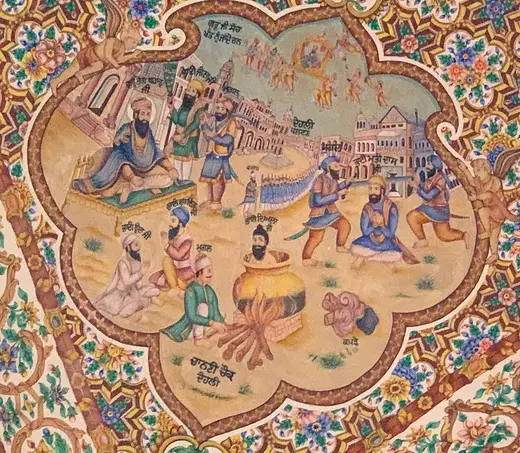
A later fresco at Gurdwara Baba Bakala showing the martyrdom of Bhai Dayala and Bhai Mati Das in the presence of Sri Guru Tegh Bahadur Ji. Credited on Commons to Jaimal Singh Naqqash and Mehtab Singh.
Jaimal Singh Naqqash and Mehtab Singh, Late 19th or early 20th century. Gurdwara Baba Bakala. Public domain. Source
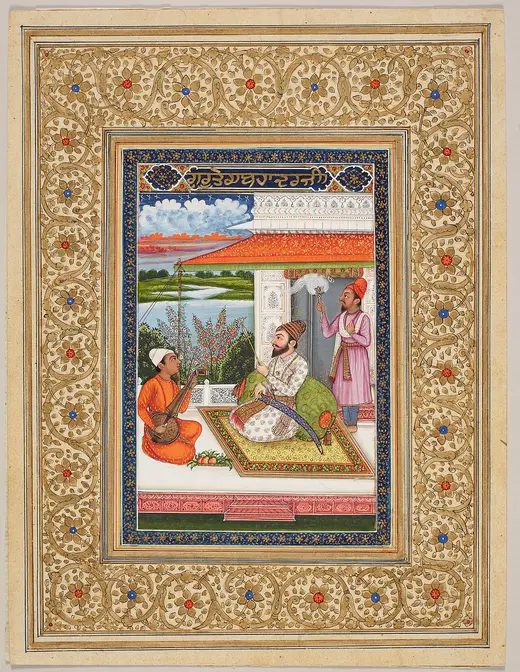
A later artist's imagining of Sri Guru Tegh Bahadur Ji, from a set of the first nine Gurus painted about 1800-1840. No portrait from Guru Ji's lifetime is established.
Unknown, c. 1800-1840. Royal Collection Trust, RCIN 925210 (as credited on Commons). Public domain. Source
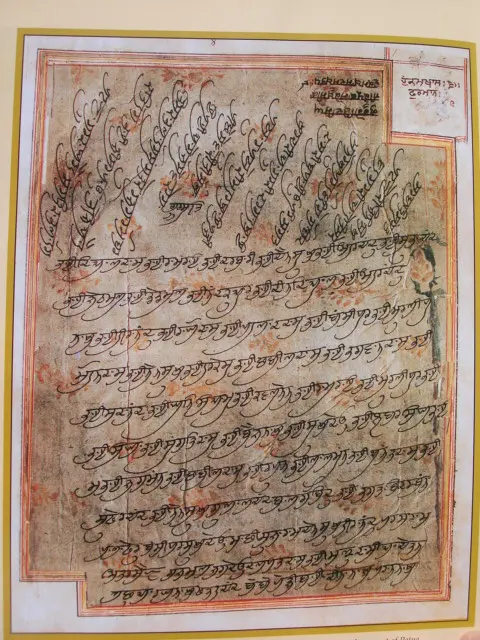
A hukamnama of Sri Guru Tegh Bahadur Ji said to have been sent to Patna when Guru Ji's son was born, and kept at Takht Harmandir Sahib. The source is a Flickr post.
Sri Guru Tegh Bahadur Ji and his scribe, c. 1666-1667. Takht Harmandir Sahib, Patna (as stated on Commons). Public domain. Source
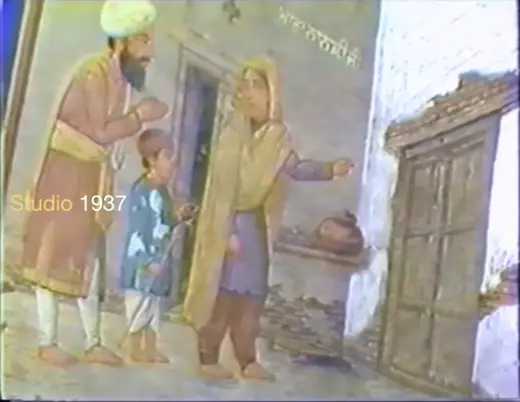
A later fresco at Gurdwara Baba Bakala of Bhai Makkhan Shah Lubana finding Sri Guru Tegh Bahadur Ji, taken from film footage. The uploader doubts that the original fresco survives.
Jaimal Singh Naqqash and Mehtab Singh, Late 19th or early 20th century. Public domain. Source


- Mother: Mata Damodari
Married Bhai Sadhu in 1629. All five of her sons fought at Bhangani in 1688, and two of them, Sango Shah and Jit Mall, attained martyrdom there.
- Ani Rai[EoS]Mother: Mata Damodari
- Mother: Mata NanakiMarried Mata Gujri 1624–1705. Daughter of Lal Chand Subhikkhi and Bishan Kaur. Married 4 February 1633. Her brother Kirpal Chand looked after the family at Patna.[EoS][EoS]
1 child in the full tree