Tenth Guru, founder of the Khalsa
Sri Guru Gobind Singh Ji
Guru at nine after his father's martyrdom, he turned the Sikhs into the Khalsa in 1699, a self-governing order with a shared name, dress and code; fought the hill chiefs and the Mughals; lost all four sons and his mother in the winter of 1705; wrote to Aurangzeb in Persian verse; and in 1708, passing away at Nanded, ended the line of human Gurus by vesting the office in the scripture and the community.
Read the full life and times →Sources disagree
- 1661-12-22: An older tradition, followed by some early writers and recorded on Wikidata, gives 1661. The Encyclopaedia of Sikhism and most modern accounts give 1666, which fits his father's eastern journey.[WD][EoS]
- 1667-01-05: The Nanakshahi calendar fixes the birthday celebration on 5 January; the Bikrami date converts to 22 December 1666.[EoS]
Early life
Gobind Rai was born at Patna in December 1666 while his father was travelling in Bengal and Assam. He spent his first five years there with his mother Gujri and his uncle Kirpal, and reached Anandpur in 1672. His father's execution in 1675 made him Guru at nine. His education, in Punjabi, Braj, Sanskrit and Persian as well as riding and arms, continued at Anandpur under teachers the family engaged.
He married Jito in 1677 and Sundari in 1684; a third relationship, with Sahib Devan, the tradition treats as a spiritual marriage. His four sons were Ajit (b. 1687), Jujhar (1691), Zorawar (1696) and Fateh (1699).[EoS][EoS][EoS]
Paonta and the hill wars
In 1685 he accepted an invitation from the ruler of Sirmaur and built Paonta on the Yamuna, where for three years he kept a court of poets and translators and wrote much of his own early work. Jealousy among the hill rajas, and resentment of a Guru who kept an army, led to the battle of Bhangani in 1688, in which his small force, stiffened by Pathan mercenaries who stayed loyal and Udasi ascetics who did not flee, beat a coalition led by Fateh Shah of Garhwal on 18 September 1688.
He returned to Anandpur, which he fortified with five small forts, and fought alongside Raja Bhim Chand of Bilaspur against a Mughal tax-collecting expedition at Nadaun in 1691. The 1690s were spent building up Anandpur, resisting Mughal detachments sent from Lahore and Sirhind, and recasting the community.[EoS][EoS][EoS]
The Khalsa, 1699
At the Vaisakhi gathering of 30 March 1699 at Anandpur, Guru Ji asked the crowd for a head. The five who came forward one by one, a Khatri from Lahore, a Jat from Hastinapur, a washerman from Dwarka, a water-carrier from Jagannath Puri and a barber from Bidar, were brought out alive, initiated with sweetened water stirred with a double-edged sword, and named the Panj Piare, the five beloved. Guru Ji then asked them to initiate him in turn.
Those initiated took the name Singh, lion, and were to keep uncut hair, carry a sword, wear a steel bracelet, short breeches and a comb, and reject caste, tobacco, the masands and the rival Guru lines. The masand system of deputies, which had grown corrupt, was abolished; Sikhs were to deal with Guru Ji directly. The Khalsa, the pure or the sovereign, was a community that could recognise itself and act without a Guru present, which within a decade is exactly what it had to do.
The earliest account of the event, Sainapati's Sri Gur Sobha, written within a few years of Guru Ji's passing, confirms the abolition of the masands and the new code, though it does not give the dramatic details of the five heads.[EoS][EoS][EoS][Src]
1705 to 1706
A combined force of hill rajas and Mughal troops besieged Anandpur from May 1705. On the night of 5-6 December 1705 Guru Ji accepted sworn promises of safe passage and evacuated the town. The promise was broken at the Sarsa river in flood, where the party was attacked and scattered. His mother and two younger sons were separated and taken to Sirhind, where the boys, aged nine and six, were martyred by the governor Wazir Khan after refusing conversion, and Mata Gujri passed away in custody.
Guru Ji reached Chamkaur with about forty men and held a mud-walled house against the pursuing army for a day; his two elder sons were martyred in sorties. At the insistence of the remaining Sikhs he left by night, and crossed the Malwa alone and on foot, sheltered by two Pathan brothers who had served him, Ghani Khan and Nabi Khan. At Dina he wrote the Zafarnama to Aurangzeb, a letter in Persian verse which accuses the emperor of perjury and tells him that when every other means has failed it is lawful to draw the sword.
At Khidrana in late December 1705 forty Sikhs who had deserted him at Anandpur returned under Mai Bhago's leadership and attained martyrdom holding off Wazir Khan's pursuit. He named the place Muktsar. He rested at Talwandi Sabo for most of 1706, where tradition says he dictated the final text of the Adi Granth, adding his father's hymns, with Bhai Mani Singh as scribe.[EoS][EoS][EoS][EoS][EoS][EoS][EoS]
Nanded and passing
Aurangzeb, who had invited Guru Ji to meet him, died in February 1707. Guru Ji supported Bahadur Shah in the succession war, met him at Agra in July 1707, and travelled south with the imperial camp while the question of Wazir Khan went unresolved. At Nanded on the Godavari in September 1708 he met the ascetic Madho Das, initiated him as Banda Singh, and sent him north with authority to punish Sirhind.
Shortly afterwards two Pathans, by most accounts hired by Wazir Khan, stabbed him in his tent. The wound was stitched but reopened. Before passing away on 7 October 1708 Guru Ji declared, according to Sikh tradition, that there would be no further human Guru: Sri Guru Granth Sahib Ji was to be Guru, and the Khalsa the embodiment of Guru Ji. The passages of Sri Gur Sobha checked for this site name the Khalsa in this connection. The decision gave the Sikhs a scripture and a community as their authority through the century of persecution and war that followed.[EoS][EoS][Src][EoS]
Writing
Works attributed to Guru Ji, with those of his court poets, were collected after his passing in the Dasam Granth. The Jaap Sahib, the Akal Ustat, the Bachitra Natak autobiography, the Zafarnama and the Savaiyyas are generally accepted as his; the authorship of the Charitropakhyan tales and some of the mythological material has been disputed since the nineteenth century. He added no compositions of his own to Sri Guru Granth Sahib Ji beyond a single salok in some recensions.[EoS][EoS]
What the sources disagree on
- Year of birth
1666 (Encyclopaedia of Sikhism, modern consensus) against 1661 (older tradition, Wikidata). The site uses 1666.[EoS][WD]
- The Dasam Granth
How much of the Dasam Granth is Guru Ji's own work has been argued since the Singh Sabha period. The core devotional and autobiographical texts are widely accepted; the Charitropakhyan and some Puranic retellings are contested. The site cites the Dasam Granth for Guru Ji's own voice only where attribution is broadly accepted.[EoS][(eds.)]
- Details of the 1699 Vaisakhi
The 'five heads' narrative comes from eighteenth-century sources. Sri Gur Sobha, the nearest contemporary account, confirms the creation of the Khalsa and its code without that episode.[Src][EoS]
Images
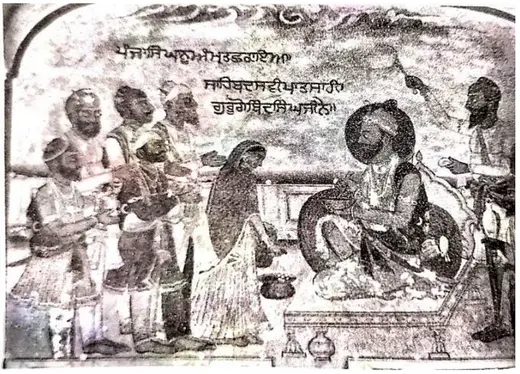
A mid-1800s fresco from the Akal Takht building that stood before 1984. It imagines Sri Guru Gobind Singh Ji and Mata Jito preparing amrit for the Panj Piare. Published by Kanwarjit Singh Kang in 1995.
Unknown, c. mid 19th century. Original Akal Takht building (no longer standing). Public domain. Source
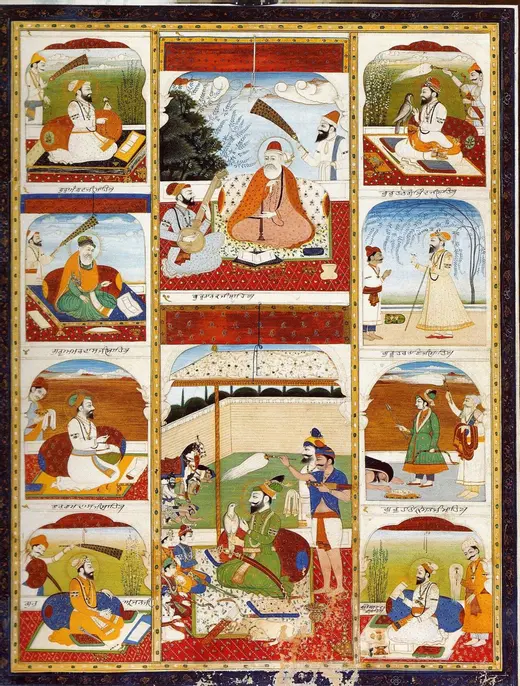
A later artist's imagining of the ten Gurus, from Sri Guru Nanak Dev Ji to Sri Guru Gobind Singh Ji, from the workshop of Purkhu of Kangra. No portrait from any Guru's lifetime is established.
Purkhu of Kangra, Early 19th century. Kapany Collection (as credited on Commons). Public domain. Source
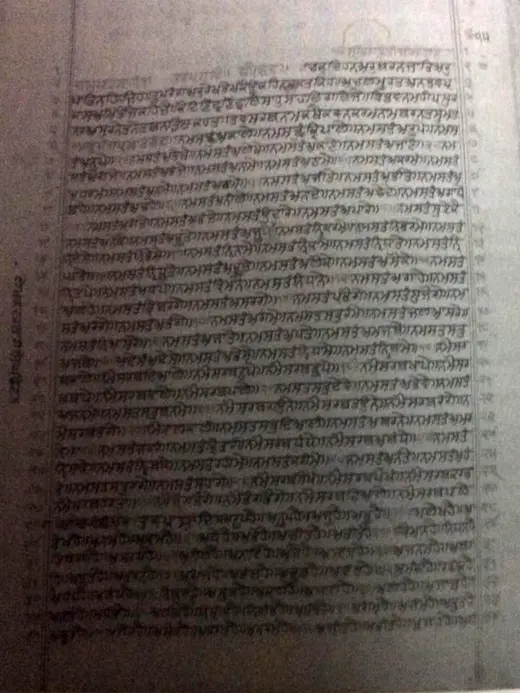
The opening of the Jap in the Anandpur manuscript. Commons gives 1695-1696 or 1698, while Mann says it is undated but from the 1690s.
Unknown scribes (Commons credits Sri Guru Gobind Singh Ji), 1690s, undated. Private collection (per Mann, 2008). Public domain. Source
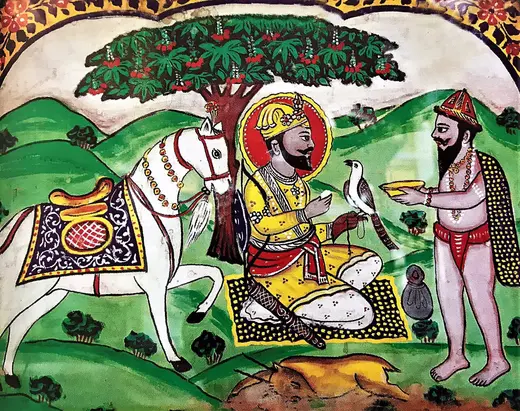
A fresco at Sri Khat Wari Darbar, Shikarpur, Sindh, imagining Bhai Kanhaiya meeting Sri Guru Gobind Singh Ji. Commons gives only a broad date range.
Unknown, 18th to early 20th century, uncertain. Sri Khat Wari Darbar, Shikarpur, Sindh. Public domain. Source
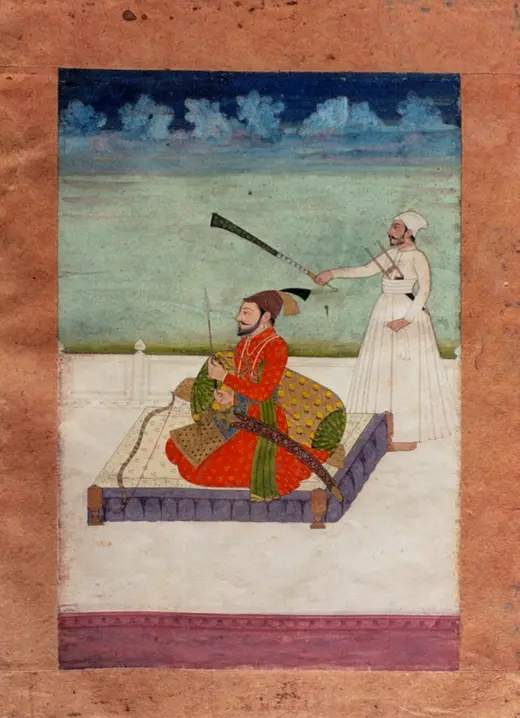
One of two paintings pasted into the Anandpur manuscript, showing Sri Guru Gobind Singh Ji enthroned with an attendant, dated to the 1690s or early 1700s. Mann thinks artists at Anandpur made it. That it is a true likeness is not established.
Unknown painter, 1690s or early 1700s, disputed. Private collection (per Mann, 2008). Public domain. Source
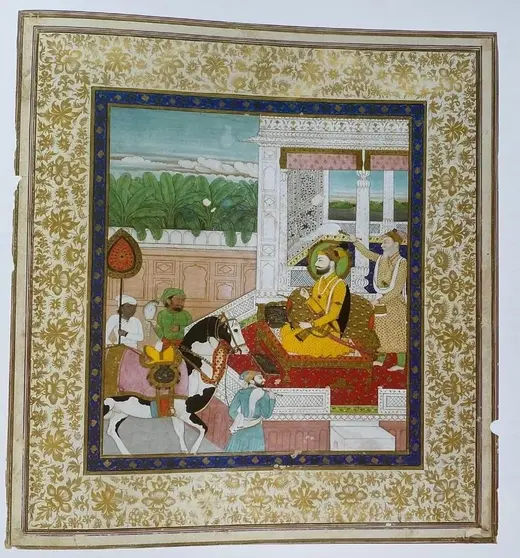
A later artist's imagining of Sri Guru Gobind Singh Ji, from the Pahari workshop of the family of Nainsukh of Guler, about 1815. No portrait from Guru Ji's lifetime is established.
family workshop of Seu-Nainsukh of Guler, c. 1815. Samrai Collection, London (as credited on Commons). Public domain. Source
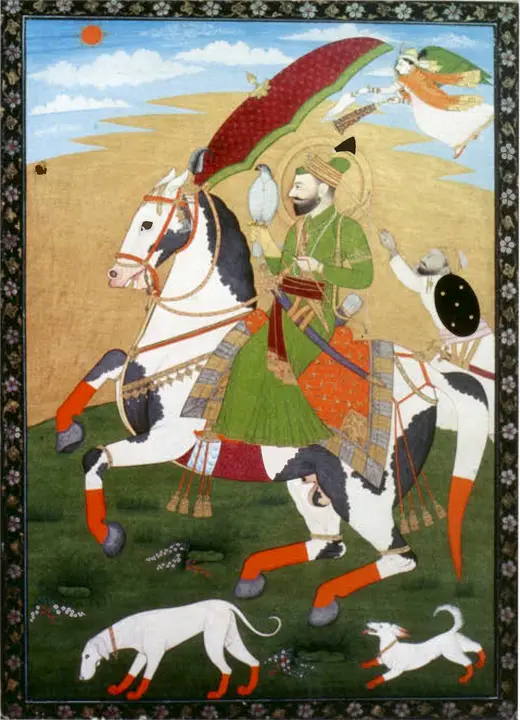
A later artist's imagining of Sri Guru Gobind Singh Ji on horseback, from the Guler-Kangra schools in the early 1800s. No portrait from Guru Ji's lifetime is established.
Unknown, Early 19th century. Collection of Gursharan and Elvira Sidhu (as credited on Commons). Public domain. Source
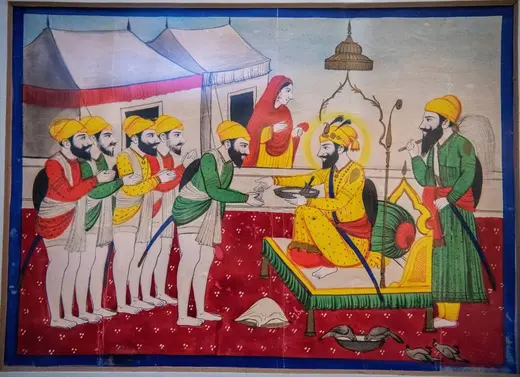
A later artist's imagining of the 1699 Khalsa ceremony at Anandpur. Commons says the attribution to Gian Singh Naqqash comes from his grandson.
Gian Singh Naqqash, Late 19th or early 20th century. Public domain. Source
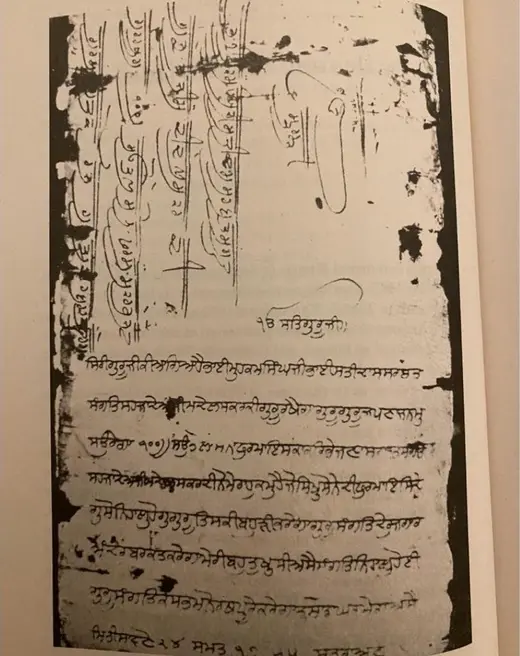
A hukamnama of Sri Guru Gobind Singh Ji dated 24 July 1698. The date comes from Commons, whose source is a social media post.
Sri Guru Gobind Singh Ji and his scribe, 24 July 1698. Public domain. Source
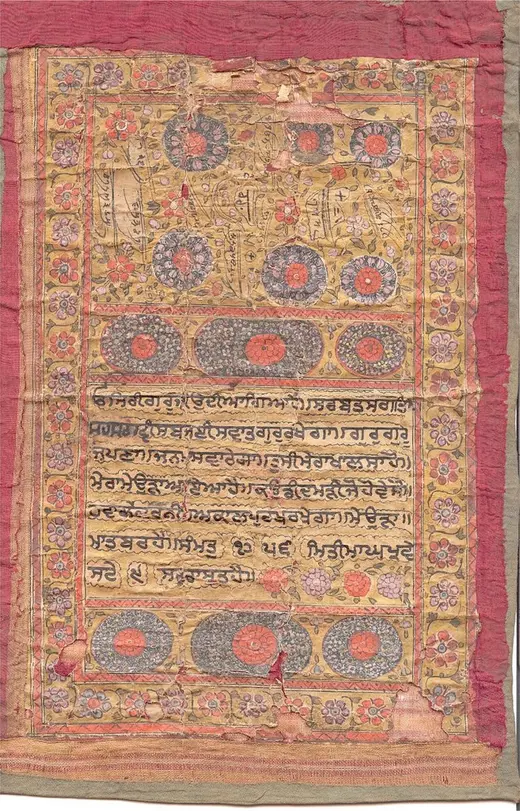
An illuminated hukamnama of Sri Guru Gobind Singh Ji of 1699 (Samat 1756), published by Gurinder Singh Mann in 2008 from a family collection in the United States.
Sri Guru Gobind Singh Ji and his scribe, 1699. Private collection, USA (per Mann, 2008). Public domain. Source
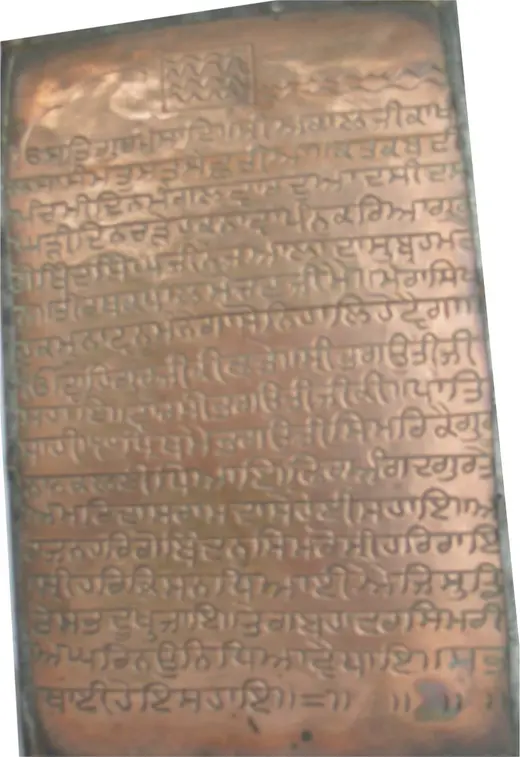
The copper plate at Kapal Mochan, inscribed with a date in 1679 and naming Sri Guru Gobind Singh Ji. Its use of 'Singh' and 'Khalsa' before 1699 raises questions that Mann discusses.
Unknown maker (attributed to Sri Guru Gobind Singh Ji), 1679, as inscribed. Shiva temple, Kapal Mochan (per Mann, 2008). Public domain. Source
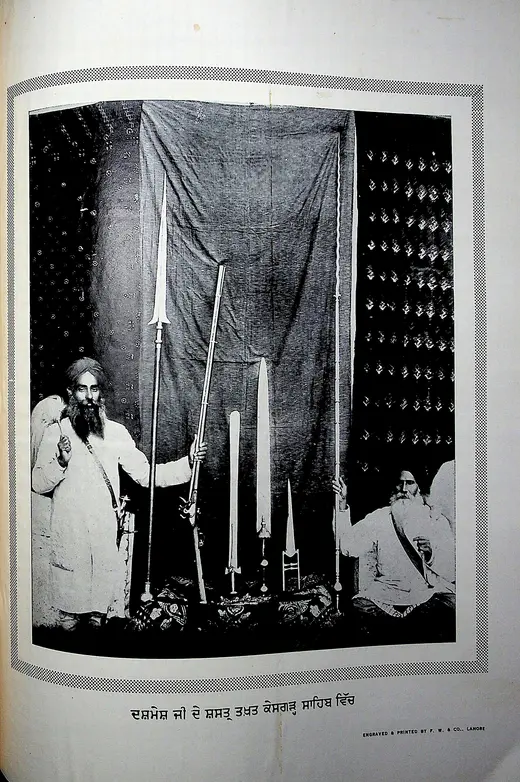
Weapons displayed at Takht Kesgarh Sahib as relics of Sri Guru Gobind Singh Ji, printed in Kahn Singh Nabha's Mahan Kosh of 1930. Commons names them as a spear, a musket, a khanda, a saif, a katar and a nagni.
Kahn Singh Nabha, Before 1930. Takht Kesgarh Sahib. Public domain. Source
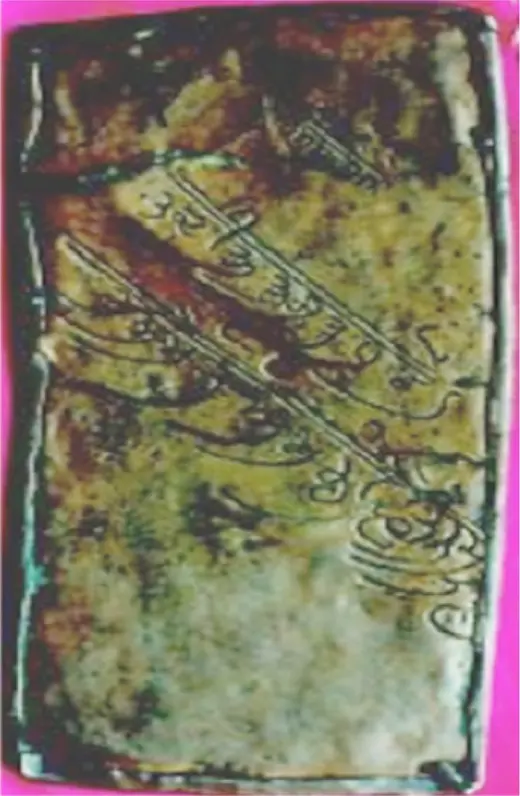
The copper plate shown at Naina Devi to Gurinder Singh Mann in 2000 and attributed to Sri Guru Gobind Singh Ji. It is undated, and Mann places it around 1700 by genealogy.
Unknown maker (attributed to Sri Guru Gobind Singh Ji), Undated. c. 1700. Priests of Naina Devi temple (per Mann, 2008). Public domain. Source
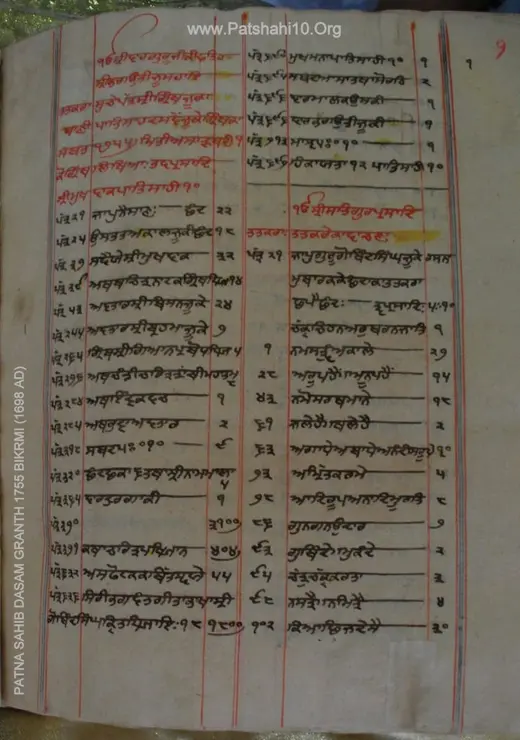
A page of the Patna manuscript of the Dasam Granth, traditionally dated 1698. Mann questions whether this volume is from 1698 or a later copy.
Unknown scribes (Commons credits Sri Guru Gobind Singh Ji), 1698 by tradition. Takht Harmandir Sahib, Patna. Public domain. Source
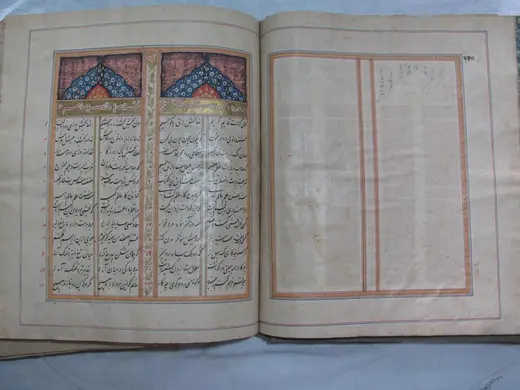
The opening of the Zafarnama in an illuminated Dasam Granth manuscript dated 1765, known on Internet Archive as the Patna Missal manuscript. Its origin was not independently checked.
Patna Missal (faction of Sikhs), 1765. Public domain. Source
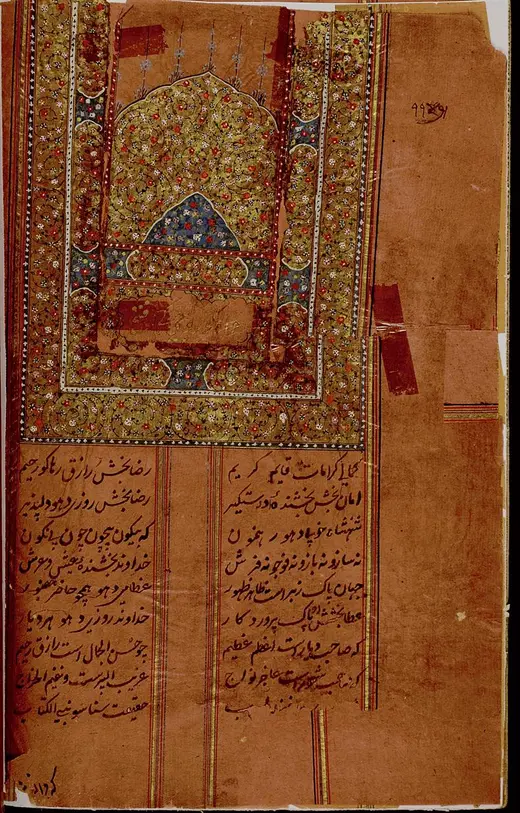
The opening of a copy of the Zafarnama said to have been prepared by Bhai Daya Singh. That attribution is a claim. The original letter has not been located.
Unknown, Early 18th century, as claimed. Public domain. Source


- Married Mata Sundari d. 1747. Married 4 April 1684. She later adopted a boy at Delhi and named him Ajit Singh.[EoS]Married Mata Sahib Devan. Married 15 April 1700. She had no children, and by tradition is the mother of the Khalsa.[EoS]
He named no human successor. All four sons were martyred before him, in December 1705.
4 children in the full tree
Words
- Akal Ustat: know all humanity as oneਕੋਊ ਭਇਓ ਮੁੰਡੀਆ ਸੰਨਿਆਸੀ ਕੋਊ ਜੋਗੀ ਭਇਓ ਕੋਊ ਬ੍ਰਹਮਚਾਰੀ ਕੋਊ ਜਤੀ ਅਨੁਮਾਨਬੋ ॥One becomes a shaven monk, one a sannyasi, another a yogi, one takes a vow of celibacy, another is counted an ascetic.· Kabitt
- Sri Guru Gobind Singh Ji: grant me this one wishਦੇਹ ਸਿਵਾ ਬਰੁ ਮੋਹਿ ਇਹੈ ਸੁਭ ਕਰਮਨ ਤੇ ਕਬਹੂੰ ਨ ਟਰੋ ॥Grant me this, Lord: may I never turn away from doing right.· Savaiyya