First Sikh military commander after the Gurus; executed 1716
Banda Singh Bahadur
A Rajput hunter turned ascetic whom Sri Guru Gobind Singh Ji initiated at Nanded in 1708 and sent north with five arrows, a drum and a banner. Within two years he had taken Sirhind, abolished the zamindari system in the territory he held, and struck coins in the Gurus' names. Captured after an eight-month siege in 1715, he was executed in Delhi with hundreds of followers.
Before 1708
Lachhman Dev was born in 1670 at Rajauri in the Jammu hills. The tradition says that killing a pregnant doe while hunting turned him to religion; he became a Vaishnava ascetic under the name Madho Das, travelled, and settled on the Godavari at Nanded with a reputation for occult powers. Sri Guru Gobind Singh Ji, arriving there in 1708, sought him out, and the meeting ended with the ascetic calling himself Guru Ji's banda, his slave. Guru Ji gave him the vows of the Khalsa and the name Banda Singh, from that word.[EoS][EoS]
The campaign
Guru Ji gave him authority over the Sikhs of Punjab, five arrows as a token, five Sikhs as counsellors, and letters calling the community to arms. He reached the Punjab plains in late 1709, gathered a following among the Jat peasantry and the poorer classes, took Samana, Sadhaura and other towns, and in May 1710 defeated and killed Wazir Khan at Chappar Chiri and sacked Sirhind.
He set up at Lohgarh in the Shivalik foothills, struck coins and a seal in the names of Sri Guru Nanak Dev Ji and Sri Guru Gobind Singh Ji, declared the end of the landlords' rights over cultivators in his territory, and dated documents from a new era. Bahadur Shah marched against him in person in late 1710; Lohgarh fell but Banda escaped to the hills and fought on for five more years, retaking Sirhind briefly in 1712.
In 1715 the emperor Farrukhsiyar's forces besieged him at Gurdas Nangal near Gurdaspur. After eight months of starvation the garrison surrendered in December. Banda and several hundred Sikhs were paraded through Lahore and reached Delhi on 27 February 1716. Over the following weeks the prisoners were executed in batches after refusing conversion. On 9 June 1716 Banda Singh Bahadur was martyred after enduring torture, and after being made to watch the martyrdom of his small son.[EoS][EoS][Grewal]
Legacy
His two years of rule were the first exercise of Sikh political power and the first serious breach in Mughal authority in Punjab. A split between his followers, the Bandai, and the Tat Khalsa over his innovations was settled at Amritsar in 1721 in favour of the latter. The persecution that followed his death drove the Khalsa into the hills and deserts for a generation, from which the misls emerged.[EoS][Grewal]
Images
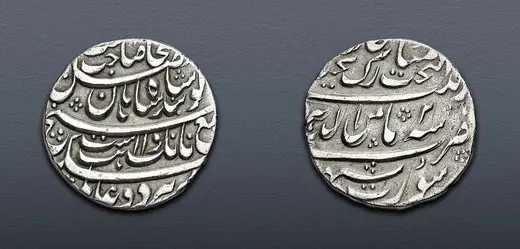
A silver rupee struck under Banda Singh Bahadur at Amritsar, dated Year 2 (1711) according to the auction house that sold it. This is a different coin from the one at the American Numismatic Society.
Mint of Banda Singh Bahadur. Image: Classical Numismatic Group, 1711, as catalogued. Sold at auction by Classical Numismatic Group (present owner unknown).CC BY-SA 2.5. Source
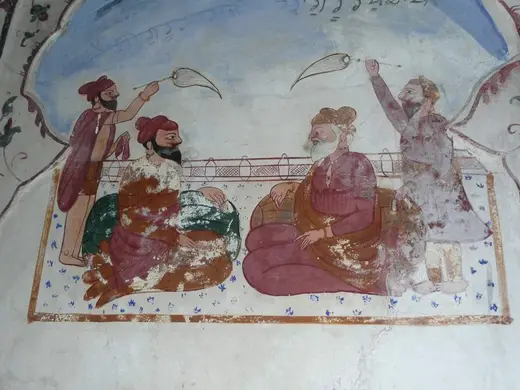
A wall painting at Gurdwara Dera Baba Banda Bahadur, Reasi, showing Banda Singh Bahadur and a boy read as his son. Probably 19th century, so an artist's imagining.
Unknown, Probably 19th century. Gurdwara Dera Baba Banda Bahadur, Reasi (as stated on Commons). Public domain. Source
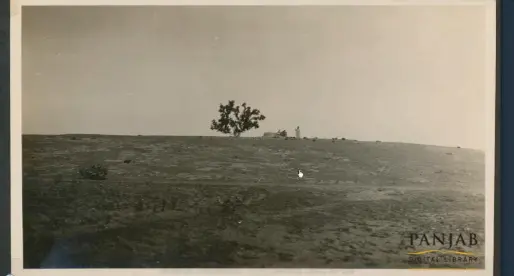
The site of Banda Singh Bahadur's last battle and capture at Gurdas Nangal, photographed by Dhanna Singh Chahal in 1934.
Dhanna Singh Chahal 'Patialvi', 1934. Public domain. Source
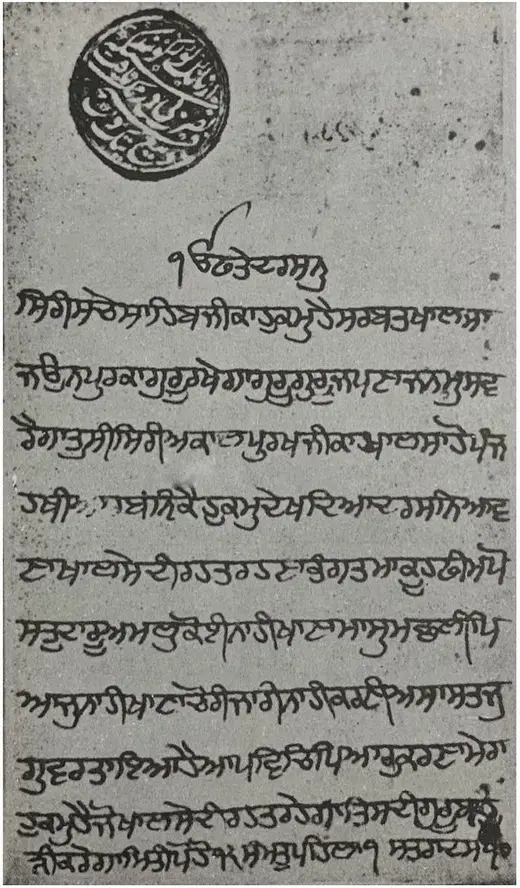
A hukamnama of Banda Singh Bahadur to the congregation of Jaunpur, dated 12 December 1710 (12 Poh 1769 Bk). It asks them to join his campaign.
Banda Singh Bahadur, 12 December 1710. Public domain. Source


