The first five initiated into the Khalsa, 1699
The Panj Piare
Five men from five regions and five castes, a Khatri, a Jat, a water-carrier, a washerman and a barber, who answered Sri Guru Gobind Singh Ji's call for a head at Vaisakhi 1699, became the first members of the Khalsa, and then initiated Guru Ji himself. Any five initiated Sikhs acting together have carried their authority since.
The five
Daya Ram, a Sobti Khatri of Lahore, came forward first; Dharam Das, a Jat of Hastinapur near Delhi, second; Himmat Rai, a water-carrier from Jagannath Puri in Orissa, third; Mohkam Chand, a washerman from Dwarka in Gujarat, fourth; and Sahib Chand, a barber from Bidar in the Deccan, fifth. Each was taken into a tent in turn; each time Guru Ji came out with a bloodied sword. The sources written nearest the time give less drama and more substance: five men were chosen, initiated with amrit, and given the name Singh.
The spread of origins across the subcontinent and across the caste order was the point. Three of the five came from occupations the caste system placed near its bottom. After their initiation Guru Ji knelt and asked them to initiate him in the same way, which inverted the relation of Guru and disciple and gave the Khalsa an authority that did not depend on Guru Ji's person.[EoS][EoS][Src]
Afterwards
All five fought in Guru Ji's later battles. Himmat Singh, Mohkam Singh and Sahib Singh died at Chamkaur in December 1705. Daya Singh and Dharam Singh were among the Sikhs who ordered Guru Ji to leave Chamkaur that night, speaking as the Khalsa to Guru Ji. Daya Singh carried the Zafarnama to Aurangzeb at Ahmadnagar. Both went south with Guru Ji and passed away at Nanded in 1708.
The institution outlived them. Five initiated Sikhs conduct every Khalsa initiation, lead religious processions, and in the eighteenth century acted as the collective leadership of the community. Decisions of the Panj Piare are binding on any Sikh, including, by the precedent of 1699, Guru Ji.[EoS][EoS][EoS]
What the sources disagree on
Images
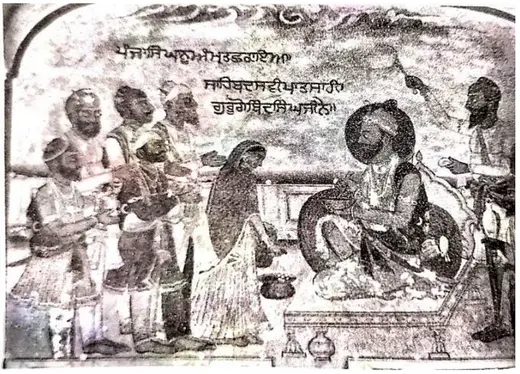
A mid-1800s fresco from the Akal Takht building that stood before 1984. It imagines Sri Guru Gobind Singh Ji and Mata Jito preparing amrit for the Panj Piare. Published by Kanwarjit Singh Kang in 1995.
Unknown, c. mid 19th century. Original Akal Takht building (no longer standing). Public domain. Source
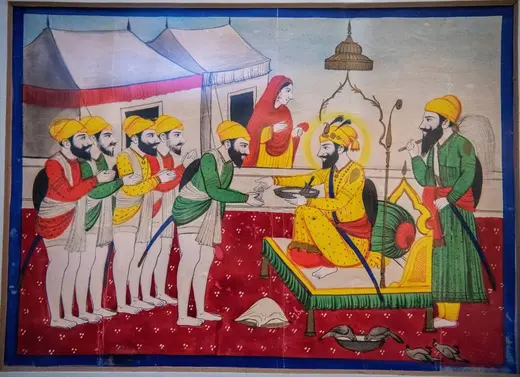
A later artist's imagining of the 1699 Khalsa ceremony at Anandpur. Commons says the attribution to Gian Singh Naqqash comes from his grandson.
Gian Singh Naqqash, Late 19th or early 20th century. Public domain. Source

