Historic gurdwara
Gurdwara Sri Nanak Jhira Sahib
The gurdwara at Bidar around a spring that tradition links to a visit by Sri Guru Nanak Dev Ji. Muslim priests looked after the place until 1948, and the present buildings date from after that.
History
Bidar in Guru Ji's time
The spring, by tradition
As the Encyclopaedia tells it, Guru Ji stayed on the edge of the town beside a monastery of Muslim ascetics. They and their head, Pir Jalal-ud-Din, were drawn by the hymns sung to Bhai Mardana's rebeck. The tract was rocky and without water. Tradition says a spring of clear sweet water rose when Guru Ji lifted a stone at the Pir's request. It is called Amrit Kund, and the place took the name Nanak Jhira.
Kohli and G. S. Randhir add a second divine, Yaqub Ali, and describe people asking for water because their wells were unfit to drink. They say Guru Ji touched the hillside with a wooden sandal or with a toe. The story is presented here as tradition, and no early source for it has been confirmed.[EoS][Kohli][Randhir]
- To 1948
Under Muslim care
- 1948 to 1966
The modern gurdwara
The place became prominent as a pilgrimage centre after control passed to Sikhs in 1948, which a court verdict confirmed in 1950. A managing committee under Sardar Bishan Singh of Hyderabad began building. The main building, called Sri Harmandir Sahib, was finished in 1966, and Sri Guru Granth Sahib Ji was installed in it at Hola Mohalla.
The central building has three storeys, with the divan hall on the first floor around a sanctum about 10 metres square. The spring is now a canopied square pool, which feeds a bathing tank 50 metres away.[EoS]
- Today
Institutions
Later additions include a pilgrim block of 101 rooms, a hospital, a museum, langar and an engineering college, all named after or attached to the gurdwara. The committee draws members from Bidar and from other southern cities and from Bombay. Guru Ji's birthday and Hola Mohalla are the largest gatherings. Randhir says the museum is dedicated to the memory of Sri Guru Tegh Bahadur Ji and shows Sikh history in pictures.[EoS][Randhir]
What the sources disagree on
- When the gurdwara was built
Wikipedia says it was built in 1948. The Encyclopaedia of Sikhism dates Sikh control to 1948 and completion of the main building to 1966.[Web][EoS]
- Wikipedia's attribution to the Janamsakhis
Wikipedia ascribes the story to the Janamsakhis and dates the journey to 1510-1514. The Encyclopaedia introduces the spring only as tradition and gives no year.[Web][EoS]
Images
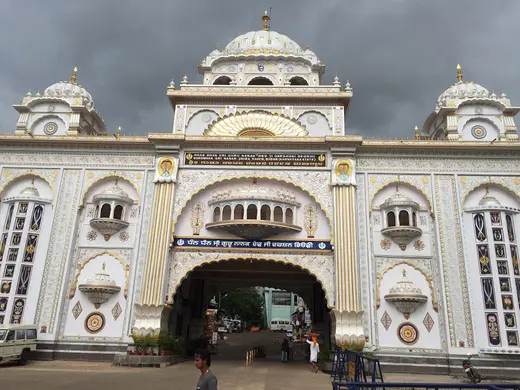
The entrance gate of Gurdwara Sri Nanak Jhira Sahib, Bidar, photographed in July 2017.
Sunnya343, 2017.CC BY-SA 4.0. Source
