Takht
Takht Sri Kesgarh Sahib
The white marble gurdwara on the site of the Kesgarh fort, where the Khalsa was created on Vaisakhi 1699. It is one of the five Takhts.
History
- 1665
Anandpur
Sri Guru Tegh Bahadur Ji founded the settlement on 19 June 1665, on land bought from the hill state of Kahlur, over the mound of an older village called Makhoval. Sri Guru Gobind Singh Ji later ringed it with forts, with Kesgarh at the centre.[EoS]
- 1699
The Khalsa
A great assembly met at the Kesgarh fort on Vaisakhi day, 30 March 1699, when Guru Ji created the Khalsa.[EoS]
- Today
The gurdwara
The Takht stands on a hillock, with rooms for staff and pilgrims on the lower slopes and an 80-metre square sarovar at ground level to the west. Relics in the inner sanctum include a khanda and a dagger. Its Jathedar is an ex-officio member of the Shiromani Committee.[EoS]
Images
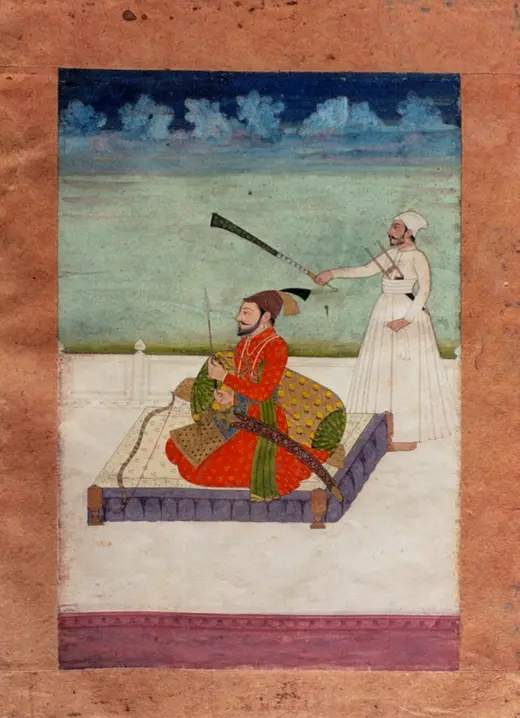
One of two paintings pasted into the Anandpur manuscript, showing Sri Guru Gobind Singh Ji enthroned with an attendant, dated to the 1690s or early 1700s. Mann thinks artists at Anandpur made it. That it is a true likeness is not established.
Unknown painter, 1690s or early 1700s, disputed. Private collection (per Mann, 2008). Public domain. Source
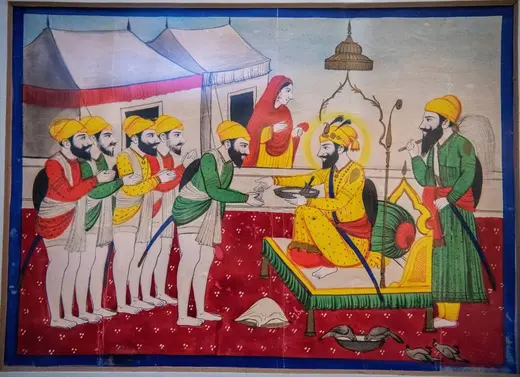
A later artist's imagining of the 1699 Khalsa ceremony at Anandpur. Commons says the attribution to Gian Singh Naqqash comes from his grandson.
Gian Singh Naqqash, Late 19th or early 20th century. Public domain. Source
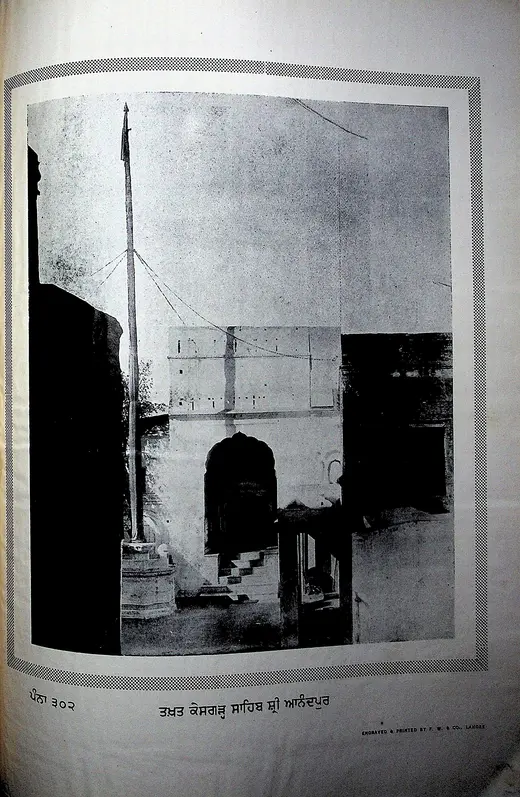
Takht Kesgarh Sahib in its earlier form, printed in the Mahan Kosh of 1930. Commons says this building was replaced from 1938. The Encyclopaedia of Sikhism dates the present complex to 1936-44.
Unknown, c. 1899-1930. Public domain. Source
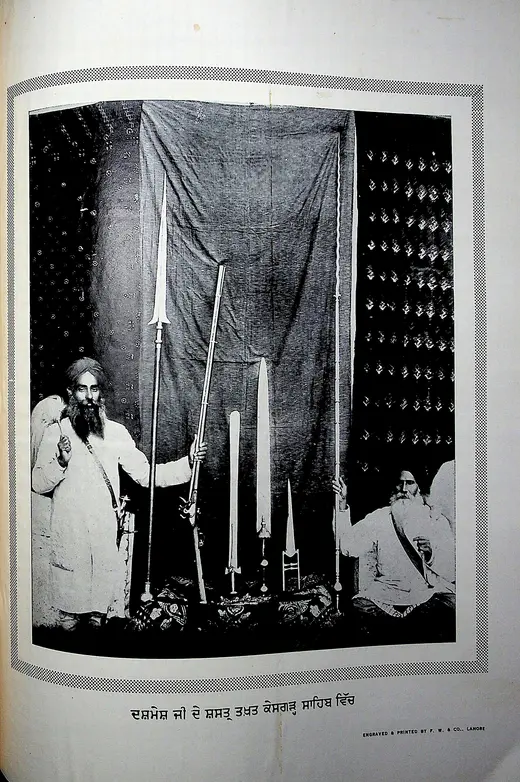
Weapons displayed at Takht Kesgarh Sahib as relics of Sri Guru Gobind Singh Ji, printed in Kahn Singh Nabha's Mahan Kosh of 1930. Commons names them as a spear, a musket, a khanda, a saif, a katar and a nagni.
Kahn Singh Nabha, Before 1930. Takht Kesgarh Sahib. Public domain. Source


