Ruler of the Sikh kingdom of Lahore, 1799-1839
Maharaja Ranjit Singh
Heir to the Sukerchakia misl as a boy, he took Lahore at eighteen, absorbed the other Sikh confederacies, and over forty years built a kingdom from the Khyber to the Sutlej with a European-drilled army, a cabinet of Sikhs, Muslims and Hindus, and a treasury that paid for the gilding of the Harmandir. The state did not survive him by ten years.
Rise
Ranjit Singh was born in 1780 at Gujranwala, the son of Mahan Singh, chief of the Sukerchakia misl, one of the dozen Sikh warbands that had carved up Punjab after the collapse of Mughal and Afghan authority. Smallpox cost him an eye in childhood. His father died in 1792, and under his mother and then his mother-in-law Sada Kaur of the Kanhaiya misl he learned the politics of the confederacies.
In 1799 the Afghan ruler Zaman Shah, retreating from Punjab, confirmed him in possession of Lahore, which he had taken in July with Sada Kaur's help. In 1801 he was proclaimed Maharaja. Amritsar followed in 1802, and over the next two decades he absorbed the misls north of the Sutlej one by one, by marriage, purchase, pressure or force.[EoS][Grewal]
The kingdom
The Treaty of Amritsar with the East India Company in 1809 fixed the Sutlej as his southern boundary and left the cis-Sutlej Sikh states under British protection, so he expanded north and west instead: Multan in 1818, Kashmir in 1819, Peshawar and the Afghan frontier through the 1820s and 1830s, Ladakh in 1834. The army, reorganised with French and Italian officers from 1822, became the strongest native force in India.
He ruled through a council that included the Dogra brothers from Jammu, the Muslim Fakir family of Lahore, and Hindu and Sikh generals and ministers; the kingdom was Sikh in its symbols and its ruling elite but not in its policy towards other communities. He commissioned the marble and gold-leaf facing of the Harmandir at Amritsar that gives the Golden Temple its name, and the Sikh sacred sites received endowments. He kept the title Sarkar Khalsa Ji for the government rather than claiming personal sovereignty.[EoS][EoS][EoS]
Death and aftermath
He died at Lahore in June 1839 after a series of strokes. Four of his widows and seven other women died on his pyre. In the ten years that followed, three of his successors were murdered, the army and the court fought for control, and two wars with the British (1845-46 and 1848-49) ended in the annexation of Punjab in March 1849. His youngest son Duleep Singh was taken to England.[EoS][Grewal]
Images
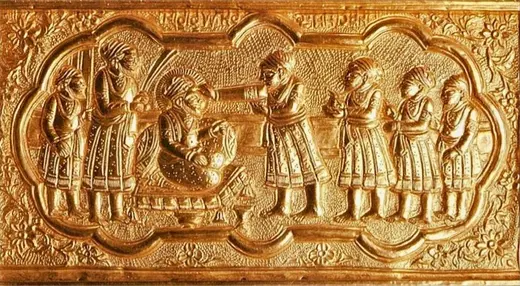
A gilded panel from doors given to the Harmandir Sahib by Maharaja Ranjit Singh, now in the treasury according to Commons. It imagines Baba Buddha anointing Sri Guru Amar Das Ji under Sri Guru Angad Dev Ji's command.
Unknown, c. 1801-1839. Toshakhana, Harmandir Sahib (as stated on Commons). Public domain. Source
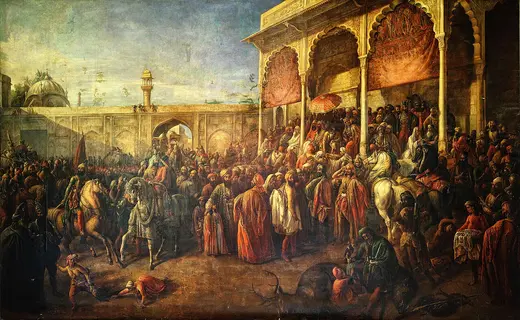
The Court of Lahore by August Schoefft, an oil of about the 1840s to 1855, based on drawings made at Lahore around 1841. Commons places it in the Princess Bamba Collection.
Ágoston Schoefft, c. 1841-1855. Princess Bamba Collection, Lahore Fort (as credited on Commons). Public domain. Source
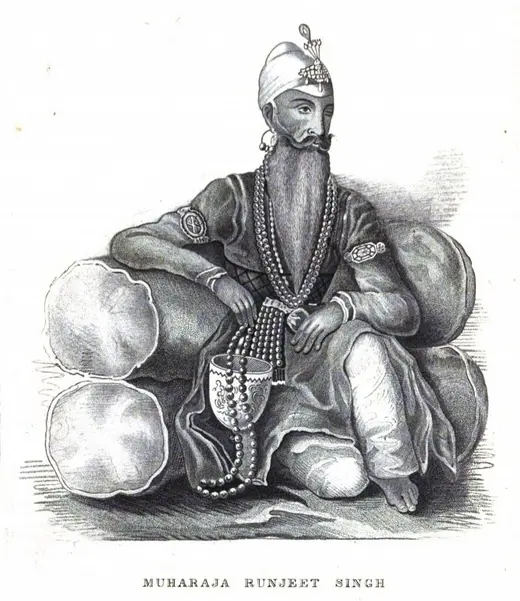
An engraving of Maharaja Ranjit Singh after a portrait attributed to Jivan Ram, from H.T. Prinsep's book of 1834. The file name says he wears the Koh-i-Noor, which was not independently checked.
Kasinath, sculptor, after an original work by Jivan Ram, 1834. Public domain. Source
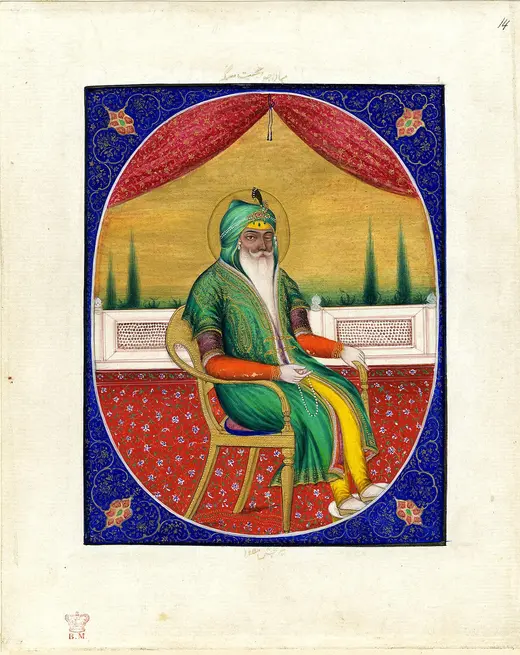
Maharaja Ranjit Singh on a terrace, an album leaf in gouache from about 1830, made during his lifetime and linked from Commons to the British Museum.
Unknown, c. 1830. British Museum, 1920,0917,0.227 (as credited on Commons). Public domain. Source
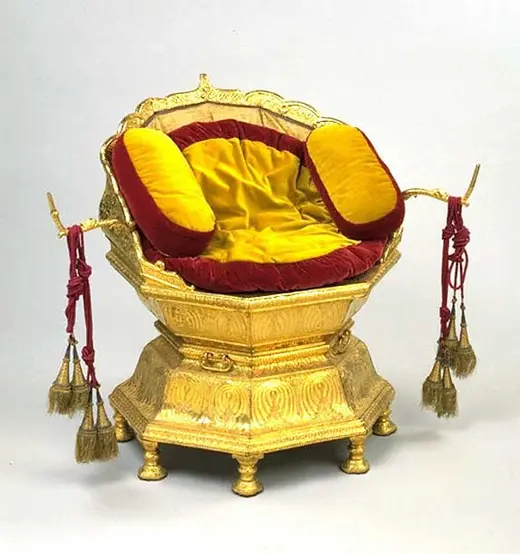
Maharaja Ranjit Singh's throne by Hafez Muhammad Multani, V&A 2518(IS). This older Commons file says about 1820-1830, but the V&A now gives probably 1805-1810.
Hafez Muhammad Multani. Image: VAwebteam, Probably 1805-1810. Victoria and Albert Museum, 2518(IS).CC BY-SA 3.0. Source
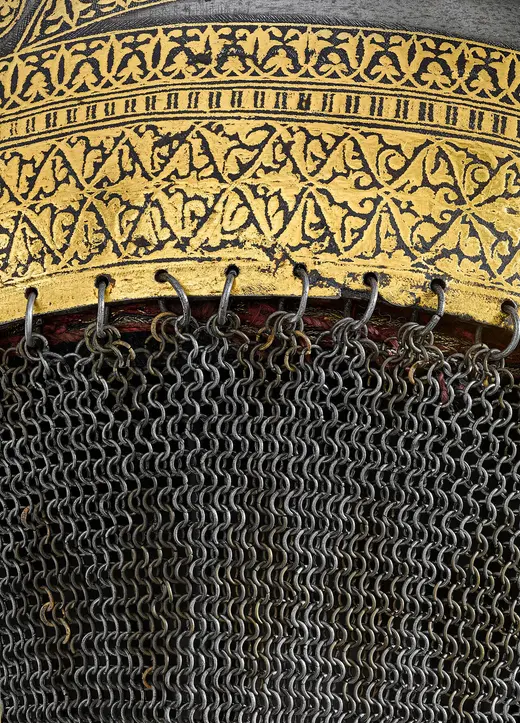
Detail of a Sikh helmet of the early 1800s, shaped to take a turban and topknot, with gold overlay and patterned mail. Royal Armouries XXVIA.138.
Royal Armouries, Early 19th century. Royal Armouries, XXVIA.138.CC BY 2.0. Source
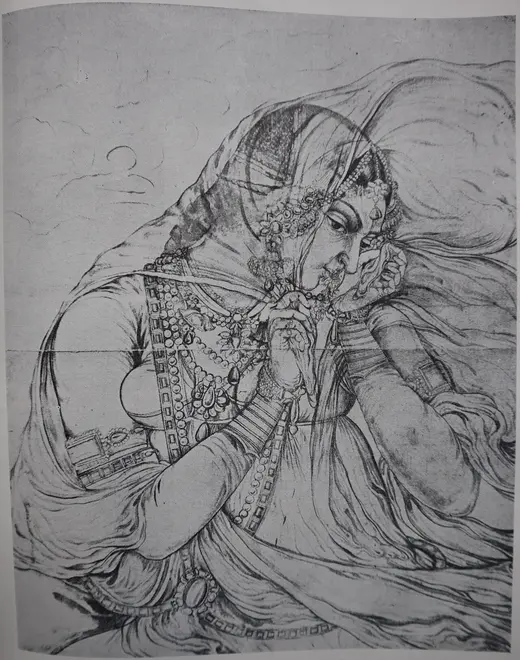
Sardarni Sada Kaur in a sketch credited to Kehar Singh, an artist of Maharaja Ranjit Singh's court. Published in 1983 by R.P. Srivastava from the Central Sikh Museum.
Kehar Singh, court artist of Maharaja Ranjit Singh, 19th century. Central Sikh Museum, Amritsar (as credited on Commons). Public domain. Source


