Historic gurdwara
Gurdwara Janam Asthan
The main gurdwara at Nankana Sahib, commemorating the birthplace of Sri Guru Nanak Dev Ji. It grew from a single room remembered as the house of Guru Ji's father, was rebuilt under Maharaja Ranjit Singh, and in February 1921 became the scene of the Nankana Sahib massacre.
History
- 15 April 1469
The birthplace
Sri Guru Nanak Dev Ji was born in this town, according to the Encyclopaedia of Sikhism, on Vaisakh sudi 3, 1526 Bikrami, or 15 April 1469. The place was then called Talwandi Rai Bhoe, after a retainer of the Delhi rulers of the early fifteenth century. His descendant Rai Bular was the local chief in Guru Ji's lifetime.
Guru Ji spent the first 15 or 16 years of life at Talwandi and then moved to Sultanpur Lodhi, where his sister Bibi Nanaki lived. The Encyclopaedia says he came back to see his parents only from time to time during his travels, and it dates the last visit to 1510. The town is now named after Guru Ji.[EoS]
- 16th century
Kalu ka Kotha
The first building on the site was one room. The Encyclopaedia says Guru Ji's son Baba Lakhmi Das (1497-1555) may have raised it, but thinks his grandson Baba Dharam Chand (1523-1618) the more likely builder. People knew it as Kalu ka Kotha, the house of Mehta Kalu, Guru Ji's father. It was later called Nanakayan, the home of Guru Ji.[EoS]
- Early 19th century
Maharaja Ranjit Singh's building
Maharaja Ranjit Singh put up the present building, urged on by Baba Sahib Singh Bedi and Akali Phula Singh. It has a square domed sanctum and a pavilion in front, on a wide raised platform.
The Maharaja also gave about 20,000 acres of land to support Guru ka Langar. A 1962 survey by Pakistan's Department of Archaeology adds that the gurdwara had been altered and enlarged several times since the Sikh period.[EoS][Khan]
- To 1921
Under the mahants
Udasi priests managed the gurdwara until the violence of 20 February 1921, known as the Nankana Sahib massacre, after which it passed to the Shiromani Gurdwara Parbandhak Committee.
By 1918 Sikhs were petitioning the government to remove the head priest, Mahant Narain Das, after two complaints of the molestation of women pilgrims. A large Sikh gathering at Dharowali protested in October 1920. The Encyclopaedia says the mahant answered by hiring armed men and collecting weapons.
On the morning of 20 February 1921 a jatha of 150 Sikhs entered the gurdwara and was attacked while singing hymns. Its leader, Bhai Lachhman Singh, and Bhai Dalip Singh, who came to plead with the mahant, were among those martyred. The dead and wounded were piled together and burned. Estimates of the number martyred run from 82 to 156.
The government handed the gurdwara to a committee of seven Sikhs led by Sardar Harbans Singh of Atari. A sessions court sentenced Narain Das to death in October 1921, and in March 1922 the High Court reduced this to life imprisonment. The Committee asked Sikhs to wear black turbans in memory of the martyrs, and the black turban became the mark of the Akalis.[EoS][EoS]
- Since 1947
After Partition
After the partition of 1947 most Sikhs left the area and management of gurdwaras in Pakistan passed to the Waqf Board. The Encyclopaedia says Pakistan's government later let 15 Sikhs stay at Nankana Sahib to keep up the daily services, a number cut to 5 in 1968.
Pakistan's government carried out thorough repairs in October 1959. The 1962 survey also records a cloak called Chola Sahib among the relics kept here, embroidered with Quranic verses and said to have been presented to Guru Ji at Baghdad. It is a separate item from the Chola Sahib at Dera Baba Nanak, and its present whereabouts have not been confirmed.
Iqbal Qaisar's survey, published in 1998, found about 50 Sikh families in the town, along with a new two-storey langar hall and a pilgrim inn paid for by Sikhs abroad. He lists memorials inside and beside the compound to the martyrs of 1921. Wikipedia now describes the gurdwara as a protected heritage monument of Punjab, Pakistan, in the care of the Pakistan Sikh Gurdwara Parbandhak Committee.[EoS][Khan][Qaisar][Web]
- Today
The other gurdwaras of the town
Gurdwara Janam Asthan is the first of several sites in Nankana Sahib tied to Guru Ji's childhood. Gurdwara Patti Sahib marks the school, Gurdwara Bal Lila the children's playing field, and Gurdwaras Kiara Sahib and Mal Ji Sahib the stories of the herd and the shading tree told in the Janamsakhis. Gurdwara Tambu Sahib recalls a tradition about the money that Mehta Kalu gave Guru Ji for trade. Gurdwara Chhati Patshahi honours Sri Guru Hargobind Ji, who the Encyclopaedia says came to the town in 1620-21.[EoS]
What the sources disagree on
- The date of birth
The Encyclopaedia of Sikhism gives 15 April 1469, in the month of Vaisakh. The Bala Janamsakhis instead give the full moon of Kartik, more than six months later, which McLeod identifies as the source of the popular Kartik tradition.[EoS][McLeod]
- Who built the first room
The Encyclopaedia names Baba Lakhmi Das or, more probably, Baba Dharam Chand. Wikipedia names only Baba Dharam Chand. Neither gives a contemporary record of the building.[EoS][Web]
- The number martyred in 1921
The Encyclopaedia gives estimates from 82 to 156. Wikipedia gives 86. Qaisar's survey prints the date of the cremation as 20 February 1920, which appears to be an error for 1921; the Encyclopaedia places the cremation on 23 February 1921.[EoS][Web][Qaisar]
Images
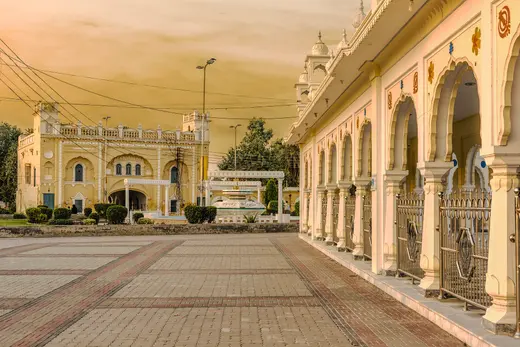
The main entrance of Gurdwara Janam Asthan, Nankana Sahib, photographed in 2016.
Shaguftakarim, 2016.CC BY-SA 4.0. Source
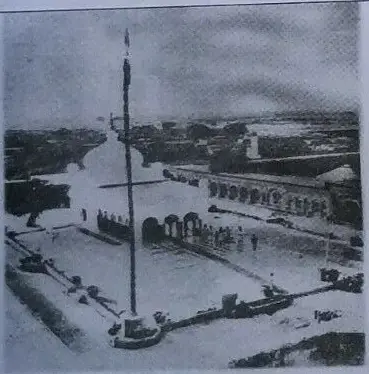
Gurdwara Janam Asthan as printed in Bhai Kahn Singh Nabha's Mahan Kosh of 1930. Commons dates the photograph to about the 1920s.
Published by Kahn Singh Nabha, c. 1920s. Public domain. Source
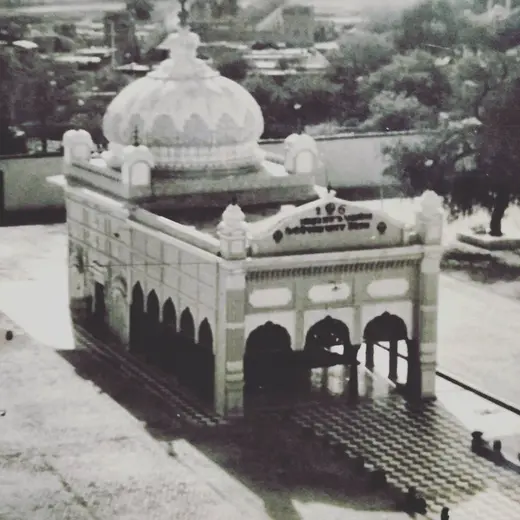
Gurdwara Janam Asthan at Nankana Sahib before Partition. The date is broad and the source is a social media post.
Unknown, Before 1947. Public domain. Source
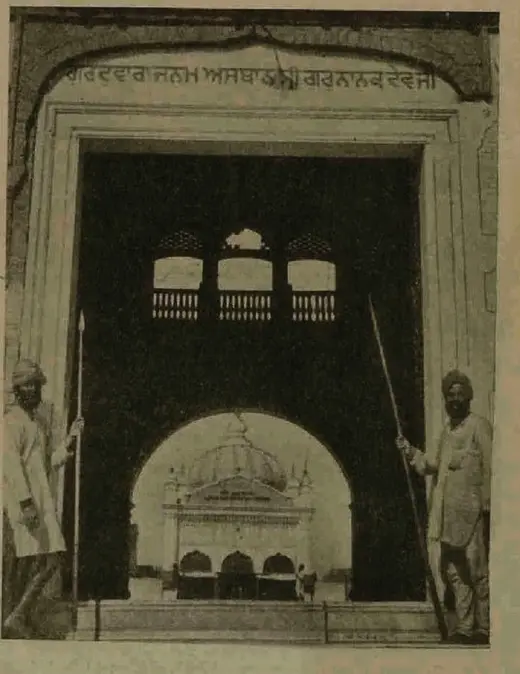
Two Sikh volunteers guarding the gateway of Gurdwara Janam Asthan, Nankana Sahib, in a photograph captioned 'The Last Sikhs of Nankana Sahib, October 1947', from a 1948 report.
Unknown, c. October 1947. Public domain. Source


