Elder son of Sri Guru Nanak Dev Ji, founder of the Udasis
Baba Sri Chand
Sri Guru Nanak Dev Ji's elder son, who chose an ascetic life, founded the Udasi order, and stayed on good terms with the Gurus who succeeded his father.
Early life
Sri Chand was born at Sultanpur Lodhi in 1494, the first son of Sri Guru Nanak Dev Ji and Mata Sulakhni. When his father left on his travels, Mata Sulakhni took both boys to live with her parents at Pakkhoke Randhave, on the Ravi.
He was drawn to solitude from childhood. At eleven he went to Kashmir, where he studied Sanskrit texts and later practised yoga. He rejoined the family once Sri Guru Nanak Dev Ji had settled at Kartarpur, but he kept to an ascetic way of life.[EoS]
Passed over, and what he did next
Sri Guru Nanak Dev Ji chose a disciple, Lehna, as his successor rather than either son. Sri Chand went his own way but did not break with the community. When floods washed away the monument over Sri Guru Nanak Dev Ji's ashes, he recovered the urn and reburied it, and the town of Dera Baba Nanak grew up around that place.[EoS]
The Udasi order
Sri Chand gathered disciples who, like him, rejected household life and practised austerities. They travelled widely as preachers and set up centres across India and beyond, which also spread Sri Guru Nanak Dev Ji's hymns. His own main centre was at Barath, near Pathankot.
Udasi comes from a word meaning indifferent or detached. Some Udasis trace the order back to a far older age, but the Encyclopaedia of Sikhism treats Sri Chand as its historical founder.[EoS][EoS]
Relations with the Gurus
He kept in touch with successive Gurus through a very long life, and they respected him for his descent, his age and his piety. An old chronicle tradition tells of a visit to Sri Guru Ram Das Ji, in which Sri Chand teased him about his long beard. Guru Ji replied that he had grown it to wipe the feet of holy men like him, and Sri Chand then told those present that Sri Guru Ram Das Ji rightly sat in Sri Guru Nanak Dev Ji's place.
In 1626 he broke the ground for the new town of Kiratpur, founded by Baba Gurditta at Sri Guru Hargobind Ji's request. Before he passed away, he chose Gurditta as the next head of the Udasis, with Sri Guru Hargobind Ji's approval. That appointment tied the order to the Gurus' own family.[EoS][EoS][EoS]
What the sources disagree on
- His age at death
The dates in the Encyclopaedia, which follows the Bhatt Vahis for his death, mean he lived to 134. That is an exceptional age for any period, so read it as the recorded tradition rather than a securely established figure.[EoS]
- Where the Udasi order began
Some scholars, and many Udasis themselves, trace the order back to the Puranic age. The Encyclopaedia treats Sri Chand as its historical founder, and this page follows that view.[EoS]
Images
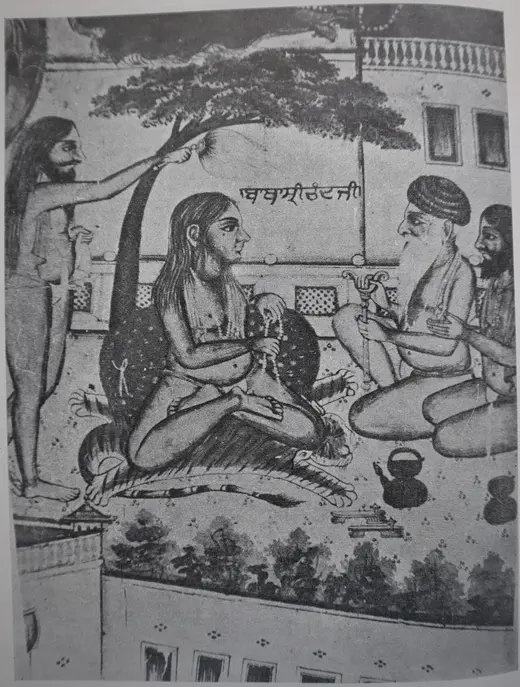
A fresco of Baba Sri Chand with followers at Akhara Bala Nand, Amritsar, an Udasi centre, about the 1870s. Published in 1983 by R.P. Srivastava. An artist's imagining.
Unknown, c. 1870s. Akhara Bala Nand, Amritsar. Public domain. Source

Elder son and founder of the ascetic Udasi order. He never married. He named Baba Gurditta, Sri Guru Hargobind Ji's eldest son, to succeed him as head of the Udasis.