1849 to the present
The Sikh diaspora
Sikhs left Punjab first as soldiers and labourers of the British Empire, then in greater numbers to Britain and North America after 1947. Today there are large communities in Canada, Britain, the United States and elsewhere, shaped by racism, by campaigns for their rights, by the events of 1984 and by their own growing place in public life.
Soldiers and labourers of the empire
1849 to 1914
Wikipedia's account of the diaspora treats the exile of Maharaja Duleep Singh as its symbolic start. After annexation the British recruited Sikhs heavily into the army, which carried them across the empire. Skilled workers went to British East Africa to build railways, and others went to East Asia.
In Malaya, Sikhs founded the Khalsa Diwan on 27 December 1903 at Taiping, in the gurdwara of the Malaya State Guides regiment, and it won recognition for Sikh marriages in 1925. Baba Gurdit Singh's family moved to Taiping after the failed monsoon of 1870. Hong Kong, Shanghai, Manila and Singapore all had Sikh communities that later supported the Ghadar party.[Web][EoS][EoS][EoS][EoS]
North America before 1947
1897 to 1947
The first Sikhs in Canada passed through as soldiers on their way to Queen Victoria's Jubilee in 1897, and the first immigrants settled in British Columbia in 1904. More than 5,000 South Asians, over 90 per cent of them Sikhs, arrived before the ban of 1908. The Khalsa Diwan Society of Vancouver built the first permanent gurdwara in 1908. Sources date the society to 1906, 1907 or 1909.
In the United States, Sikh mill workers at Bellingham, Washington, were driven out by a white mob in 1907, and the first gurdwara opened at Stockton, California, in 1912. Discrimination on the Pacific coast led to the Ghadar party and to the voyage of the Komagata Maru in 1914.
Bhagat Singh Thind, a Sikh who served in the US Army in the First World War, had his citizenship granted and revoked twice in a long legal fight, and was naturalised in 1936. Canadian Sikhs fought for their rights through the Khalsa Diwan Society. Wives and children were admitted from the 1920s, the vote came in 1947, and a 1951 agreement replaced the continuous-journey law with a small quota.[EoS][EoS][EoS][Web]
Britain
1854 to the present
Maharaja Duleep Singh, who arrived in 1854, was the first Sikh to live permanently in Britain. Princess Bamba Duleep Singh, his daughter, later visited Nankana Sahib after the massacre of 1921. A gurdwara opened in London in 1911.
Large settlement came after the Second World War, with Punjabi Sikhs from the Jalandhar Doab going to the Midlands and to Southall in west London. Some had lived first in East Africa, and Sikhs were among those expelled from Uganda in 1972. Sikhs won legal exemptions from British laws on motorcycle helmets and on carrying the kirpan.
The 2021 census of England and Wales counted about 524,000 Sikhs, or 0.9 per cent of the population. Wolverhampton (12 per cent) and Sandwell (11.5 per cent) had the highest shares. Piara Singh Khabra became the first Sikh MP in 1992. Wikipedia's article names Gurharpal Singh and Darshan S. Tatla's Sikhs in Britain (2006) as the main academic history.[Web][DB][EoS][EoS][Web]
Canada and the United States after the 1960s
1960s to the present
Canada's immigration rules stopped favouring Europeans in the 1960s, and tens of thousands of skilled Sikhs settled across the country. The 2021 census counted 771,790 Sikhs in Canada, or 2.1 per cent of the population, up from about 147,400 in 1991. They live mostly in Ontario, British Columbia and Alberta. Differences over tradition have shaped control of gurdwara committees.
Justin Trudeau, as Prime Minister, apologised on 18 May 2016 in the House of Commons for the treatment of the Komagata Maru passengers, after apologies in 2008 from British Columbia and Prime Minister Stephen Harper that many Sikhs thought inadequate.
The US census does not ask about religion, so estimates vary widely. Sikhs there were attacked after the September 2001 attacks, often mistaken for Muslims. Balbir Singh Sodhi, a petrol station owner, was killed on 15 September 2001, and six people were killed at a gurdwara in Oak Creek, Wisconsin, in August 2012.[EoS][DB][EoS][Src][Web]
1984 and the diaspora
1984 to the present
Operation Blue Star and the November killings had a deep effect overseas. Scholars cited in the Wikipedia account, such as Tatla, say grievances in India were amplified among emigrants, and the Khalistan demand drew support overseas.
Air India Flight 182 was destroyed by a bomb on 23 June 1985 off Ireland, killing all 329 aboard, 268 of them Canadian citizens. Inderjit Singh Reyat pleaded guilty to manslaughter in 2003 and is the only person convicted. Canadian police suspected Talwinder Singh Parmar of the Babbar Khalsa, but charges against him were dropped. Ripudaman Singh Malik and Ajaib Singh Bagri were acquitted in 2005. A public inquiry reported on the failures of the Canadian authorities in 2010. Wikipedia's account calls it the worst terrorist attack in Canadian history.
The cause still divides Sikhs and strains relations with India. Hardeep Singh Nijjar, a Canadian Sikh activist for Khalistan whom India accused of terrorism, was shot in Surrey, British Columbia, on 18 June 2023. Prime Minister Trudeau said in September that Canadian agencies were pursuing credible allegations of a link to Indian government agents. India denied this, and both countries expelled diplomats. Canadian police charged three Indian nationals in 2024. In July 2026 the United States charged the jailed gang leader Lawrence Bishnoi and an associate over the killing, and their indictment was reported not to allege any role for the Indian government.[Web][Web][Web][Web][Web][Web]
The present day
2020s
The Canadian Encyclopedia puts the world's Sikhs at about 27 million, with about 2.6 per cent in North America. Canada has the highest share of Sikhs of any country, at 2.1 per cent, with India at 1.7 per cent.
India's 2011 census recorded about 20 million Sikhs, of whom about 16 million lived in Punjab, where they were about 58 per cent of the population. Sizeable communities also live in Malaysia, Australia, Italy and elsewhere, and the figures for several countries are estimates rather than census counts.
Sikhs now sit in several parliaments, and in 2024 eleven sat in the UK House of Commons. Campaigns continue on the turban and kirpan, on hate crime, and on recognition of the events of 1984.[EoS][Web][Web][DB][Web]
What the sources disagree on
- The Sikh population abroad
Census counts exist for Canada (771,790 in 2021) and for England and Wales (about 524,000 in 2021). For other countries, including the United States, Italy and Malaysia, the available figures are estimates that vary widely. The world total is given as more than 25 million by one source and about 27 million by another.[DB][EoS][Web][Web]
- Support for Khalistan overseas
Writers such as Axel and Tatla, as summarised on Wikipedia, argue that diaspora Sikhs kept the demand alive after it weakened in Punjab. Sikh organisations overseas differ widely on the issue, and the Indian government has presented it as a security threat.[Web][Web]
- Who was behind the killing of Hardeep Singh Nijjar
Canada's prime minister alleged a possible link to Indian government agents. India denied it and called Nijjar a terrorist, which he and his supporters rejected. The Canadian case was continuing as of the most recent reports.[Web]
Images
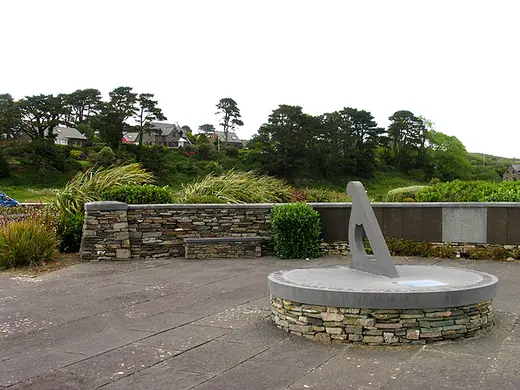
The memorial at Ahakista, County Cork, Ireland, to those killed on Air India Flight 182. Photographed in 2005.
Pam Brophy, 2005-05-28.CC BY-SA 2.0. Source
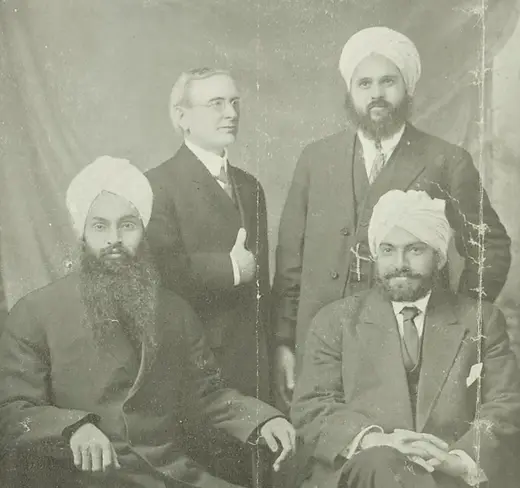
A Canadian Courier article of 1911-1912 titled 'Pleading for their Wives and Children'. Commons gives no further detail, so read the page itself for its content.
Unknown, 1911-1912. Public domain. Source
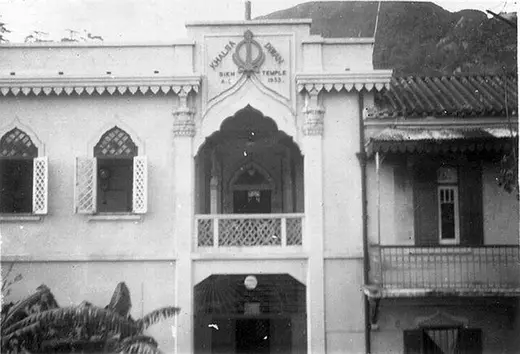
The Khalsa Diwan Sikh Temple in Hong Kong about 1935. Commons says bombing destroyed this building in 1945.
Unknown, c. 1935. Public domain. Source
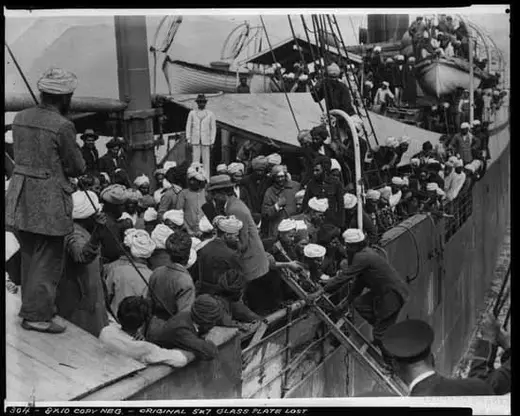
The crowded deck of the Komagata Maru at Vancouver in 1914, with Gurdit Singh in front, photographed by Leonard Frank.
Leonard Frank, 1914. Vancouver Public Library (as credited on Commons). Public domain. Source
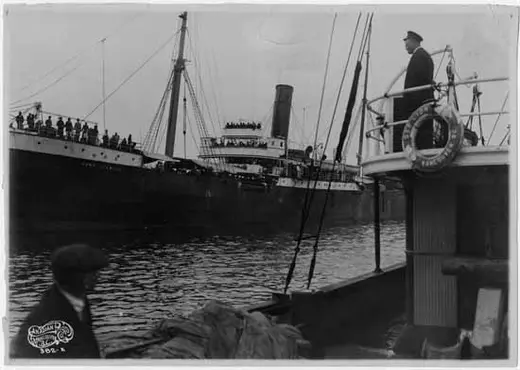
The Komagata Maru seen from the tugboat Sea Lion at Vancouver in 1914, credited on Commons to the Canadian Photo Company.
Canadian Photo Company, 1914. Public domain. Source
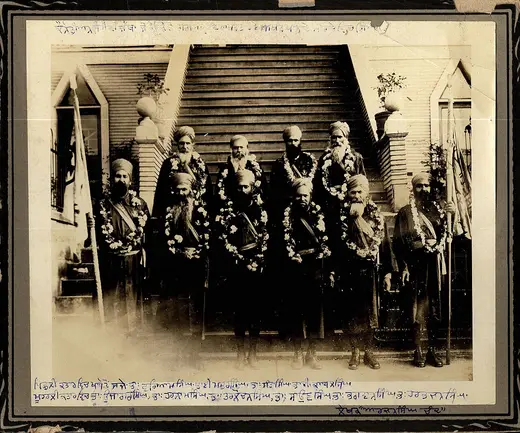
A Shahidi Jatha outside the Second Avenue Gurdwara in Vancouver, about 1924-1925, showing support abroad for the Jaito Morcha.
Unknown, c. 1924-1925. Public domain. Source
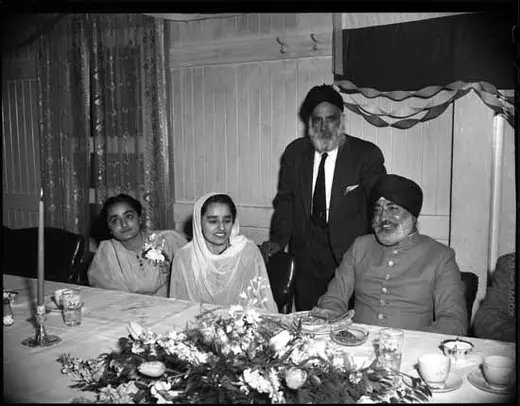
A group of Sikhs at dinner in Vancouver. Undated, and Commons suggests the mid 20th century from its look alone.
Province Newspaper Collection, Undated, perhaps 1940s-1960s. Vancouver Public Library (as credited on Commons). Public domain. Source


