1947 to the present
The Punjabi Suba and 1984
Sikh leaders campaigned for a Punjabi-speaking state until one was formed in 1966. Disputes over the state's powers, waters and territory then ran alongside rising violence, which led to the army's Operation Blue Star in June 1984, the assassination of Indira Gandhi and the killing of thousands of Sikhs that November. Over a decade of insurgency and counterinsurgency followed. Many of these events are contested, and this page gives each side's account with its source.
The Punjabi Suba campaign
1947 to 1966
After partition, Master Tara Singh and the Akali Dal asked for a Punjabi-speaking state. In 1955 the States Reorganisation Commission recommended instead that Punjab absorb Himachal Pradesh and the union of Patiala and the East Punjab States, and a Sikh convention at Amritsar on 16 October 1955 rejected this. A march at Amritsar in February 1956 drew at least 100,000 people by the estimate of the writer Michael Brecher.
Talks produced the Regional Formula of 1956, which split the state into Punjabi and Hindi regions with their own committees. In May 1960 a larger campaign began. Official figures say about 30,000 people went to jail, and Akali figures say 57,129.
Sant Fateh Singh fasted for twenty-two days from 18 December 1960. Master Tara Singh fasted for forty-eight days in 1961 and gave up without winning the demand. A panel of Panj Piare declared he had broken his vow and set him a penance of cleaning shoes and dishes. Sant Fateh Singh set up a rival Akali Dal in 1962 and won the 1965 gurdwara elections.
Sant Fateh Singh planned another fast and self-immolation for September 1965, and put it off when war with Pakistan broke out. Sikh soldiers and border villagers played a prominent part in that war, and on 23 September the government set up committees to consider the demand. Hukam Singh's parliamentary committee backed a Punjabi-speaking state, Indira Gandhi's government accepted this on 23 April 1966, and Punjab and Haryana became separate states on 1 November 1966. The sharing of Chandigarh, river waters and some Punjabi-speaking areas stayed unresolved.[EoS][EoS][EoS][Grewal]
The Green Revolution, in brief
1960s and 1970s
Punjab led India's Green Revolution, in which high-yielding seed varieties were first introduced in the state in 1966-67. Grewal says the policies of Chief Minister Partap Singh Kairon had laid the ground before his fall in 1964, and that consolidation of landholdings was finished in 1969, with better power, irrigation and rural roads.
The gains were uneven. By the 1970s farmers with more than ten acres, about 23 per cent of landholders, worked nearly 65 per cent of the farmland. Poor peasants, who were 57 per cent of landholders, worked about 15 per cent. Many Sikhs left to find work elsewhere: by 1971 more than a fifth of India's Sikhs lived outside Punjab.[Grewal][Web]
From Anandpur Sahib to the Dharam Yudh
1973 to 1983
After heavy election losses in 1971 and 1972, the Akali Dal set up a committee whose programme was adopted at Anandpur Sahib and became known as the Anandpur Sahib Resolution. The text asked for more powers for the state and for Punjabi-speaking areas to join it. It also became the most disputed document in Sikh politics, and the government's White Paper of 1984 itself lists several versions.
On Vaisakhi in 1978 Sikhs marched on a Sant Nirankari convention at Amritsar, and Nirankari guards opened fire. The Encyclopaedia counts thirteen Sikhs killed and seventy-eight wounded. The marchers included followers of Jarnail Singh Bhindranwale, head since 1977 of the Damdami Taksal, and the Akhand Kirtani Jatha. The accused Nirankaris were acquitted on 4 January 1980.
Violence grew from 1981. Lala Jagat Narain, a newspaper owner, was assassinated on 9 September 1981, and Bhindranwale was arrested and then freed for lack of evidence. In 1982 Sant Harchand Singh Longowal's Akali Dal moved its campaign over river waters and other demands to Amritsar as the Dharam Yudh, and Bhindranwale joined it. Talks with Indira Gandhi's government did not reach a settlement.
Grewal counts about sixty violent incidents in 1982 and nearly 140 in 1983, including attacks on police and public figures and the murder of Hindu bus passengers near Dhilwan in October 1983. There was also mob violence against Sikhs in Haryana in February 1984. President's rule began on 6 October 1983, and Bhindranwale moved into the Akal Takht on 15 December, where former Major-General Shahbeg Singh prepared its defences.[EoS][Src][EoS][EoS][Grewal]
Operation Blue Star
June 1984
The government called in the army on 2 June 1984, and on 3 June Punjab was sealed and placed under curfew. Many pilgrims were in the Darbar Sahib complex for the anniversary of the martyrdom of Sri Guru Arjun Dev Ji, which fell on 3 June that year. Human Rights Watch says 41 other gurdwaras were raided at the same time.
Fighting began on 4 June according to Grewal and Human Rights Watch. The main assault came on the night of 5 to 6 June, and tanks were used against the Akal Takht on 6 June. Bhindranwale's body was found at the Akal Takht, in the basement according to the Encyclopaedia and on the ground floor according to the White Paper. The Encyclopaedia says the Akal Takht was destroyed, and Human Rights Watch reports heavy damage across the complex.
The government's White Paper of 10 July 1984 says troops had strict orders to protect the holy buildings, faced heavy fire from fortified positions, and killed no women or children. Grewal writes that many pilgrims, including women and children, were killed in crossfire, that troops shot some young men whose hands were tied, and that some prisoners suffocated. Human Rights Watch says thousands were believed killed, most of them pilgrims.
The attack outraged Sikhs of many political views. Two Congress Sikh MPs resigned, and Sikh soldiers in several places mutinied and marched toward Amritsar. The government rebuilt the Akal Takht with the help of the Nihang Santa Singh, who was excommunicated in July 1984. Sikhs rejected that building, and it was pulled down in early 1986 and raised again by voluntary labour.[Src][EoS][Grewal][Web][EoS][EoS]
November 1984
31 October to November 1984
Indira Gandhi was shot by two of her Sikh guards, Beant Singh and Satwant Singh, on 31 October 1984. Violence against Sikhs started in Delhi that evening. The Nanavati Commission's report says the first attacks came from angry crowds, and that from the morning of 1 November the pattern changed. It describes mobs brought in by bus, supplied with kerosene and an inflammable powder, shown which houses were Sikh, and men beaten and burned alive with tyres around their necks.
The most contested questions are how many were killed and who organised it. The official count and other estimates are set out below. Attacks also took place in Kanpur, Bokaro and other cities.
Three groups gave accounts of responsibility. A joint inquiry by two civil rights bodies, PUCL and PUDR, concluded in November 1984 that attacks were planned, with Congress(I) politicians and officials involved. Human Rights Watch calls them pogroms orchestrated by senior politicians and police officers. The Mishra Commission, reporting in 1986, had found a spontaneous reaction that turned into riots through anti-social elements and police passivity. It ruled out the Congress(I) as a party, while finding that some of its members took part on their own.
The Nanavati Commission reported in 2005 that local leaders and workers of the Congress(I) had incited or helped the mobs, that police were negligent, and that there was no evidence Rajiv Gandhi or other top leaders had organised the attacks. Some critics rejected the report. The activist Uma Chakravarti, quoted by the 1984 Sikh Archive, called it a whodunit without an ending.[Src][Src][Web][Grewal][EoS][Web]
Accord, insurgency and counterinsurgency
1985 to 1995
Rajiv Gandhi and Sant Longowal signed an accord in July 1985. Sant Longowal was shot dead on 20 August at a gurdwara at Sherpur. The Akalis won the September elections and formed a government under Surjit Singh Barnala, but the accord's terms on Chandigarh and water went unfulfilled and his government was dismissed. Punjab was under President's Rule from 1987 until early 1992.
The insurgency claimed thousands of lives. Militants fought for an independent Khalistan and, according to Human Rights Watch, massacred civilians, attacked Hindu minorities, set off bombs and assassinated political leaders. The South Asia Terrorism Portal records 21,677 deaths between 1981 and 2019, nearly all before 1994, with 5,265 in 1991 alone. It counts 11,799 civilians, 1,761 security personnel and 8,117 militants.
The security forces' record is also heavily disputed. Human Rights Watch reports arbitrary detention, torture, extrajudicial killing and enforced disappearance of thousands of Sikhs between 1984 and 1995, under laws such as the Terrorist and Disruptive Activities (Prevention) Act and a system of rewards for police. K. P. S. Gill, Director General of Police in the early 1990s, denied any systematic abuse and called the human rights campaign propaganda, according to Human Rights Watch. Wikipedia's account credits police operations under him with ending the mass killings.
Jaswant Singh Khalra, a human rights activist, used crematoria records to reveal more than 6,000 secret police cremations in a single district. Police abducted him on 6 September 1995 and killed him that October. The government later acknowledged 2,097 illegal cremations in Amritsar, and six officers were convicted of his murder in 2005. Chief Minister Beant Singh was assassinated in 1995, in what is often counted as the last major militant attack of the period.[EoS][EoS][Grewal][Web][DB][Web]
Inquiry, apology and trial
1985 onward
The Ahuja Committee, set up after the Mishra Commission, found in 1988 that 2,733 Sikhs were killed in Delhi. Further committees followed, and the Nanavati Commission, appointed in May 2000, reported in 2005. Human Rights Watch says that no senior politician or police officer named by survivors had been held criminally responsible by 2007, when the Central Bureau of Investigation said it would close its case against some Congress politicians.
In August 2005 Prime Minister Manmohan Singh, the country's first Sikh prime minister, told Parliament that he had no hesitation in apologising to the Sikh community and the nation. His minister Jagdish Tytler, whom the report had named, resigned.
The Delhi High Court overturned a 2013 acquittal in December 2018 and sentenced former Congress MP Sajjan Kumar to life imprisonment for the killing of five relatives in a Sikh family at Raj Nagar. He received a second life sentence in 2025 for the killing of two men at Saraswati Vihar, and was acquitted or discharged in several other cases. He died on 20 August 2026 while serving his sentence.
The name for these events is itself disputed. The Jathedar of the Akal Takht called them a Sikh genocide on 15 July 2010, and the Ontario legislature passed a similar motion in 2017, which the Indian government opposed. Official Indian usage has mostly been riots, though Prime Minister Modi spoke of genocide in 2019.[Src][Web][Web][Web][Web][Web][Web]
What the sources disagree on
- Casualties of Operation Blue Star
The White Paper lists 493 civilians and militants killed and 86 injured in the Golden Temple area, with 83 army dead (4 officers, 4 junior commissioned officers and 75 other ranks) and 249 injured. For all of Punjab it gives 554 civilians and militants killed and 92 army dead. Grewal cites Chand Joshi's estimate of about 700 soldiers and about 5,000 civilians. Human Rights Watch says thousands were believed killed, most of them pilgrims. A Wikipedia summary reports Inderjit Singh Jaijee's citation of human rights estimates of over 10,000, and an army figure of about 700 attributed to a disclosure by Rajiv Gandhi. No independent count exists.[Src][Grewal][Web][Web]
- How the Sikh Reference Library burned
The White Paper says a fire broke out during the fighting and that militant gunfire stopped troops from putting it out. Wikipedia, citing later accounts, says the library was intact on the night of 6 June and that the army burned it around noon on 7 June after removing books. Library staff and the SGPC have asked for the return of the books.[Src][Web]
- Damage to the Harmandir Sahib and the use of force
The White Paper says fire on the Akal Takht began only after heavy army losses, that militants fired from the Harmandir Sahib itself, and that troops showed restraint. The Encyclopaedia says the Akal Takht was destroyed and that shells damaged the treasury on the night of 5 to 6 June. Human Rights Watch describes indiscriminate use of force. Grewal says the action came too late and proved too much.[Src][EoS][EoS][EoS][Web][Grewal]
- Jarnail Singh Bhindranwale
The White Paper presents him as the leader of an extremist and secessionist movement that used the Sri Harmandir Sahib complex as a base for killing. The Encyclopaedia's entry presents him as a religious missionary driven into confrontation by government actions and the Nirankari killings of 1978. Grewal records that he declined any settlement short of the Anandpur Sahib Resolution in June 1984, and that senior Congress ministers had greeted him with respect in 1981. Human Rights Watch notes that many Sikhs angered by the attack did not support the Khalistan campaign.[Src][EoS][Grewal][Web]
- Deaths in November 1984
The Home Minister told the Rajya Sabha 2,146 Sikhs were killed in Delhi and 586 elsewhere. The Ahuja Committee found 2,733 in Delhi, and Human Rights Watch uses at least 2,733 in Delhi alone. An early official figure was 325. The PUCL and PUDR team estimated over 1,000 by mid-November. Sikh bodies told the Nanavati Commission the figure was above 3,000, and it accepted the Ahuja number for lack of firmer evidence. Business Standard wrote of over 4,000 in 2005. Wikipedia reports a later government figure of 3,350 and other estimates of 8,000 to 17,000.[Src][Web][Src][Web][Web]
- Riot, massacre, pogrom or genocide
The Nanavati report says riots and also organised carnage. Human Rights Watch writes of pogroms. Grewal calls them massacres and refers to spontaneous anger as well as Congressmen in the crowds. Reuters writes of anti-Sikh riots. The word used often marks the writer's view of who was responsible.[Src][Web][Grewal][Web]
- The Anandpur Sahib Resolution
Grewal calls it the most controversial resolution in Akali history. The White Paper sets out three versions, from 1973, 1981 and 1982. The Encyclopaedia prints a version naming the Sikhs a nation and asking for an autonomous region within India. Its date is given as Vaisakhi 1973 by Grewal and as 16-17 October 1973 by the White Paper and the Encyclopaedia.[Grewal][Src][EoS]
- Deaths in the insurgency and its suppression
Human Rights Watch says tens of thousands lost their lives. The South Asia Terrorism Portal counts 21,677. Human Rights Watch describes faked encounters and secret cremations that would not appear as such in official counts. Police officials have presented those killed as militants who fell in clashes.[Web][DB]
Images
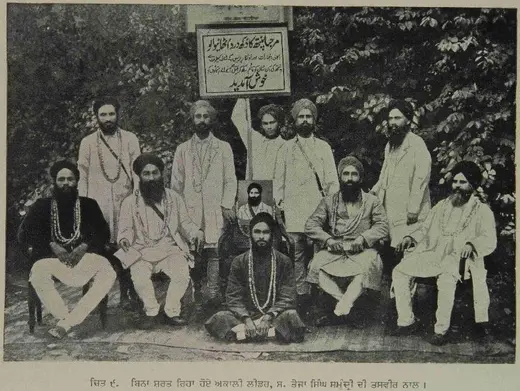
Master Tara Singh with other Akali leaders after release from jail in 1926, with a portrait of Teja Singh Samundri on a chair at the centre.
Unknown, c. September 1926. Public domain. Source
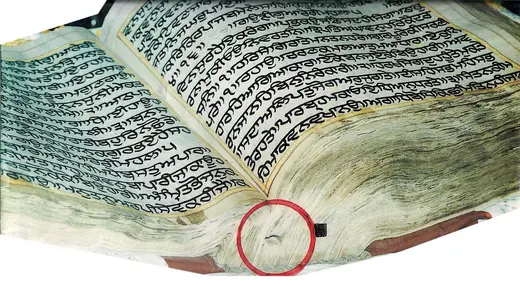
A handwritten copy of Sri Guru Granth Sahib Ji said to have been struck by a bullet in June 1984, during Operation Blue Star. The source is a Flickr post and the claim is not independently confirmed.
Unknown, Photographed after 1984. Public domain. Source
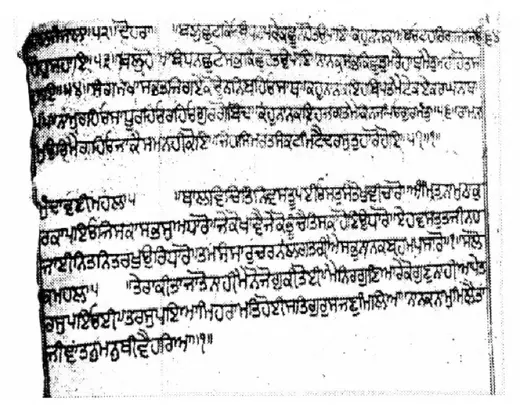
A page from a manuscript said to have been reduced to ashes in June 1984 with the Sikh Reference Library. The claim comes from a website and a 1991 book, and the fate of the collection is disputed.
Unknown, Manuscript undated. Public domain. Source


