1947
Partition
The division of Punjab in August 1947 split the Sikh community in two, left Nankana Sahib and many other gurdwaras in Pakistan, and drove almost every Sikh out of West Punjab amid mass killing. Sikhs rebuilt in East Punjab, and the experience shaped their politics for decades.
Sikh positions before the plan
1940 to 1946
The Muslim League's Pakistan Resolution of March 1940 alarmed Sikhs, who feared life as a permanent minority in a Muslim state. Yet any line that kept the eastern districts out of Pakistan would also divide them. In the undivided province they were about 13 per cent of the population.
The Sikh delegation to the Cabinet Mission in 1946, led by Master Tara Singh, said it wanted a united India. If Pakistan came, Tara Singh said, there should be a separate Sikh state free to join either side. Giani Kartar Singh and Baldev Singh described its boundaries. The Encyclopaedia reports Sikh proposals that population be transferred under government auspices.
The Mission rejected this. Its plan would have kept the province whole inside a Muslim-majority group, so Sikhs turned it down at first. The Akalis were then persuaded to join in, and Baldev Singh became defence minister in the interim government on 2 September 1946.[EoS][EoS][EoS][EoS]
March 1947 and the June plan
March to July 1947
Tara Singh protested at Lahore on 3 March 1947 and shouted against Pakistan. In the rioting that month, Sikhs in the mostly Muslim districts of Rawalpindi and Attock were attacked and many fled. The Encyclopaedia says this convinced many Sikhs they could not live under Muslim rule.
Lord Mountbatten announced the partition plan on 3 June 1947, and Baldev Singh agreed for the Sikhs. Mountbatten told the press on 4 June that he had been astounded to find the plan cut the Sikh community into two nearly equal parts. In the Punjab Assembly the eastern members voted for partition by 50 to 22.
A secret intelligence report said Tara Singh was plotting sabotage and even the killing of Jinnah. Arrests were discussed and rejected on the advice of the governors, who feared they would make matters worse.[EoS][EoS][EoS]
The Radcliffe line
July to August 1947
The Boundary Commission was told to use contiguous majority areas and to take account of other factors. Sikhs had been led to believe that population would not be the only test. The four judges disagreed widely, so the decision fell to the chairman, Sir Cyril Radcliffe, whose award is dated 12 August and was announced on 16 August.
India received two whole divisions, Ambala and Jalandhar, along with Amritsar district, three tahsils of Gurdaspur and four police circles of Kasur. The lines proposed by Justices Mahajan and Teja Singh would have put Nankana Sahib in East Punjab, but neither was adopted.
The Encyclopaedia's entry on the award says Sikhs felt the other factors were a mere sop, and that they had lost holy places and the canal colonies they had developed. Radcliffe himself wrote that his line could not satisfy the deep feelings on either side.[EoS][EoS][EoS]
Killing and migration
August to November 1947
Attacks had been going on for months in Lahore, Amritsar and Gurgaon. After 15 August they grew into mass killing that spread out from central Punjab. The Punjab Boundary Force of over 50,000 men could not hold twelve districts of 14.5 million people, and it was broken up on 31 August.
In about three months, East Punjab was emptied of Muslims and West Punjab of Hindus and Sikhs. Columns of refugees up to 50 miles long moved in opposite directions under attack.
The Encyclopaedia's author, Penderal Moon, reports estimates of 200,000 to 1,000,000 dead and thinks the lower figure closest. He gives about 3.5 million Hindus and Sikhs moving east and about 5 million Muslims moving west. Hindus and Sikhs left behind 6.2 million acres of land, and Muslims 3.96 million. He also says Muslims lost rather more lives, though less property. His account has attacks coming from both sides.[EoS]
Gurdwaras left behind
1947 onward
Of the 241 gurdwaras in Schedule I of the 1925 Act, 65 remained in Pakistan. These included Nankana Sahib, Kartarpur and the Lahore gurdwaras, among them the Shahidganj. In January 1952 the Akal Takht told Sikhs to add a prayer to the ardas asking for access to and care of Nankana Sahib and the other gurdwaras lost to them.
Control later rested with Pakistan's Evacuee Trust Property Board and the Pakistan Sikh Gurdwara Parbandhak Committee. A visa-free corridor for Indian pilgrims to Kartarpur opened in November 2019. India objected in November 2020 when a project unit under the Board was given a role at Kartarpur, and Pakistan answered that the Sikh committee kept its responsibility for rituals.
India restricted travel through the corridor in March 2020 because of Covid-19 and reopened it on 17 November 2021. The agreement behind it, signed on 24 October 2019 for five years, was renewed in October 2024. India closed its side again on 7 May 2025, in the crisis with Pakistan after the Pahalgam attack, and the Indian government says the security situation requires the suspension to continue. Pakistan says its side remains open. The SGPC asked for reopening on 28 March 2026, and the Punjab Vidhan Sabha did so on 27 October 2026. No reopening had been announced as of 5 November 2026.[EoS][EoS][EoS][EoS][Web][Web][Web][Web][Web][Web][Web]
Rebuilding in East Punjab
after 1947
Refugees were resettled on smaller holdings in East Punjab, with cuts to their claims because Muslims had left less land behind. Moon writes that Sikh recovery was the fastest of any community and credits the skill of farmers from the canal colonies.
The migration also created a Sikh majority in several districts near the new border. The entry on Master Tara Singh ties the Punjabi Suba demand directly to this new pattern of settlement. Moon adds that partition was not without benefit to Sikhs in the long run because it gathered them in one state. That is his judgement.[EoS][EoS]
What the sources disagree on
- The number of dead
Estimates begin at 200,000 and reach 1,000,000. The Encyclopaedia's author favours the lower end. This is one writer's opinion rather than a count.[EoS]
- The Sikh leadership's choices
Sikh sources stress that their leaders were caught with no good option. The Encyclopaedia also reports a British intelligence claim about Tara Singh's plans, which it attributes to a secret report without further proof. Mountbatten said the idea of dividing Punjab came mainly from Sikh requests and from Congress, while Sikhs said the promise of other factors misled them.[EoS][EoS]
- Management of Kartarpur
India's foreign ministry said the management of the gurdwara had been passed to a non-Sikh body. Pakistan's foreign ministry called this propaganda and said the unit only assisted the Sikh committee.[Web]
Images
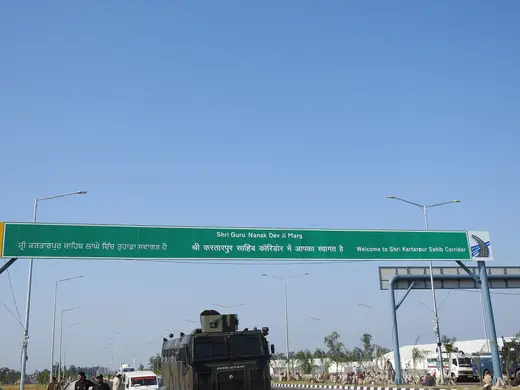
The Kartarpur corridor seen from the Indian side at Dera Baba Nanak on 8 November 2019, the day before it opened.
Harvinder Chandigarh, 2019-11-08.CC BY-SA 4.0. Source
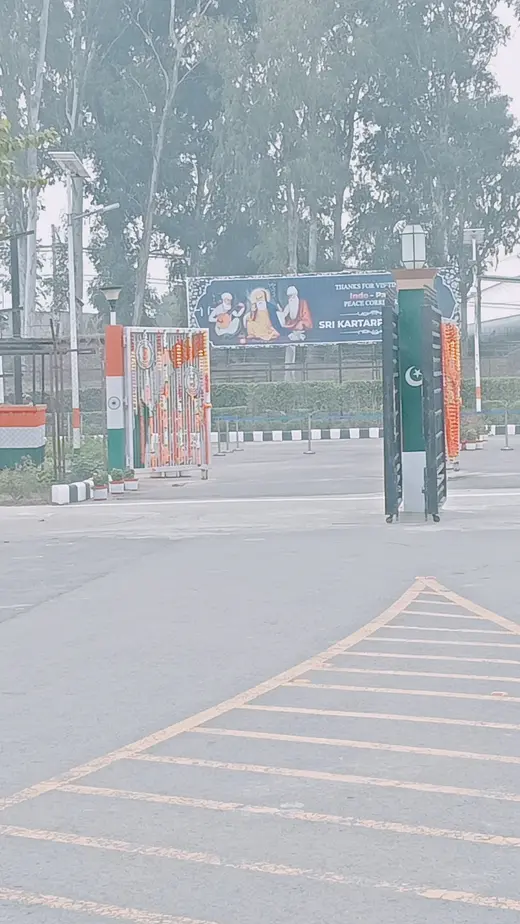
The zero line of the Kartarpur corridor, photographed from the Pakistani side in 2023, before the suspension of 2025.
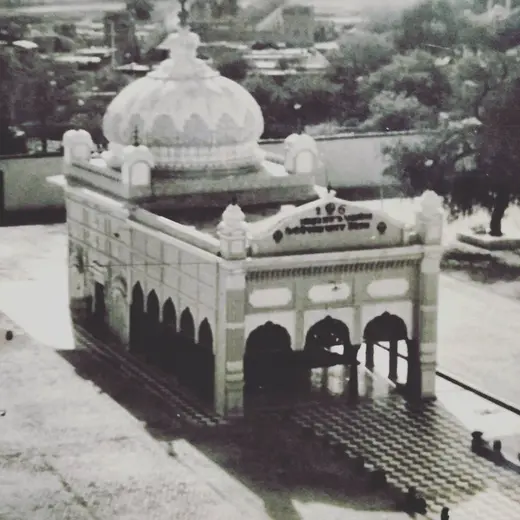
Gurdwara Janam Asthan at Nankana Sahib before Partition. The date is broad and the source is a social media post.
Unknown, Before 1947. Public domain. Source
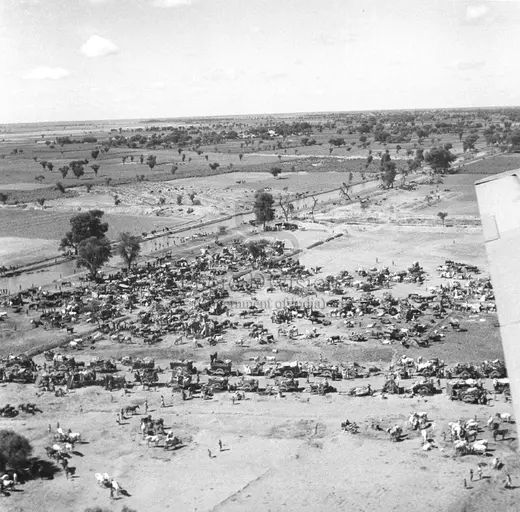
Refugees from West Punjab moving towards India near Baloke Head in September 1947. Credited to the Government of India's Photo Division.
Photo Division, Govt. of India, September 1947. Public domain. Source
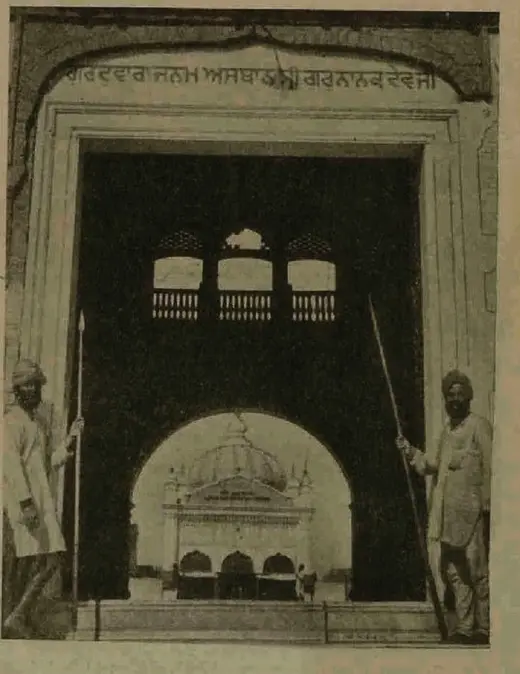
Two Sikh volunteers guarding the gateway of Gurdwara Janam Asthan, Nankana Sahib, in a photograph captioned 'The Last Sikhs of Nankana Sahib, October 1947', from a 1948 report.
Unknown, c. October 1947. Public domain. Source
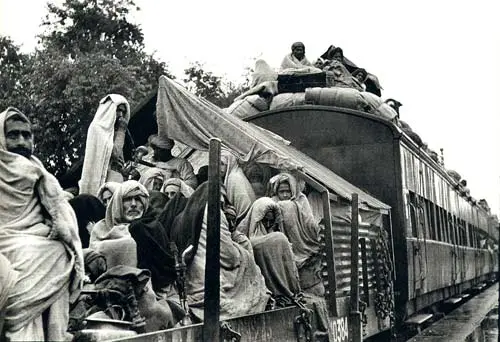
A crowded refugee train in Punjab, 1947. The source is a web page, and the image's history is not documented.
Unknown, 1947. Public domain. Source


