1920 to 1947
Gurdwara reform
Between 1920 and 1925 Akali volunteers took the historic gurdwaras from hereditary custodians and the British-backed managers of the Darbar Sahib, at a heavy cost in lives and imprisonments. The Sikh Gurdwaras Act of 1925 placed the gurdwaras under an elected body. Over the same years Sikh soldiers fought in two world wars, and Sikh politics turned on how to survive in a divided Punjab.
Gurdwaras under mahants and the British
to 1920
During the persecutions of the eighteenth century many gurdwaras passed to Udasis and other hereditary custodians, known as mahants. Maharaja Ranjit Singh endowed them with land and left them in place. After 1849 some treated the gurdwaras and lands as personal property, and Singh Sabha reformers complained about their conduct and about Hindu ceremonial in Sikh gurdwaras.
The Darbar Sahib at Amritsar was run by a manager, the sarbarah, chosen by the British Deputy Commissioner. The Encyclopaedia says idols stood in the precincts and that pilgrims of backward classes were barred from the Harmandir Sahib before nine in the morning.
On 12 October 1920 a meeting at Jallianwala Bagh gave initiation to Sikhs of low caste. Next morning the priests refused their offering at the Harmandir Sahib. A reading from Sri Guru Granth Sahib Ji, taken at random, was held to favour them, and the offering was accepted. The priests then left the Akal Takht and the reformers took it over.
A general assembly met before the Akal Takht on 15 November 1920 and elected a committee of 175, including 36 men named by the government two days earlier. It took the name Shiromani Gurdwara Parbandhak Committee (SGPC). Sundar Singh Majithia became its first president, and a volunteer corps, the Akali Dal, was formed two days after the committee's first session on 12 December.[EoS][EoS][EoS]
Tarn Taran and Nankana Sahib
1921
Many custodians gave way. Where they resisted, violence followed. At Tarn Taran in January 1921 priests attacked a party of reformers invited to talks, and Hazara Singh of Aladinpur and later Hukam Singh of Vasau Kot succumbed to their injuries.
Mahant Narain Das, who held Gurdwara Janam Asthan at the birthplace of Sri Guru Nanak Dev Ji, was the richest custodian and had been the subject of scandals, including the molestation of women pilgrims in 1918. Sikh petitions went unanswered, and he hired armed men.
On the morning of 20 February 1921 a band of about 150 Akalis under Bhai Lachhman Singh entered the gurdwara and were fired upon from a roof. Bhai Lachhman Singh was martyred. He was shot while attending Sri Guru Granth Sahib Ji, then tied to a tree and burnt alive. Bhai Dalip Singh, who came to plead with the mahant, was martyred when the mahant shot him. The dead and wounded were burned on a pyre.
The news shocked the country, and Mahatma Gandhi came on 3 March. Narain Das and seven others received death sentences at the sessions court, and the High Court later cut his sentence to life imprisonment. Black turbans, worn in mourning, became the mark of the Akalis.[EoS][EoS][EoS]
The keys and Guru ka Bagh
1921 to 1922
The Punjab government took the keys of the Harmandir Sahib treasury on 7 November 1921. The SGPC called for protest, and Baba Kharak Singh, its president, was among those jailed. The government handed the keys back wrapped in red cloth in January 1922, and Gandhi telegraphed that the first decisive battle for India's freedom had been won.
At Guru ka Bagh the mahant Sundar Das had signed over the gurdwara but claimed the land was still his. On 9 August 1922 police arrested five Sikhs for cutting firewood for the langar. The SGPC sent a batch of volunteers each day to cut wood and court arrest.
From late August the police beat the volunteers until they lay senseless, and they did not fight back. C. F. Andrews, an English missionary, witnessed this on 12 September and his report reached the press. Sir Edward Maclagan, the Lieutenant-Governor, ordered the beatings stopped the next day. The Encyclopaedia's entry on the Akali movement gives 5,605 Akalis arrested and 936 in hospital by that point, while its entry on Guru ka Bagh gives 5,605 as the SGPC's total to April 1923.[EoS][EoS][EoS][EoS][Grewal]
Jaito and the Babbar Akalis
1923 to 1925
Maharaja Ripudaman Singh of Nabha, who backed the Akalis, was made to sign an abdication on 7 July 1923 and was deposed on 9 July. Police interrupted a continuous reading of Sri Guru Granth Sahib Ji at Jaito on 14 September, which turned a political protest into a question of free worship. Government declared both the SGPC and the Akali Dal unlawful, and all sixty members of the SGPC's interim committee were arrested.
A band of 500 left the Akal Takht on 9 February 1924 and reached Jaito on 21 February. Nabha's administrator ordered fire. The official count was 19 dead and 29 injured, and the Akalis put it much higher. The campaign won the right to worship at Jaito, but the Maharaja was not restored.
Some rejected non-violence altogether. The Babbar Akalis, also spelled Babur, who grew out of anger at Tarn Taran and Nankana Sahib, killed officials and informers from 1922 to 1923. Most were caught, and six were sentenced to death in the trial that began in 1923, including Kishan Singh Gargajj.[EoS][EoS][EoS][EoS]
The Sikh Gurdwaras Act and the SGPC
1925
A first act of 1922 proposed a committee named by government, and Akali leaders refused it. After Sir Malcolm Hailey became governor in May 1924, talks began with the leaders held at Lahore Fort, and a new bill was drafted with their advice.
Tara Singh of Moga moved the bill on 7 May 1925 and Bhai Jodh Singh piloted it. It passed on 7 July and took effect on 1 November 1925. Schedule I listed 241 gurdwaras, to be run by a central board that later took the name Shiromani Gurdwara Parbandhak Committee. Tribunals were set up to settle disputes over other gurdwaras.
Some leaders, including Teja Singh Samundri, who passed away in custody on 17 July 1926, refused to buy their release by promising to work the Act. The Encyclopaedia's summary of the movement gives about 40,000 jailed, 400 dead and 2,000 injured.[EoS][EoS][EoS][EoS]
Sikh soldiers in two world wars
1914 to 1945
The UK government's 2018 statement on a Sikh memorial says Sikhs were two per cent of India's people at the start of the First World War and over 20 per cent of the Indian Army. It also says that across both wars over 83,000 turbaned Sikh soldiers lost their lives and over 100,000 were wounded. The Empire, Faith and War project records Sikh units on the Western and Turkish fronts, in trenches alongside British troops.
Service was not the whole story. Soldiers were among the targets of the Ghadar party in 1915, and Sikh recruitment fell after the clashes of the early 1920s, according to Grewal. In 1940 a Sikh squadron refused to embark at Bombay and other Sikh soldiers refused steel helmets.
The Akali Dal chose to support the Second World War. The Maharaja of Patiala headed a Khalsa Defence League from January 1941, partly from fear of losing more army places, and Baldev Singh joined the Punjab ministry under a pact with Sir Sikandar Hayat Khan in June 1942.
After the fall of Singapore in February 1942, Captain Mohan Singh, a Sikh officer of the 14th Punjab Regiment, raised the Azad Hind Fauj, or Indian National Army, from prisoners of war, with Giani Pritam Singh and Japanese support. By 1 September 1942 about 40,000 had signed the pledge. Sikh prisoners in Europe also joined a legion raised by Subhas Chandra Bose.[Web][Web][Web][EoS][EoS][EoS][Grewal]
Revolutionaries, seats and gurdwaras
1928 to 1945
Bhagat Singh, born in 1907 into a family of nationalists, joined the Hindustan Socialist Republican Association. He took part in the 1928 killing of J. P. Saunders at Lahore and threw a bomb into the Central Assembly. He was hanged on 23 March 1931 and is remembered as Shahid-i-Azam, the greatest of martyrs.
The Communal Award of 16 August 1932 gave Sikhs about 19 per cent of seats in the Punjab legislature and Muslims a fixed majority. The Akalis fought it, and Master Tara Singh, who led both the SGPC and the Akali Dal for most of the years until 1962, became the dominant Sikh politician.
The old building at the Shahidganj site in Lahore, which Muslims claimed as a mosque and the courts had given to the gurdwara, was pulled down in 1935. The dispute ran until 1940 and raised tension between Sikhs and Muslims. The Muslim League passed its Pakistan Resolution at Lahore in March of that year.
The Akali answer was the Azad Punjab scheme of 1943, which aimed to redraw the province so that no community had a majority and Sikhs would hold the balance. Baba Kharak Singh and the Central Akali Dal opposed both Pakistan and Azad Punjab.[EoS][EoS][EoS][EoS][EoS][EoS][EoS]
What the sources disagree on
- Deaths at Nankana Sahib
The entry on the massacre gives estimates between 82 and 156. The SGPC entry says about 200, and the Central Sikh League entry about 150.[EoS][EoS][EoS]
- The return of the keys
The Encyclopaedia dates the surrender of the keys variously to 5 January 1922, 17 January and 19 January.[EoS][EoS][EoS]
- The Babbar Akalis
The Encyclopaedia calls them both a terrorist movement and patriots attached to their faith. They killed British officials and Indians they saw as informers, and the SGPC's leaders held to non-violence.[EoS][EoS]
- Numbers for Sikh war service
Figures vary by source and definition. The UK government gives 83,000 Sikh dead across both wars. A University of Huddersfield news item, quoting a student on the Empire, Faith and War project, says Sikhs grew from 35,000 in the army to some 100,000 volunteers by 1918. The government statement gives no breakdown of its figure.[Web][Web]
Images
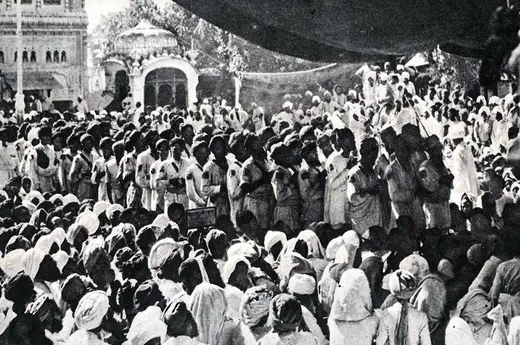
A Shahidi Jatha at the Akal Takht. Commons dates it to August-September 1923, the first months of the Jaito agitation.
Unknown, c. 1923. Public domain. Source
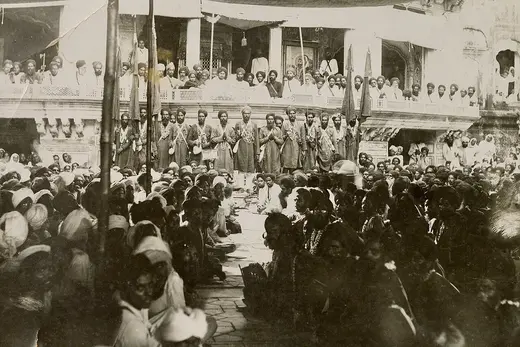
The 12th Shahidi Jatha of the Jaito Morcha at the Akal Takht about 1924, led by Sucha Singh of Moga and Kanwar Singh. A silver print by Sewa Singh and Jawahar Singh.
Sewa Singh and Jawahar Singh, c. 1924. Public domain. Source
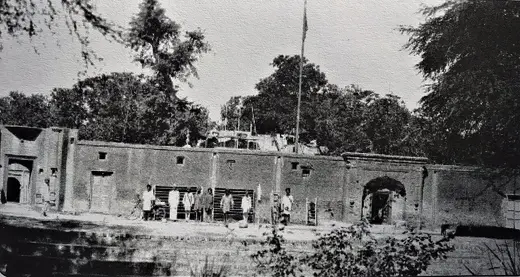
Gurdwara Darbar Sahib, Kartarpur, under construction, photographed by Dhanna Singh Chahal on 6 May 1933.
Dhanna Singh Chahal 'Patialvi', 6 May 1933. Public domain. Source
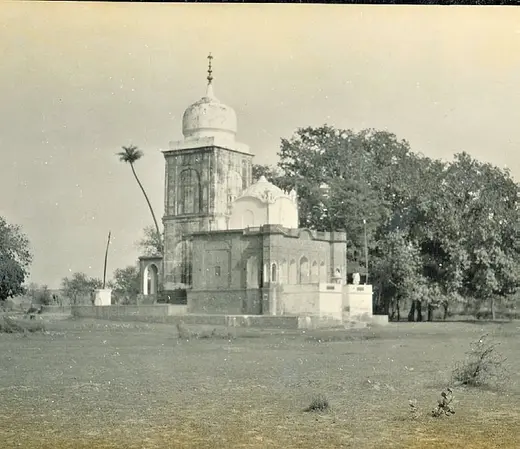
Gurdwara Patalpuri Sahib at Kiratpur Sahib, photographed by Dhanna Singh Chahal in May 1934.
Dhanna Singh Chahal 'Patialvi', May 1934. Public domain. Source
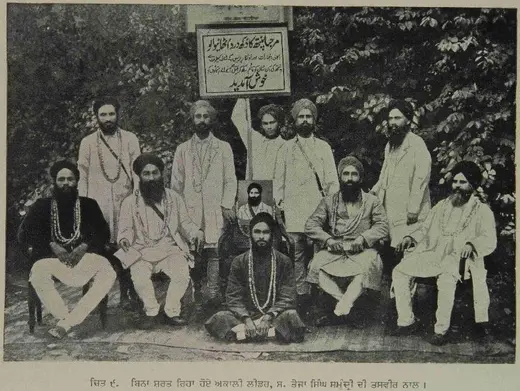
Master Tara Singh with other Akali leaders after release from jail in 1926, with a portrait of Teja Singh Samundri on a chair at the centre.
Unknown, c. September 1926. Public domain. Source
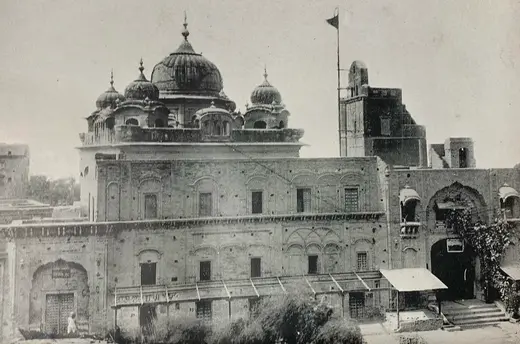
Gurdwara Sri Darbar Sahib at Sri Muktsar Sahib, about 1923-1924. The photographer may have been Kahn Singh Nabha.
Unknown (possibly Kahn Singh Nabha in the 1924 first edition of his magnum opus 'Gur Shabad Ratanakar Mahankosh'), c. 1923-1924. Public domain. Source
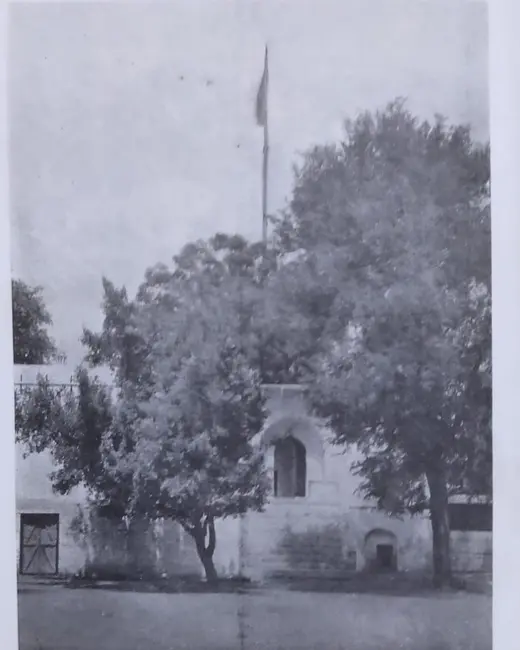
Gurdwara Rakab Ganj Sahib, Delhi, in the 1920s. The Encyclopaedia of Sikhism says the present building was started in 1960.
Unknown, c. 1920s. Public domain. Source
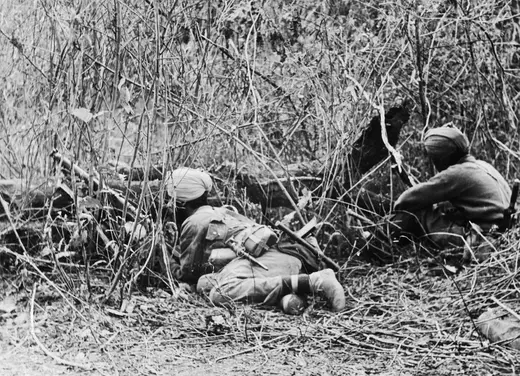
Sikh soldiers of the 7th Indian Division at an observation post in the Ngakyeduak Pass area of Burma, during the fighting that followed the Japanese offensive of 6 February 1944. Taken by No. 9 Army Film and Photographic Unit.
No. 9 Army Film and Photographic Unit, 1944-02. Imperial War Museums, IND 2994. Public domain. Source
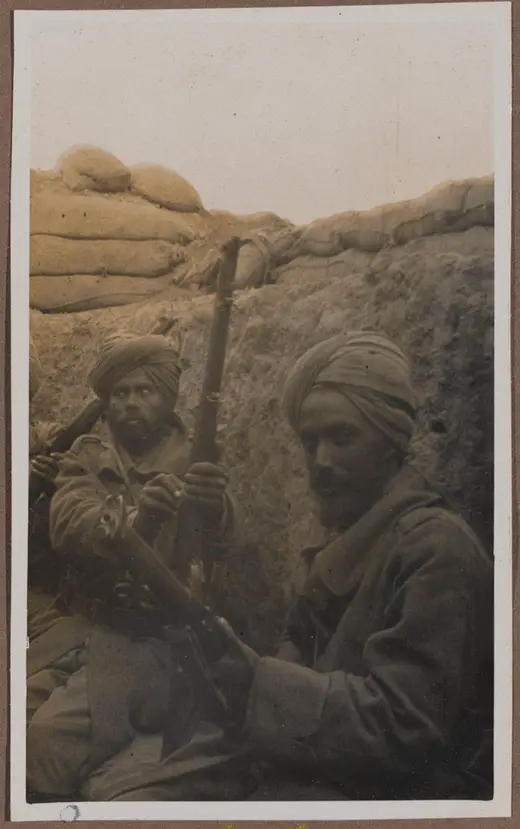
Sikh soldiers of the 29th Indian Infantry Brigade resting in a trench at Gallipoli, probably near Cape Helles, in May 1915.
Unknown photographer, 1915-05-09. National Army Museum.CC0. Source
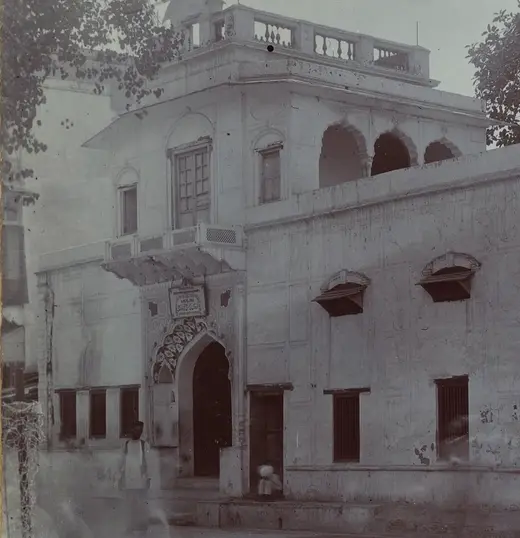
Gurdwara Sis Ganj Sahib on Delhi's Chandni Chowk about 1913-1916, with a tram line in front. The source is a social media post.
Unknown, c. 1913-1916. Public domain. Source
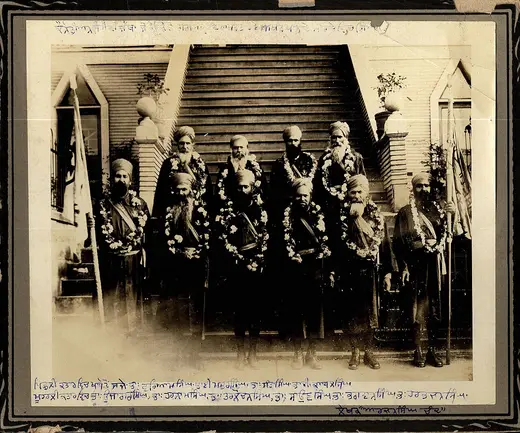
A Shahidi Jatha outside the Second Avenue Gurdwara in Vancouver, about 1924-1925, showing support abroad for the Jaito Morcha.
Unknown, c. 1924-1925. Public domain. Source


