1849 to 1920
Colonial Punjab
Under British rule Sikhs lost their kingdom and, the government expected, their faith. Instead the Namdhari, Nirankari and Singh Sabha movements renewed Sikh religious life, Sikh men filled the Indian Army and went overseas, and the Ghadar rising and the Amritsar massacre of 1919 turned many against the empire.
The kingdom's end and the exiles
1849 to 1863
Maharaja Duleep Singh was placed under Dr John Login and moved to Fatehgarh in 1850. He was baptised a Christian there on 8 March 1853 and sailed for England in April 1854. Maharani Jindan Kaur escaped from Chunar Fort to Nepal, reaching Kathmandu on 29 April 1849, and lived there under British watch until she joined her son in Calcutta and went with him to England. She passed away at Kensington on 1 August 1863.
Bhai Maharaj Singh, a religious leader who had fought at Chillianwala and Gujrat, tried to keep the resistance alive. He was arrested on 28 December 1849 and deported to Singapore, where he passed away in solitary confinement on 5 July 1856.
Akali units were disbanded after annexation. Government reports of 1851-52 and 1855-56 predicted that the Khalsa would fade and that Sikhs would return to Hinduism. Census figures later showed only a few hundred Nihangs left by 1901.[EoS][EoS][EoS][EoS][EoS]
Nirankaris and Namdharis
1850s to 1885
Baba Dayal, born at Peshawar in 1783, preached at Rawalpindi against image worship and ceremonial, and married by the anand rite in 1808. His followers became the Nirankaris, after his teaching of Nirankar, the Formless One.
Baba Balak Singh of Hazro taught a simple devotional life. Baba Ram Singh, who met him while serving in the Sikh army, left the service after the first Anglo-Sikh war and set up his centre at Bhaini. On Vaisakhi in 1857 he laid down a code for his followers, the Namdharis, also called Kukas from their ecstatic cries.
The Namdharis forbade meat, liquor and tomb worship, forbade female infanticide and dowry, and refused British schools, courts and goods in favour of homespun cloth. They ran their own postal service under twenty-two appointed subas. The government kept Baba Ram Singh confined to his village for some years from 1863.
Namdharis killed butchers at Amritsar and Raikot in 1871 over beef shops. On 15 January 1872 over a hundred of them attacked the treasury at Malerkotla. Sixty-eight were blown from guns on 17 January without trial, and Baba Ram Singh was exiled to Burma, where he passed away on 29 November 1885.[EoS][EoS][EoS]
The Singh Sabha movement
1873 to 1909
Two events in 1873 set the movement going. Four Sikh pupils at the Amritsar Mission School announced they would become Christians, and Pandit Shardha Ram spoke disrespectfully of the Gurus at Amritsar. Thakur Singh Sandhanwalia, Baba Khem Singh Bedi, Kanwar Bikrama Singh and Giani Gian Singh called a meeting on 30 July, and the Sri Guru Singh Sabha held its first formal session before the Akal Takht on 1 October 1873.
Its aims were to teach Sikh religion, publish Punjabi books and reform Sikh practice. A more radical Sabha followed at Lahore on 2 November 1879, led by Bhai Gurmukh Singh and joined by Giani Ditt Singh. The Amritsar leaders kept closer ties with Hindu practice and the Bedi and Sodhi families, while the Lahore group saw Sikhs as a separate faith with no caste privilege.
The argument centred on whether Sikhs were Hindus. Bhai Kahn Singh Nabha published Ham Hindu Nahin in 1898. Khalsa College, Amritsar, had its foundation laid on 5 March 1892, and the Chief Khalsa Diwan was set up on 30 October 1902.
Bhai Vir Singh founded the Khalsa Tract Society in 1894 and the weekly Khalsa Samachar in 1899, and through his novels and poems helped create modern Punjabi literature. The Anand Marriage Act of 1909 gave legal standing to the Sikh wedding rite.[EoS][EoS][EoS][EoS][EoS]
Duleep Singh's return
1884 to 1893
In England the Maharaja lived at Elveden in a grand style and ran into debt. He pressed the India Office over his family's private property, and in 1884 Thakur Singh Sandhanwalia came to read Sri Guru Granth Sahib Ji with him and to bring prophecies of his restoration.
He sailed for India on 31 March 1886 and was stopped at Aden, where he took the Sikh vows on 25 May. Rumours in the Punjab said he would come with a Russian army. Thakur Singh ran his cause from Pondicherry until he passed away on 18 August 1887, and the Maharaja went to Russia that year without result.
After a stroke he passed away in a Paris hotel on 22 October 1893. He was buried at Elveden.[EoS][EoS]
Soldiers and emigrants
1870s to 1914
Sikh men became a large part of the British Indian Army and travelled the empire with it. At Saragarhi on 12 September 1897, a garrison of the 36th Sikhs held a signal post for six hours against thousands of Orakzai and Afridi tribesmen, and none survived. Sources count between 21 and 22 men, and the Encyclopaedia includes one non-combatant sweeper.
Shrinking farms drove men abroad as well, first to East Asia and then to North America. Malaya had a Khalsa Diwan from 27 December 1903. Some 5,000 Indians, most of them Sikhs, had reached Canada by 1908, and the Canadian government responded with the continuous-journey rule and a higher landing fee.[EoS][EoS][EoS][EoS][Web][Web][Web]
Ghadar and the Komagata Maru
1912 to 1916
Faced with racism on the Pacific coast, Indian workers formed the Hindustani Association of the Pacific Coast with Sohan Singh Bhakna as president and Lala Har Dayal as secretary. Its weekly Ghadar, meaning revolt, first appeared in November 1913, and the movement took its name. Most of its members were Sikhs, and its aim was armed revolution in India.
In 1914 Baba Gurdit Singh chartered the Japanese ship Komagata Maru, renamed Guru Nanak Jahaz, to test the Canadian ban. It reached Vancouver on 23 May with 376 Indians aboard, and only a few were allowed to land. Sent back after two months, it reached Budge Budge near Calcutta on 29 September, where a clash with troops and police left about twenty dead.
Thousands of Ghadarites came home once war broke out. Their rising, moved up to 19 February 1915, was given away by the informer Kirpal Singh. The Lahore conspiracy trials sentenced 42 of 291 accused to death, among them Kartar Singh Sarabha, and 114 to transportation for life. Soldiers at Singapore mutinied in February 1915, and that revolt was also crushed.[EoS][EoS][EoS][EoS][EoS][Grewal]
Rakab Ganj and Jallianwala Bagh
1913 to 1920
In May 1913 the government pulled down a wall of Gurdwara Rakab Ganj in Delhi to tidy the setting of the new capital. Sikh protest ran through the war years, and in 1920 a band of volunteers set out to rebuild it, but the government rebuilt the wall itself.
In April 1919 protests against the Rowlatt Act reached Amritsar. The governor, Sir Michael O'Dwyer, had two local leaders deported on 10 April, and troops fired on the crowd that marched in protest. Rioters then killed five Europeans. Brigadier-General Dyer banned all meetings on 12 April.
On Vaisakhi, 13 April, people gathered in Jallianwala Bagh, among them many Sikhs in the city for the festival. Dyer arrived at about 5.15 pm and, without warning, had his men fire 1,650 rounds into the crowd. The official count was 379 dead and 1,200 wounded. Pandit Madan Mohan Malaviya's inquiries gave more than 1,000 dead.
The Hunter Committee faulted Dyer, who was removed and retired early. When the priests of the Darbar Sahib honoured him, the anger of Sikhs fed the demand to take back the gurdwaras. Udham Singh, a Sikh orphan who was at the Bagh that day, shot O'Dwyer in London on 13 March 1940 and was hanged on 31 July.[EoS][EoS][EoS][Grewal]
What the sources disagree on
- The founding of the Ghadar party
The Encyclopaedia's Ghadar entry says the association was formed at Portland in 1912 and the party in May 1913. The entry on Sohan Singh Bhakna places the founding at Stockton in summer 1913.[EoS][EoS]
- Deaths at Budge Budge
The Komagata Maru entry says nineteen Sikhs and four police and officers were killed, while the entry on Baba Gurdit Singh and J. S. Grewal say eighteen.[EoS][EoS][Grewal]
- Deaths at Jallianwala Bagh
Dyer estimated 200 to 300, the official figure was 379 killed, and Pandit Malaviya's inquiries put it above 1,000.[EoS]
- How Namdharis should be described
The Encyclopaedia describes them both as religious reformers and as an early form of nationalism. Grewal adds that their belief in a living Guru could not fit the Singh Sabha's view of the Granth and the Panth.[EoS][EoS][Grewal]
Images
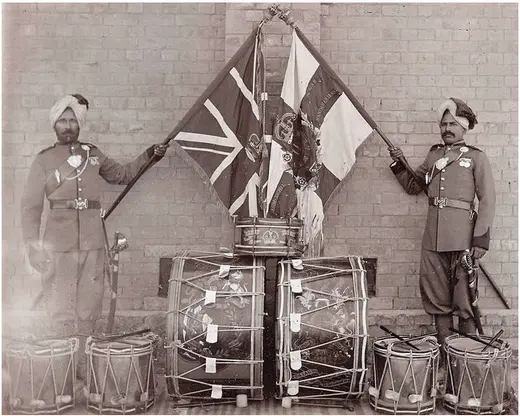
Soldiers of the 52nd Sikhs at Kohat in 1905, from a web collection of old Indian photographs.
Unknown, 1905. Public domain. Source
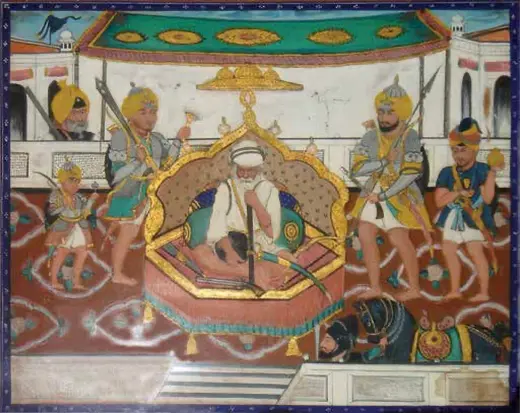
Bhai Maharaj Singh holding court, in a 19th-century painting reproduced in a Singapore Sikh publication. Its exact date and maker are not known.
Unknown, 19th century. Public domain. Source
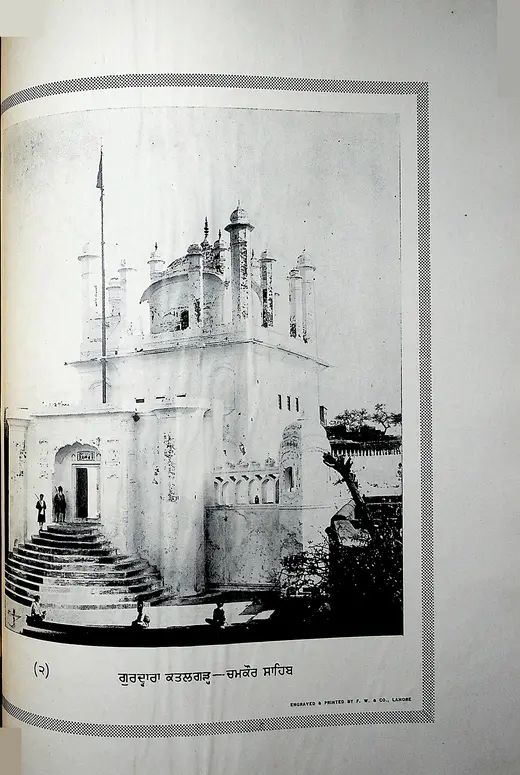
Gurdwara Katalgarh Sahib at Chamkaur Sahib, printed in the Mahan Kosh of 1930.
Kahn Singh Nabha (publisher), Before 1930. Public domain. Source
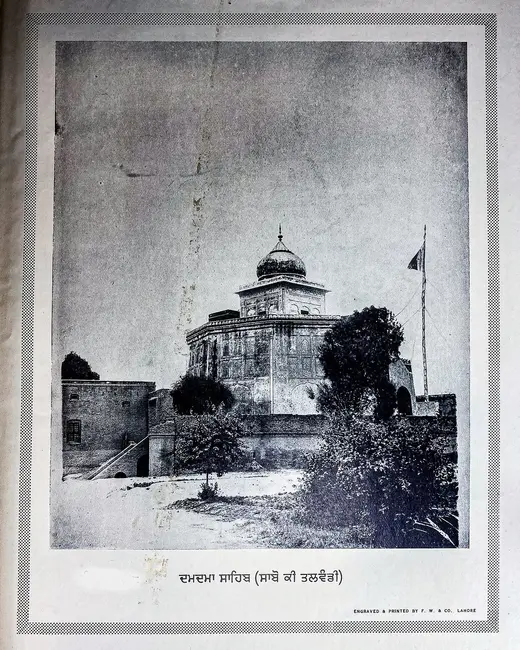
Damdama Sahib at Talwandi Sabo in the 1920s, photographed for Kahn Singh Nabha's Mahan Kosh of 1930.
Photographed by Kahn Singh Nabha, engraved and printed by F.W. & Co., Lahore., c. 1920s. Public domain. Source
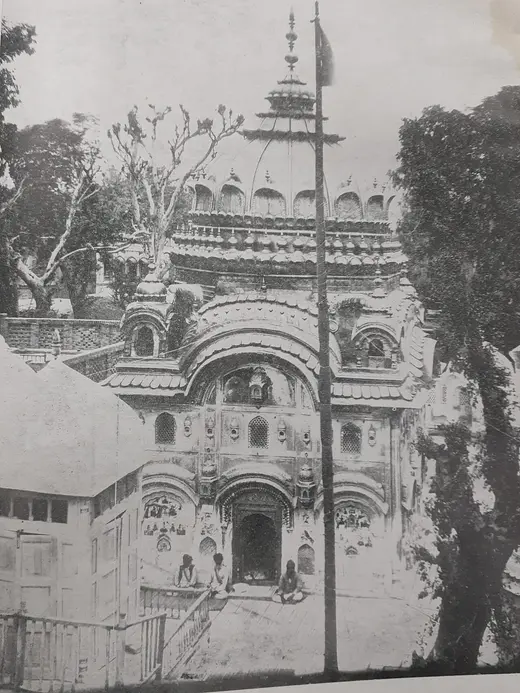
Gurdwara Dera Baba Nanak, printed in the Mahan Kosh of 1930. Commons says the photograph probably dates from the 1920s.
Kahn Singh Nabha, c. 1920s. Public domain. Source
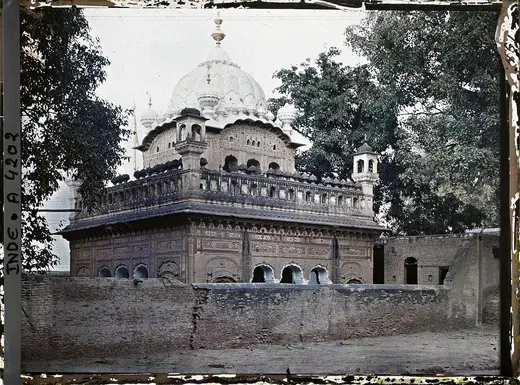
An autochrome by Stéphane Passet from 1914, labelled a Sikh temple in Lahore. Commons identifies it as Gurdwara Dera Sahib and rejects a rival identification as Gurdwara Bhai Banno at Mangat.
Stéphane Passet, c. 1914. Albert-Kahn collections (as credited on Commons). Public domain. Source
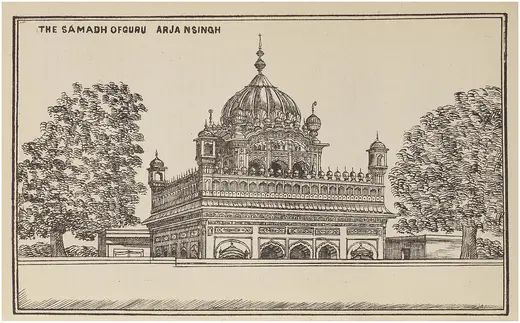
Gurdwara Dera Sahib, Lahore, marked as the samadh of Sri Guru Arjun Dev Ji. From Syad Muhammad Latif's book on Lahore, 1892.
Syad Muhammad Latif, 1892. Public domain. Source
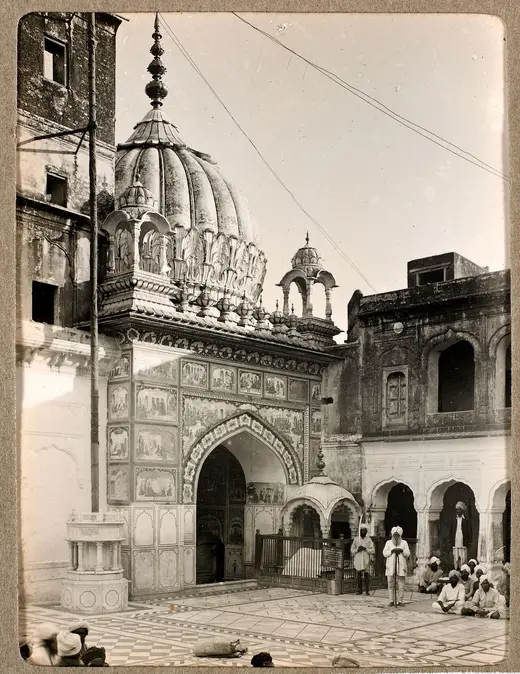
The Baoli Sahib at Goindwal, photographed by Aurel Stein in 1931. Commons links to British Library Photo 392/37/(11).
Aurel Stein, c. 1931. British Library, Photo 392/37/(11) (as credited on Commons). Public domain. Source
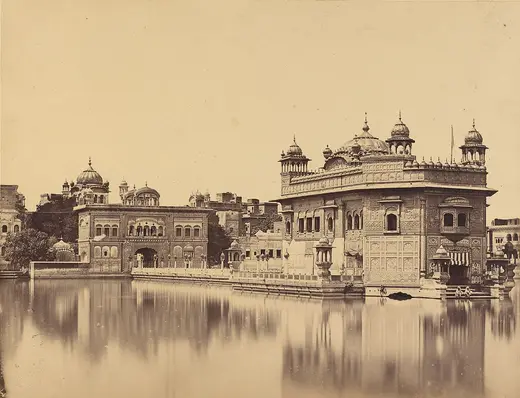
The Harmandir Sahib photographed by Felice Beato in 1858-1859, one of the earliest photographs of the gurdwara in this set.
Felice Beato, 1858-1859. J. Paul Getty Museum, 2007.26.209.9.CC0. Source
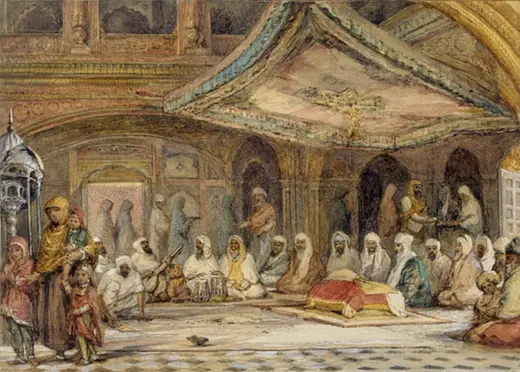
The interior of the Harmandir Sahib painted by William Carpenter, shown with a date of 1854 in the file name. Commons credits the V&A but gives no accession number.
William Carpenter (painter), c. 1854. Victoria and Albert Museum (as credited on Commons). Public domain. Source
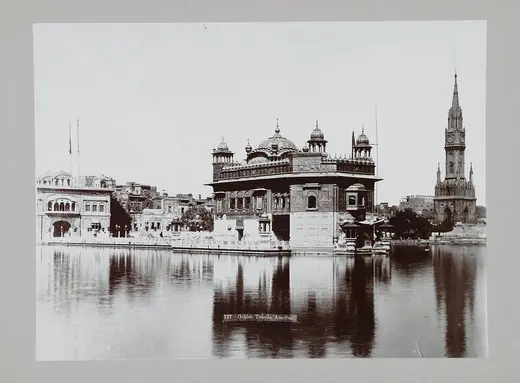
The Harmandir Sahib photographed by an unknown photographer around the turn of the 20th century.
Unknown photographer, c. 1895-1915. Rijksmuseum, RP-F-00-5347-19.CC0. Source
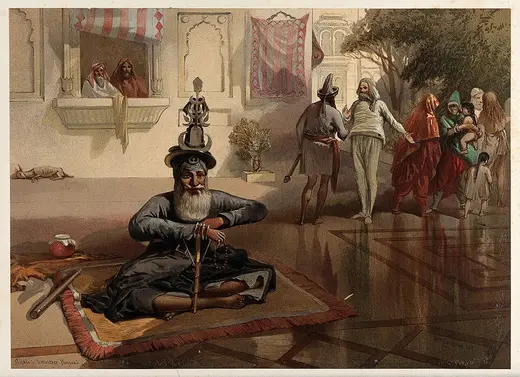
Akalis at the sacred pool in Amritsar, a chromolithograph after William Simpson. Commons gives both 1864 and about 1867.
William Simpson, c. 1864-1867. Wellcome Collection, 30292i. Public domain. Source
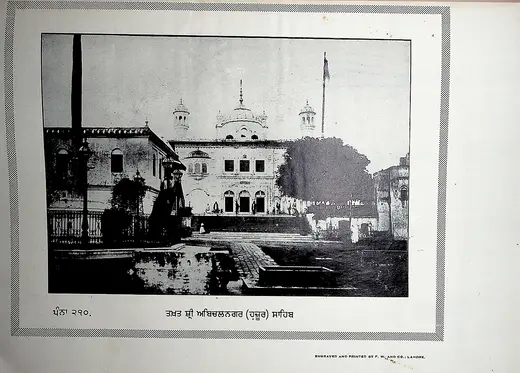
Takht Hazur Sahib at Nanded, given on Commons as about 1880 and printed in the Mahan Kosh of 1930.
Unknown, c. 1880, approximate. Public domain. Source
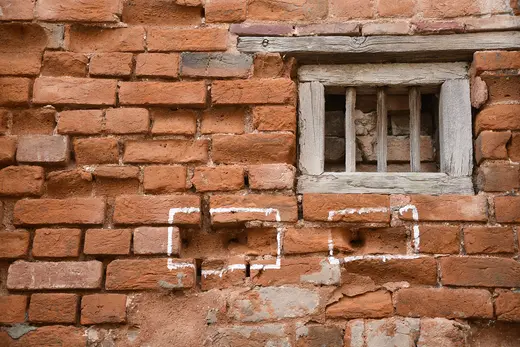
Marks in a wall at Jallianwala Bagh, preserved as bullet holes from the firing of 13 April 1919. Photographed in 2019.
Shagil Kannur, 2019-10-05.CC BY-SA 4.0. Source
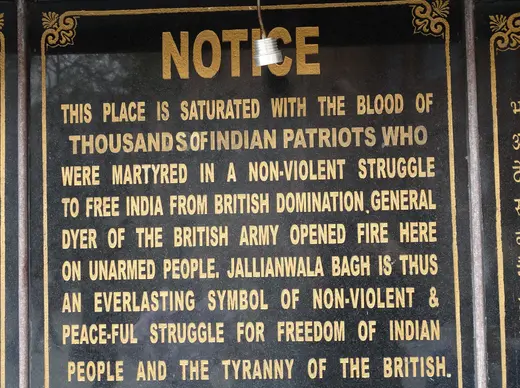
A plaque at Jallianwala Bagh commemorating the massacre of 1919. Photographed in 2014.
Adam Jones, 2014-02-21.CC BY-SA 2.0. Source
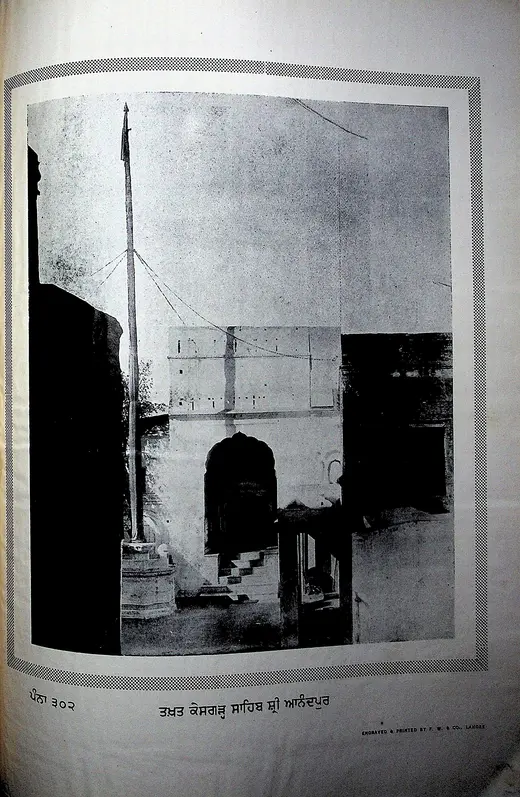
Takht Kesgarh Sahib in its earlier form, printed in the Mahan Kosh of 1930. Commons says this building was replaced from 1938. The Encyclopaedia of Sikhism dates the present complex to 1936-44.
Unknown, c. 1899-1930. Public domain. Source
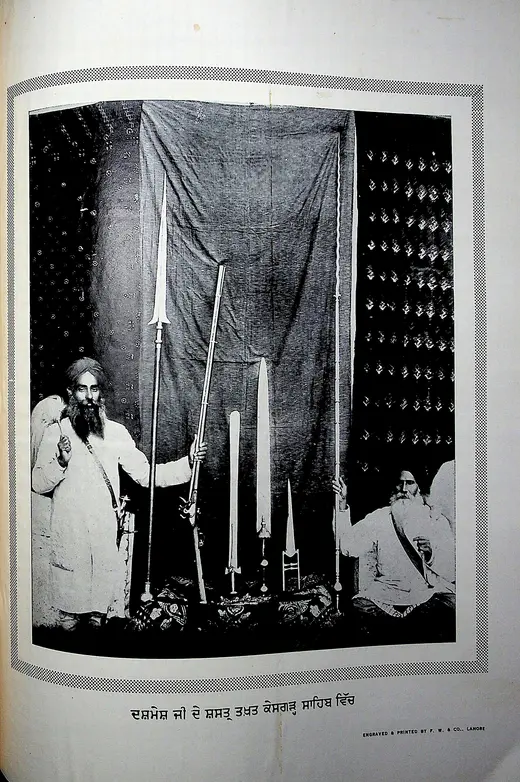
Weapons displayed at Takht Kesgarh Sahib as relics of Sri Guru Gobind Singh Ji, printed in Kahn Singh Nabha's Mahan Kosh of 1930. Commons names them as a spear, a musket, a khanda, a saif, a katar and a nagni.
Kahn Singh Nabha, Before 1930. Takht Kesgarh Sahib. Public domain. Source
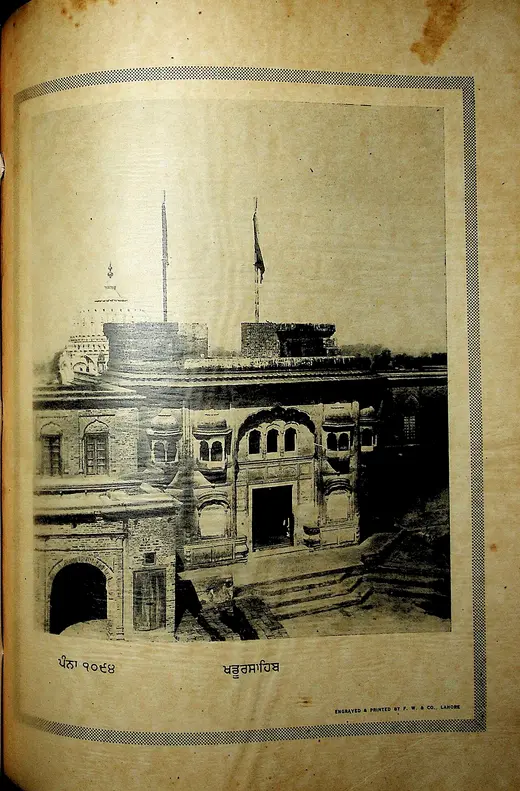
Gurdwara Sri Darbar Sahib at Khadur Sahib, printed in the Mahan Kosh of 1930. Commons says it was possibly photographed in 1924.
Kahn Singh Nabha (publisher), Before 1930. Public domain. Source
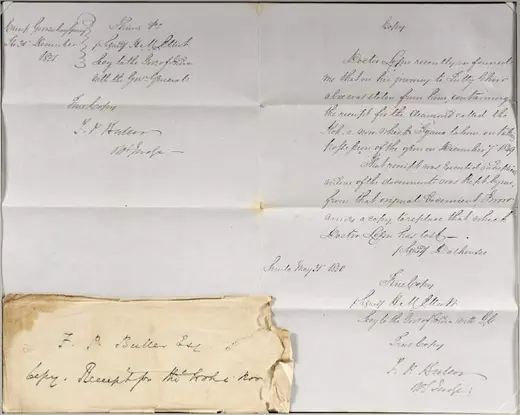
A 'true copy' receipt of 1851 recording the transfer of the Koh-i-Noor, said to have been made for Sir John Login and now in the Toor Collection.
Unknown, 1851. Toor Collection (as credited on Commons). Public domain. Source
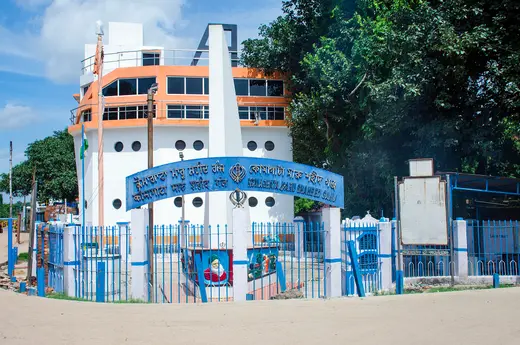
The Komagata Maru memorial at Budge Budge, West Bengal, with its museum behind. Photographed in 2020.
Rangan Datta Wiki, 2020-09-16.CC BY-SA 4.0. Source
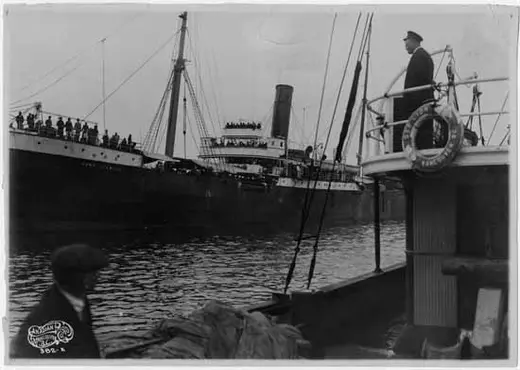
The Komagata Maru seen from the tugboat Sea Lion at Vancouver in 1914, credited on Commons to the Canadian Photo Company.
Canadian Photo Company, 1914. Public domain. Source
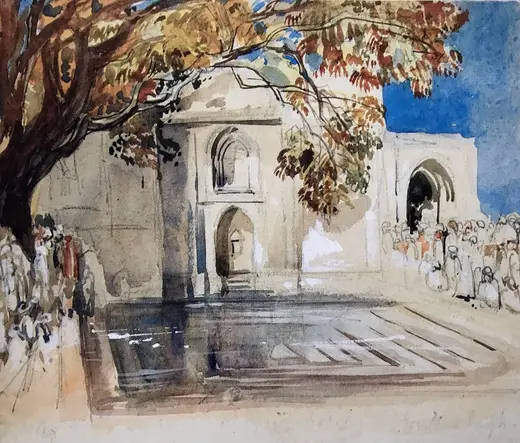
The pool at Panja Sahib, Hasan Abdal, in a watercolour by Charlotte Canning dated 3 March 1860.
Charlotte Canning, 3 March 1860. Public domain. Source
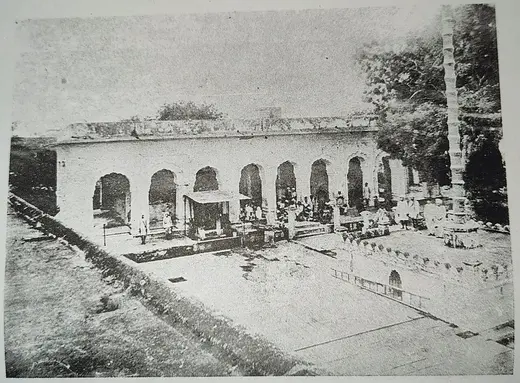
Takht Harmandir Sahib, Patna, before the 1934 earthquake damaged it. Printed in the Mahan Kosh of 1930.
Unknown, Before 1930. Public domain. Source
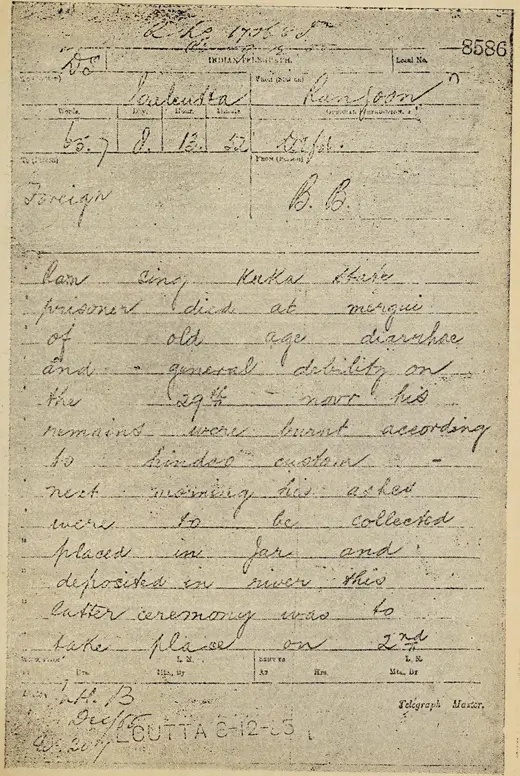
A government telegram of 8 December 1885 from Rangoon to Calcutta, reporting that the state prisoner Baba Ram Singh had passed away at Mergui on 29 November. It is held by the National Archives of India. Many of his followers did not accept this report.
Government of British Burma, 1885. National Archives of India. Public domain. Source
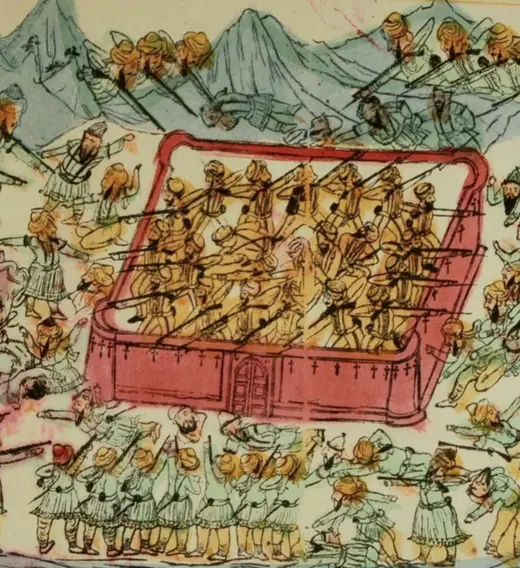
An imagined picture of the battle of Saragarhi of 12 September 1897, from a weak web source. Its date is uncertain.
Unknown, Late 19th or early 20th century, uncertain. Public domain. Source
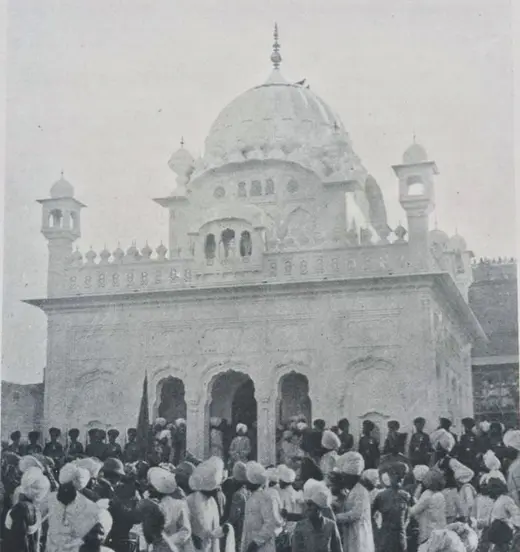
The unveiling of the Saragarhi Memorial Gurdwara at Amritsar in April 1902. Commons credits the design to Bhai Ram Singh of the Mayo School, Lahore.
Unknown photographer, 1902-04. Public domain. Source
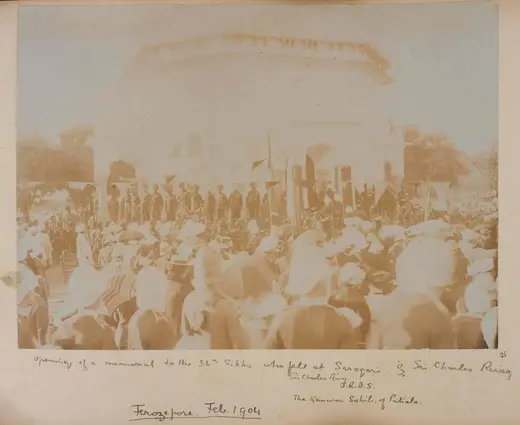
The opening of the memorial to the men of the 36th Sikhs who fell at Saragarhi, at Ferozepur in February 1904. It is now known as the Saragarhi Memorial Gurdwara.
Unknown photographer, 1904-02. British Library, Photo 355/2(125). Public domain. Source
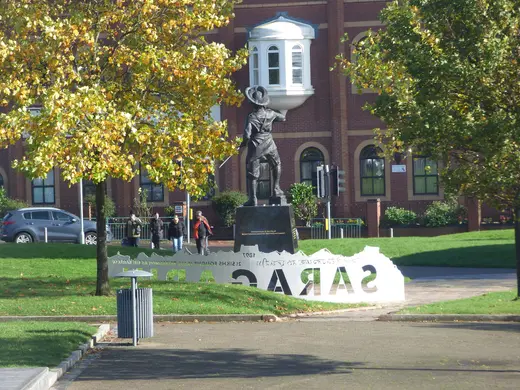
The Saragarhi Memorial at Wednesfield, Wolverhampton, unveiled in September 2021. The statue is by Luke Perry. Photographed in 2023.
Elliott Brown, 2023-10-14.CC BY-SA 2.0. Source
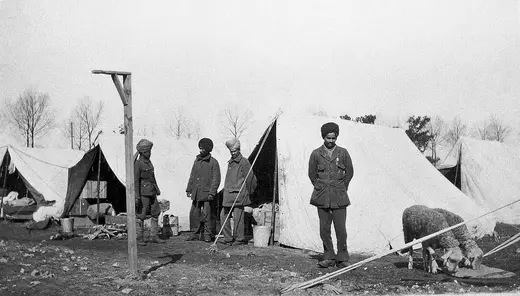
Sikh soldiers encamped on the Western Front around 1918, from the papers of Sister Knocker.
Unknown, c. 1918. Wellcome Collection, GC/258/11.CC BY 4.0. Source
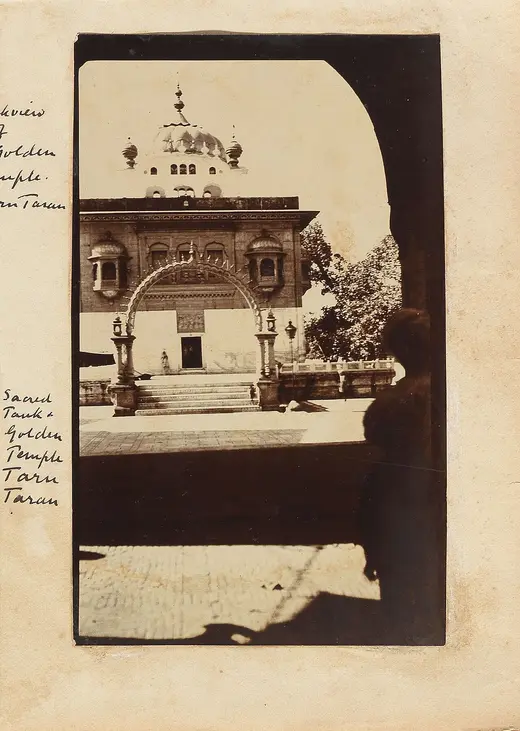
Gurdwara Sri Darbar Sahib, Tarn Taran. Commons dates the image to the later 1800s by its appearance only.
Unknown, Probably c. 1850-1900. Public domain. Source
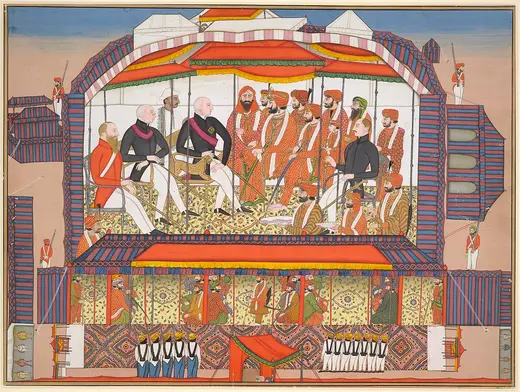
Signing the Treaty of Bhairowal, 26 December 1846, with the boy Maharaja Duleep Singh, in a gouache of about 1846-1847. Commons links it to the British Museum.
Unknown, c. 1846-1847. British Museum, 1948,1009,0.109 (as credited on Commons). Public domain. Source
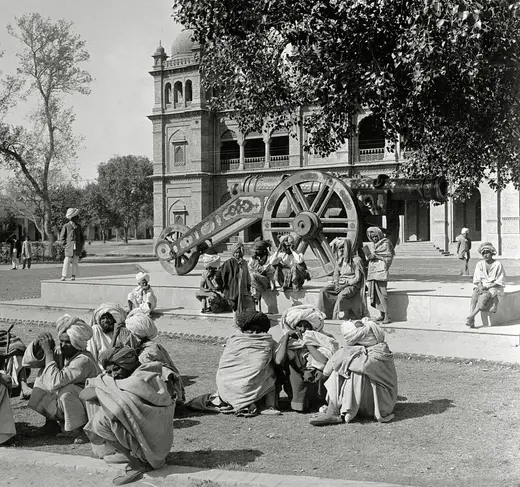
The Zamzama gun at Lahore in the later 1800s. The Encyclopaedia of Sikhism calls it Bhangian di Top after the Bhangi Sikhs who took it in 1762.
Unknown photographer, Late 19th century. Public domain. Source


