1799 to 1849
The Sikh Empire
Maharaja Ranjit Singh turned the Sikh misls into a kingdom stretching from the Khyber to the Sutlej, with a modern army and a court of Sikhs, Muslims and Hindus. Ten years of murders and army revolt followed his death in 1839, and two wars with the British ended with annexation in 1849.
From Lahore to Maharaja
1799 to 1801
Ranjit Singh was born on 13 November 1780 at Gujranwala, the son of Mahan Singh Sukerchakia and Raj Kaur. He lost the sight of his left eye to smallpox and had no schooling. His name in Sikh memory became Sher-i-Punjab, the Lion of the Punjab.
He took Lahore from the Bhangi chiefs on 7 July 1799, and the Encyclopaedia says its largely Muslim and Hindu people welcomed him. Rival chiefs and Nizam ud-Din of Kasur gathered at Bhasin in 1800 to oppose him.
On Vaisakhi in April 1801 Sahib Singh Bedi, a descendant of Sri Guru Nanak Dev Ji, marked his forehead and proclaimed him Maharaja. He refused a throne, kept striking coins in Guru Ji's name and called his government Sarkar Khalsaji, the government of the Khalsa.[EoS][EoS]
Amritsar, Kasur and the treaty of 1809
1802 to 1809
He took Amritsar in 1802, with its Gobindgarh fort, with help from Sada Kaur and Fateh Singh Ahluwalia. Akali Phula Singh mediated to prevent bloodshed in the city and took charge of the gurdwaras. Ranjit Singh ordered the Harmandir Sahib rebuilt in marble and its domes gilded.
A treaty with Lord Lake on 1 January 1806 kept British armies out of his lands as long as he moved the Maratha chief Holkar away from Amritsar. Kasur fell in early 1807 after a month of fighting.
Ranjit Singh had crossed the Sutlej to take tribute in the Malwa, and by autumn 1808 he aimed at the whole cis-Sutlej region. The Metcalfe mission blocked him. The treaty signed at Amritsar on 25 April 1809 made the Sutlej his southern limit and left him free to the north and west. He took Kangra on 24 December 1809 after driving out the Gurkhas.[EoS][EoS]
Conquest in the north and west
1810 to 1837
Multan fell in 1818 and Kashmir in 1819. Beyond the Indus he first ruled through local chiefs who paid tribute. Dera Ghazi Khan came under direct rule in 1831, Peshawar in 1834, and Tank, Bannu and Dera Ismail Khan between 1832 and 1836.
Akali Phula Singh led the storming parties at Multan and took part in Peshawar and Kashmir. He was killed at Naushehra on 14 March 1823, charging the Afghans on an elephant after his horse was shot. Maharaja Ranjit Singh gave his Akalis barracks at Amritsar, and the Encyclopaedia says he once punished the Maharaja himself for breaking the Sikh code.
Hari Singh Nalwa, appointed after a recruitment test in 1805, governed Kashmir from 1820, then settled Hazara for fifteen years and founded Haripur. He took Peshawar in 1834 and built the fort of Jamrud at the mouth of the Khyber two years later. He was mortally wounded fighting Afghans under Akbar Khan on 30 April 1837 and asked that his death be kept quiet until relief arrived.[EoS][EoS][EoS]
The court and the army
1801 to 1839
The Encyclopaedia gives the kingdom about 100,436 square miles and an estimated 5,350,000 people, in the provinces of Lahore, Multan, Peshawar and Kashmir. His ministers came from all communities. The Muslim Faqir Aziz ud-Din advised on foreign affairs, the Brahmin convert Khushal Singh was chamberlain, and the Dogra Dhian Singh rose to become the most powerful figure at court.
He began training infantry in 1802 with deserters from the East India Company, and Sikhs, who first looked down on foot service, later joined in numbers. Jean-Baptiste Ventura and Jean-Francois Allard arrived in 1822 to raise the Fauj-i-Khas, and Claude Auguste Court and the American Alexander Gardner later worked on the artillery.
Figures from Sita Ram Kohli show regular infantry growing from 7,748 in 1819 to 26,617 in 1838, and guns from 22 to 188. Another 4,000 Akalis served in a brigade of their own, and the entry on Ranjit Singh gives a total strength of almost 100,000. He spent about a third of his revenue on the army.
He kept Mughal revenue methods and took up to half the produce. There was no legal code, and fines were the usual penalty. He gave to Muslim and Hindu sites as well as Sikh ones, and his Muslim and Hindu wives kept their faiths.
He passed away at Lahore on 27 June 1839. His court historian Sohan Lal Suri and European visitors left detailed records of the reign.[EoS][EoS]
The succession crisis
1839 to 1845
His eldest son Kharak Singh succeeded him and was soon opposed by Dhian Singh Dogra. Forged letters suggested he meant to hand the Punjab to the British. On 9 October 1839 the conspirators killed his favourite Chet Singh in his presence, and his son Nau Nihal Singh took power. Kharak Singh passed away on 5 November 1840. Contemporary chroniclers say he had been slowly poisoned.
Returning from the funeral, Nau Nihal Singh was hurt by a falling gate and was then, by the Encyclopaedia's account, killed inside the fort on Dhian Singh's orders. His death is dated 8 November 1840.
Kharak Singh's widow Chand Kaur was proclaimed Maharani on 2 December 1840, while Sher Singh, another son of Ranjit Singh, claimed the throne. He won over the army and entered Lahore in January 1841. Arrears of pay led to riots, and from these came the army panchayats, elected committees in every unit that called themselves the Khalsa.
On 15 September 1843 Sher Singh, his heir and Dhian Singh were all assassinated. The child Duleep Singh was proclaimed Maharaja, with Dhian Singh's son Hira Singh as wazir. Maharani Jindan Kaur worked with the army panchayats to bring down Hira Singh, took off her veil, held court as regent and made her brother Jawahar Singh wazir. The panchayats killed Jawahar Singh in 1845 for the murder of Kanwar Pashaura Singh, and she named Misr Lal Singh in his place.[EoS][EoS][EoS][EoS][EoS][EoS]
The first Anglo-Sikh war
1845 to 1846
British strength on the frontier rose from about 2,500 men in 1838 to well over 11,000 under Lord Ellenborough, with a new post at Ferozepur. Relations broke down over Suchet Singh's treasure and the village of Mauran. The Sikh army crossed the Sutlej on 11 December 1845, and Lord Hardinge declared war on 13 December.
The first battle was at Mudki on 18 December, the second at Ferozeshah on 21 and 22 December, where the British came close to defeat by their own account. The Encyclopaedia says the Sikh commanders Lal Singh and Tej Singh abandoned their army at both. In January Ranjodh Singh Majithia captured Sir Harry Smith's baggage at Baddowal, and Smith defeated him a week later.
The decisive battle was at Sobraon on 10 February 1846, with the Sikhs entrenched on the Sutlej. Tej Singh crossed the bridge of boats as it began and part of the bridge went down. Sham Singh Atariwala, who had sworn to die rather than retreat, charged in white and was killed.
The Treaty of Lahore on 9 March 1846 took the Jalandhar Doab, a large indemnity, and the guns used in the war, and limited the army to 12,000 cavalry and 20,000 infantry. Kashmir went to Gulab Singh Dogra for 75 lakh rupees. The Treaty of Bhairowal on 16 December 1846 gave the British Resident full control and pensioned off Maharani Jindan Kaur.[EoS][EoS][EoS][EoS]
The second war and annexation
1848 to 1849
Lord Dalhousie arrived in January 1848. That April, soldiers at Multan killed the two British officers sent to replace Diwan Mul Raj, and by the Encyclopaedia's account the revolt was left to spread for five months. Maharani Jindan Kaur was exiled to Varanasi, and Sardar Chatar Singh Atariwala was accused of plotting in Hazara. His son Raja Sher Singh joined Mul Raj on 14 September 1848.
The Encyclopaedia counts Ramnagar on 22 November as a Sikh success, though Lord Gough claimed it as his own. At Chillianwala on 13 January 1849 the British took heavy losses and Gough ordered a retreat. Multan surrendered on 22 January. At Gujrat on 21 February Lord Gough's concentrated guns broke the Sikh line, and the Sikh army laid down its arms in March.
Dalhousie proclaimed the annexation on 29 March 1849. The ten-year-old Maharaja Duleep Singh signed away his kingdom in a darbar at Lahore Fort, with British troops present. The Encyclopaedia records that Sir Henry Lawrence opposed the step as unjust.[EoS][EoS][EoS][EoS]
What the sources disagree on
- The charge of treason against Lal Singh and Tej Singh
The Encyclopaedia's war entry, by B. J. Hasrat, says Lal Singh was in contact with the British agent Peter Nicholson and that both commanders deliberately lost battles. No account defending the commanders has been confirmed.[EoS]
- Maharani Jindan Kaur and the war
Some historians, according to the Encyclopaedia, say she wanted the Khalsa army destroyed in a war with the British. The entry's author rejects this and points to British preparations and provocations.[EoS]
- Was annexation lawful
Dalhousie's proclamation said Sikhs had broken the treaties. The Encyclopaedia's authors say the Multan rising was a local revolt that the British let grow, that the Darbar had supported the Resident, and that the Treaty of Bhairowal bound Britain to protect the Maharaja until 1854. Contemporaries including Henry Lawrence and John Sullivan criticised the act.[EoS][EoS]
- Dates and battlefield figures
Ranjit Singh's proclamation is dated 12 April 1801 in one entry and 11 April in another. Duleep Singh's accession is 16 or 18 September 1843. The Encyclopaedia's figures for British dead at Sobraon and Chillianwala look high beside the other numbers it gives and may be casualties rather than deaths.[EoS][EoS][EoS][EoS][EoS][EoS]
- The verdict on Ranjit Singh
The Encyclopaedia's long entry, by Khushwant Singh, is admiring and calls capital punishment unknown in his reign. The same entry describes a personal military despotism, and the entry on Sada Kaur records her confinement at Lahore until her death.[EoS][EoS]
Images
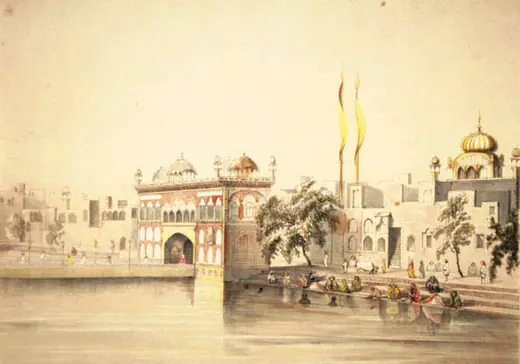
A 19th-century painting of the Akal Takht and Darshani Deori at the Harmandir Sahib complex, with Sikh flags. Its source is a personal blog.
Unknown, 19th century. Public domain. Source
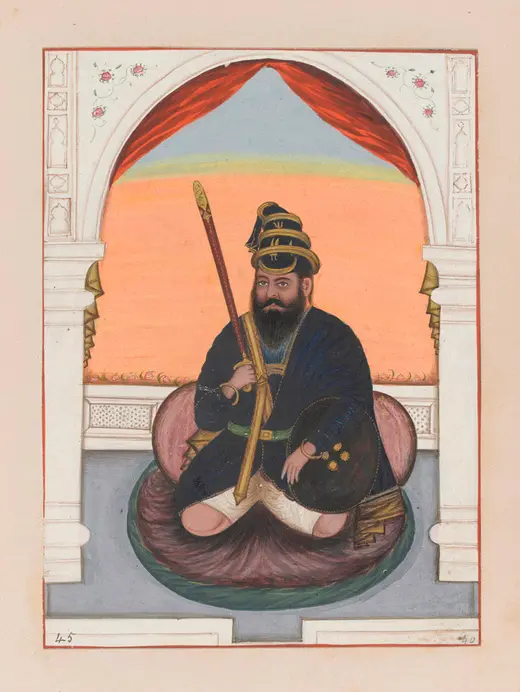
Akali Phula Singh by a Company artist, about 1865, long after his lifetime. From the album The Kingdom of the Punjab, its Rulers and Chiefs.
Unknown Company artist, c. 1865. Public domain. Source
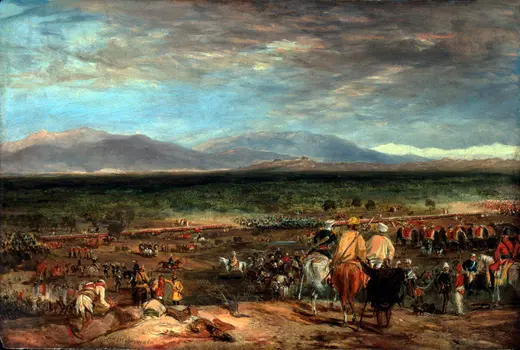
The Battle of Chillianwala, 13 January 1849. An oil painting on board of the same year by Lieutenant Charles Becher Young of the Bengal Engineers, a British officer of that time.
Charles Becher Young, 1849. National Army Museum, London. Public domain. Source
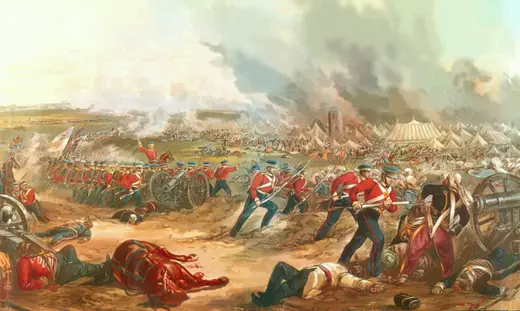
The second day at Ferozeshah, 22 December 1845. A British work of about 1847 by Henry Martens, from a sketch by Major G. F. White of the 31st Regiment. Commons suggests the unit shown may be the 62nd Regiment, which has not been confirmed.
Henry Martens, after G. F. White, c. 1847. Public domain. Source
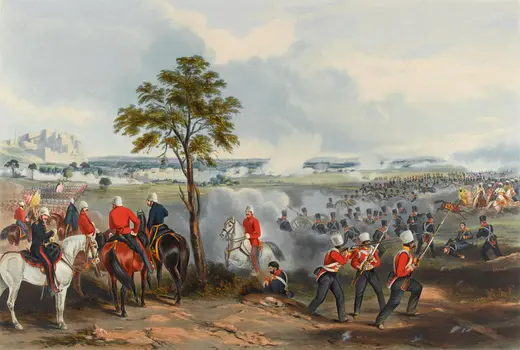
The Battle of Gujrat, 21 February 1849. A British aquatint by J. Harris after Henry Martens, published on 29 July 1850.
J. Harris after H. Martens, 1850. National Army Museum, London. Public domain. Source
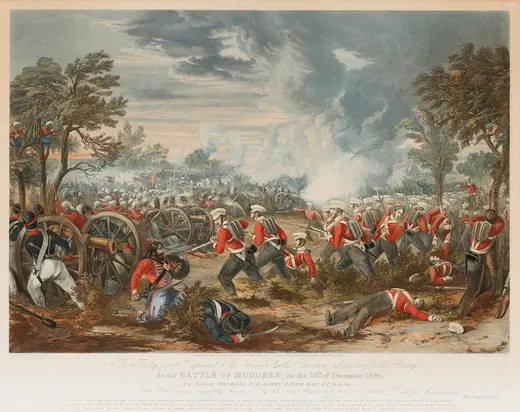
The Battle of Mudki, 18 December 1845. A British aquatint of 1848 by J. Harris after Henry Martens, from a sketch by G. F. White. It shows the battle as the British chose to remember it.
J. Harris after Henry Martens, 1848. Public domain. Source
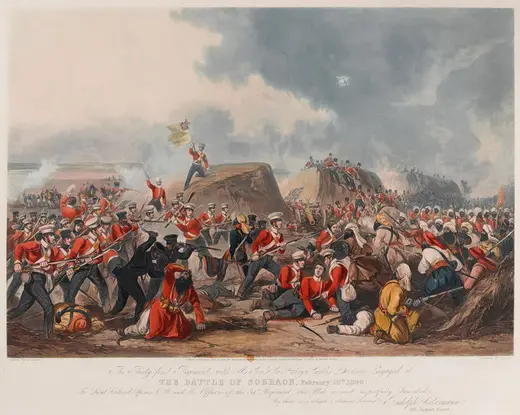
The Battle of Sobraon, 10 February 1846. A British aquatint by J. Harris after Henry Martens, published on 1 January 1848, from a sketch by Major G. F. White, whose 31st Regiment appears in it.
J. Harris after Henry Martens, after G. F. White, 1848. National Army Museum, London. Public domain. Source
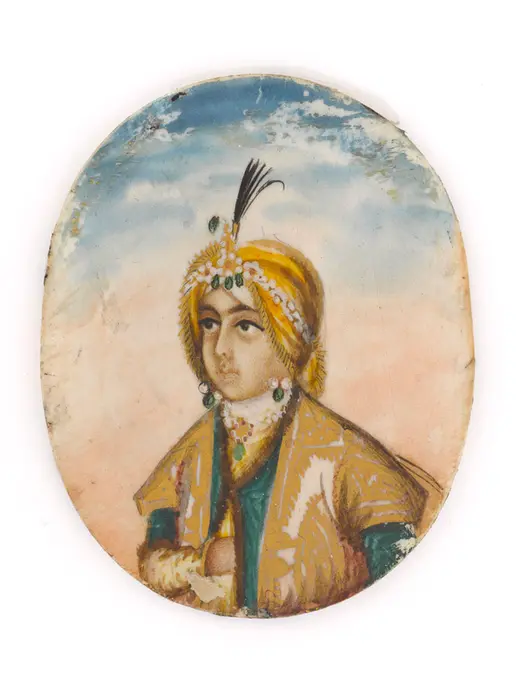
Maharaja Duleep Singh as a boy, a miniature on ivory by a Company artist at Lahore, 1845.
Unknown, 1845. National Army Museum, 1961-10-9-16 (as credited on Commons). Public domain. Source
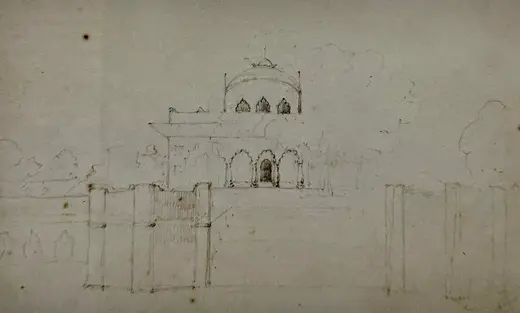
A sketch of about 1834 of the gurdwara at Fatehgarh Sahib, with the period title 'Shrine of the murdered infants of Gooroo Govind, Sirhind'. Commons calls it possibly one of the earliest sketches of a gurdwara.
Unknown, c. 1834. Public domain. Source
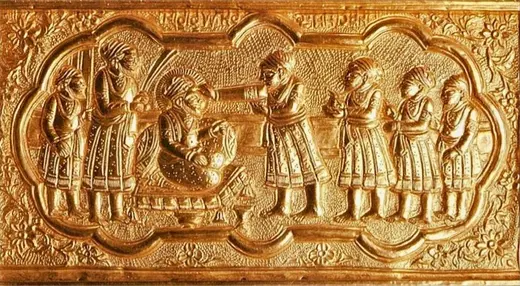
A gilded panel from doors given to the Harmandir Sahib by Maharaja Ranjit Singh, now in the treasury according to Commons. It imagines Baba Buddha anointing Sri Guru Amar Das Ji under Sri Guru Angad Dev Ji's command.
Unknown, c. 1801-1839. Toshakhana, Harmandir Sahib (as stated on Commons). Public domain. Source
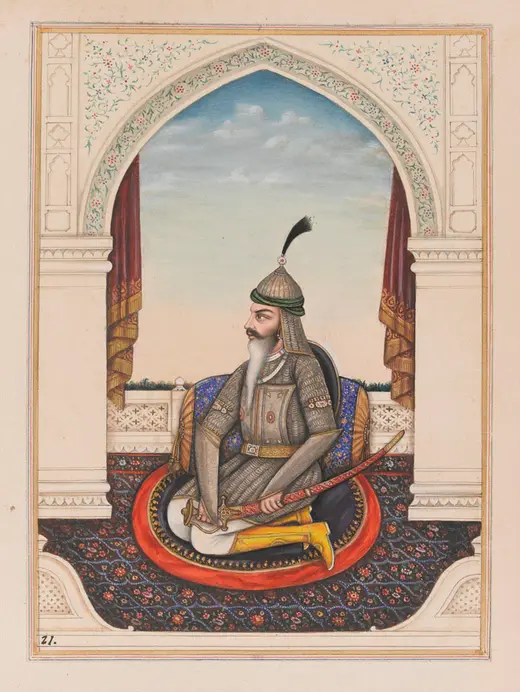
Hari Singh Nalwa by a Company artist, about 1865, nearly thirty years after he fell in battle in 1837. From the album The Kingdom of the Punjab.
Unknown Company artist, c. 1865. National Army Museum (as credited on Commons). Public domain. Source
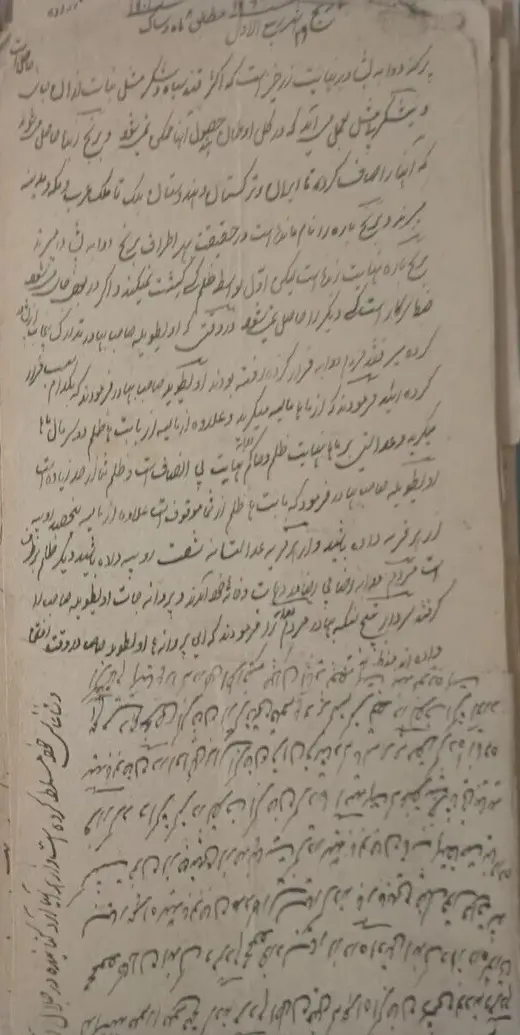
A folio labelled as a Khalsa Darbar record of about 1843-1844, recording Sikh military activity. Its link to the catalogued series in Lahore was not checked.
Scribe of the Sikh Empire's administration, c. 1843-1844. Public domain. Source
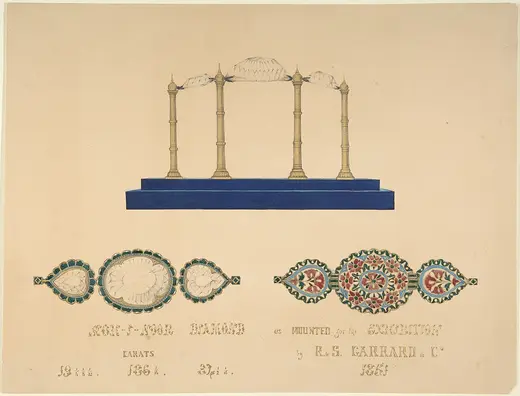
A drawing of the Koh-i-Noor by R.S. Garrard & Co., 1851, the year it was shown in London. It is from the Metropolitan Museum of Art's open access collection.
R.S. Garrard & Co., 1851. Metropolitan Museum of Art.CC0. Source
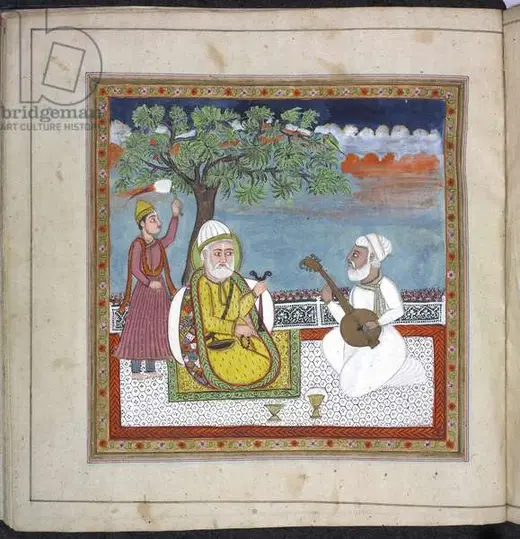
A folio credited to Rani Jindan's prayer book of 1828-30, held according to Commons by the British Library. No shelfmark was confirmed.
Unknown, c. 1828-1830. British Library (as credited on Commons). Public domain. Source
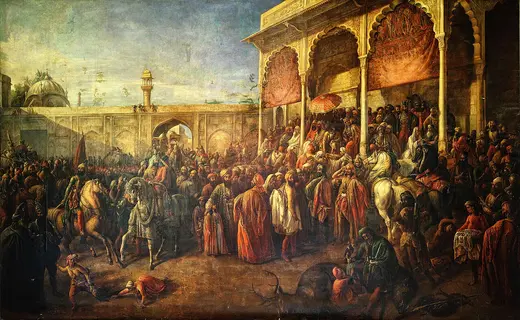
The Court of Lahore by August Schoefft, an oil of about the 1840s to 1855, based on drawings made at Lahore around 1841. Commons places it in the Princess Bamba Collection.
Ágoston Schoefft, c. 1841-1855. Princess Bamba Collection, Lahore Fort (as credited on Commons). Public domain. Source
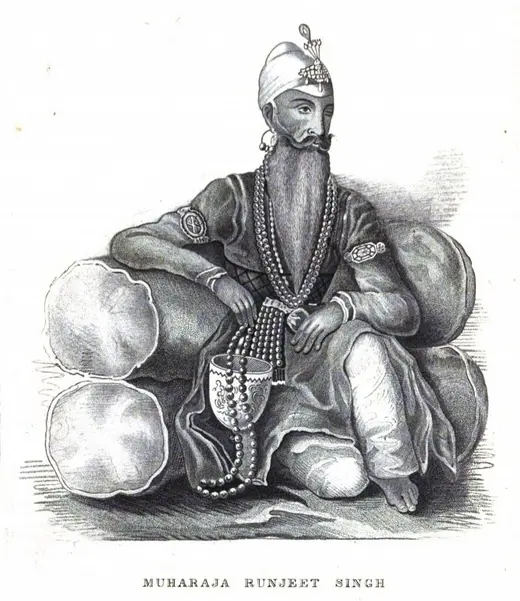
An engraving of Maharaja Ranjit Singh after a portrait attributed to Jivan Ram, from H.T. Prinsep's book of 1834. The file name says he wears the Koh-i-Noor, which was not independently checked.
Kasinath, sculptor, after an original work by Jivan Ram, 1834. Public domain. Source
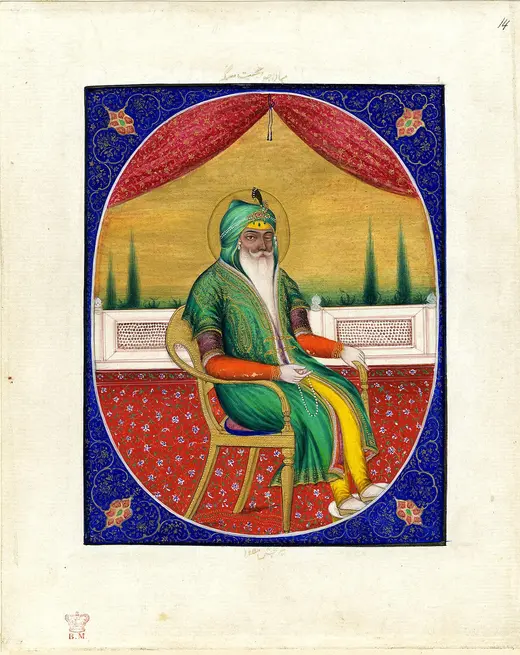
Maharaja Ranjit Singh on a terrace, an album leaf in gouache from about 1830, made during his lifetime and linked from Commons to the British Museum.
Unknown, c. 1830. British Museum, 1920,0917,0.227 (as credited on Commons). Public domain. Source
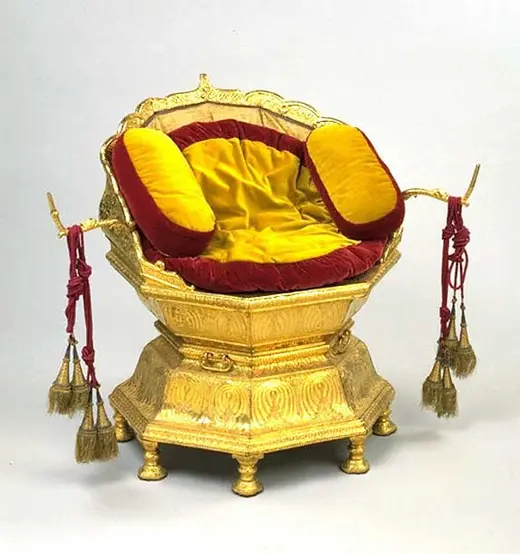
Maharaja Ranjit Singh's throne by Hafez Muhammad Multani, V&A 2518(IS). This older Commons file says about 1820-1830, but the V&A now gives probably 1805-1810.
Hafez Muhammad Multani. Image: VAwebteam, Probably 1805-1810. Victoria and Albert Museum, 2518(IS).CC BY-SA 3.0. Source
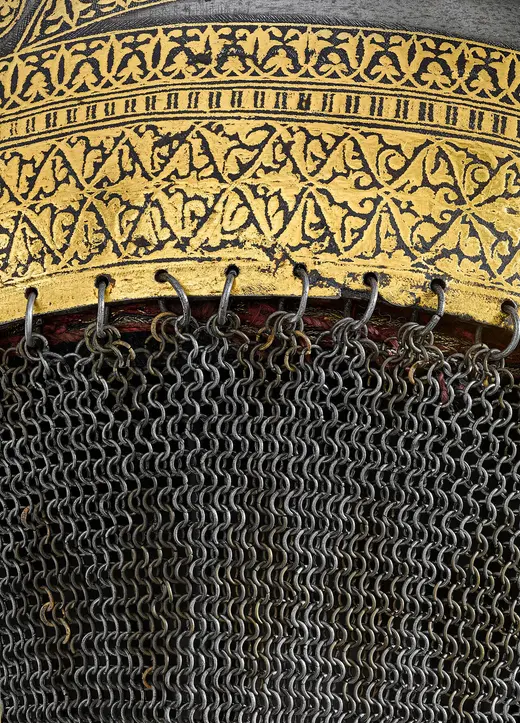
Detail of a Sikh helmet of the early 1800s, shaped to take a turban and topknot, with gold overlay and patterned mail. Royal Armouries XXVIA.138.
Royal Armouries, Early 19th century. Royal Armouries, XXVIA.138.CC BY 2.0. Source
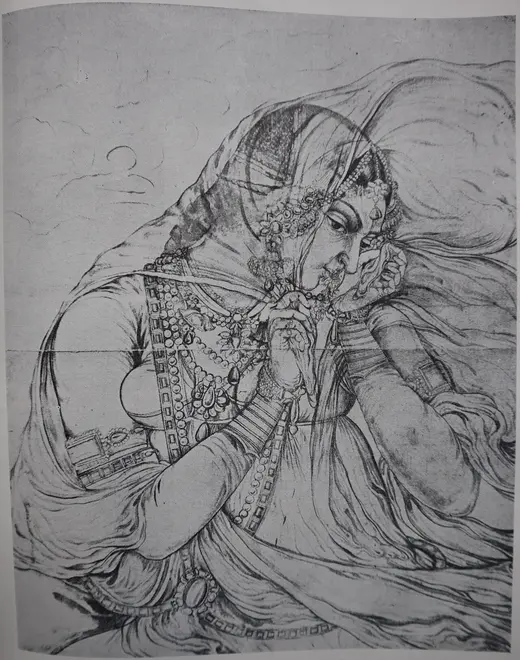
Sardarni Sada Kaur in a sketch credited to Kehar Singh, an artist of Maharaja Ranjit Singh's court. Published in 1983 by R.P. Srivastava from the Central Sikh Museum.
Kehar Singh, court artist of Maharaja Ranjit Singh, 19th century. Central Sikh Museum, Amritsar (as credited on Commons). Public domain. Source
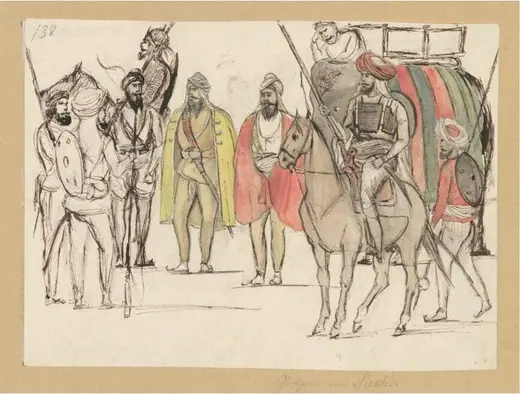
Sikh regular infantry and irregular cavalry of the Anglo-Sikh Wars, about 1850. The source and artist are not stated.
Unknown, c. 1850. Public domain. Source
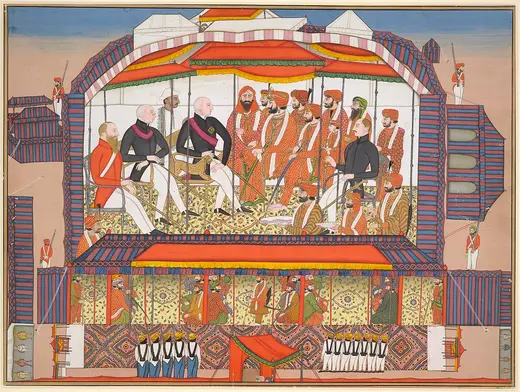
Signing the Treaty of Bhairowal, 26 December 1846, with the boy Maharaja Duleep Singh, in a gouache of about 1846-1847. Commons links it to the British Museum.
Unknown, c. 1846-1847. British Museum, 1948,1009,0.109 (as credited on Commons). Public domain. Source


