1716 to 1799
Persecution and the misls
After 1716 Sikhs were hunted by Mughal governors and later by Afghan invaders, and suffered the two great losses they remember as the Ghallugharas. In the same decades they organised the Dal Khalsa and the misls, and by the 1760s held most of the Punjab. The century ended with one misl chief, Ranjit Singh, in Lahore.
Bhai Mani Singh and the settlement of 1721
1716 to 1721
Persecution eased after Emperor Farrukh-Siyar was assassinated in 1719, and Sikhs began to gather at Amritsar again. The Bandai Khalsa then claimed half the offerings at the gurdwaras, which the Tatt Khalsa refused.
Mata Sundari sent Bhai Mani Singh from Delhi with six other Sikhs to run the Darbar Sahib and ordered that the income go to the langar. At Vaisakhi in 1721 the Bandais fortified their camp, and Bhai Mani Singh brought both sides to seek a decision.
The Encyclopaedia's entry records the test. Two slips, one bearing the Sikh greeting and one "Fateh Darshan", were put in the sacred pool, and the first slip rose first. When some questioned this, a wrestling bout was held before the Akal Takht between Miri Singh and Sangat Singh, and the Tatt Khalsa's man won. Most Bandais then joined the Tatt Khalsa.[EoS][EoS]
Zakariya Khan, the offer of 1733 and the martyrs
1726 to 1745
Zakariya Khan became governor of Lahore in 1726. His patrols forced Sikhs into remote hills and forests, and Sikh bands in turn raided treasuries and caravans. Nawab Kapur Singh, who had taken the vows from Bhai Mani Singh in 1721, rose to prominence in these years.
In 1733 the government changed course. A Sikh official, Subeg Singh, came to Amritsar at Vaisakhi with the title of Nawab and a jagir made up of Dipalpur, Kanganval and Jhabal, valued at a lakh of rupees. The assembly chose Kapur Singh, who was fanning the gathering at the time, and he laid the robe of honour before five Sikhs before accepting it.
He split the force into the Buddha Dal, for the elders, and the Taruna Dal, for the young, with the latter in five groups. The peace failed before the harvest of 1735. Zakariya Khan took the jagir back and the Buddha Dal was driven towards the Malwa. In 1739 Nawab Kapur Singh attacked the rearguard of Nadir Shah near Akhnur and freed captive girls.
The Encyclopaedia describes a scale of rewards under Zakariya Khan: a blanket for cutting a Sikh's hair, ten rupees for news of a Sikh's whereabouts and fifty for a scalp. Sheltering Sikhs became a capital offence.
Bhai Mani Singh sought leave in 1737 to hold Diwali at Amritsar, on payment of a tax. Sources give the sum as 5,000 or 10,000 rupees. Learning that troops under Diwan Lakhpat Rai would attack the gathering, he told Sikhs to stay away, so the tax could not be raised. He was tried at Lahore, refused to accept Islam and was martyred.
In 1739 Bota Singh and Garja Singh set up on the road near Sarai Nur ud-Din and collected tolls to show that the Khalsa still ruled, and sent the governor a mocking verse. They were killed fighting the hundred horsemen sent for them.
Bhai Taru Singh, a farmer of Puhla, sent what he saved to Sikhs in hiding. Betrayed by the informer Harbhagat Niranjania, he refused conversion and was martyred on 1 July 1745, his scalp scraped from his head. The Prachin Panth Prakash tells his story, and the Encyclopaedia gives the same day for the death of Zakariya Khan.[EoS][EoS][EoS][EoS][EoS][EoS]
The Chhota Ghallughara
1746 to 1747
In early 1746 Jaspat Rai, the commander at Eminabad, was killed in a clash with Sikhs. His brother Lakhpat Rai, a minister at Lahore, swore to destroy the Panth. He had the Sikhs of Lahore rounded up and executed on 10 March 1746, despite pleas from Hindu nobles led by Diwan Kaura Mall.
He then surrounded Sikhs in the swampy forest of Kahnuwan. They broke out and made for the hills at Basohli, where hill men opposed them, and many drowned recrossing the Ravi on the way back. The survivors crossed the Beas and the Sutlej and reached the Lakkhi Jungle in the Malwa.
The Encyclopaedia estimates 7,000 Sikhs killed and 3,000 captured on 1 and 2 May 1746. The captives were beheaded at the horse market outside Lahore's Delhi Gate, later the site of the Shahidganj. Lakhpat Rai ordered Sikh gurdwaras destroyed and books burnt.
Within about six months Sikhs were returning. On 30 March 1747 the Sarbatt Khalsa at Amritsar resolved to build the fort of Ram Rauni.[EoS]
The Dal Khalsa, the misls and rakhi
1748 to 1765
Sikh bands had grown to 65 by early 1748, the year Ahmad Shah Durrani first invaded and occupied Lahore. At Vaisakhi on 29 March 1748 a Sarbatt Khalsa at Amritsar, urged by Nawab Kapur Singh, merged them into one force, the Dal Khalsa, led by Jassa Singh Ahluwalia.
The bands became eleven misls, each with its own leader and banner: Ahluwalia, Singhpuria, Karorsinghia, Nishananwali, Shahid, Dallewalia, Sukerchakia, Bhangi, Kanhaiya, Nakai and Ramgarhia. A twelfth, the Phulkian under Baba Ala Singh of Patiala, stood outside the Dal Khalsa command.
The Encyclopaedia calls this a loose confederacy without a fixed constitution. A horseman could move between misls, and the Sarbatt Khalsa met twice a year at Amritsar. It also notes that the name Dal Khalsa is not found in Indian chronicles before James Browne's India Tracts of 1788.
Under rakhi, a village or group of villages paid for the Dal Khalsa's protection. The usual rate was a fifth of the government revenue, in two instalments at harvest, though it ranged from an eighth to a half. It lasted in the Punjab until 1764-65, and continued in the Gangetic Doab and around Delhi until 1803.[EoS][EoS][EoS][EoS][EoS]
Afghan invasions and Baba Deep Singh
1748 to 1761
Ahmad Shah Durrani invaded nine times between 1747 and 1769. In the first campaign Sikhs under Nawab Kapur Singh and Jassa Singh Ahluwalia harried him as he moved south from Lahore. The Mughal governor Mir Mannu, in office from 1748 to 1753, sent detachments to hunt Sikhs and besieged Ram Rauni in late 1748. Jassa Singh Ramgarhia rebuilt it after 1753, and took his name from its new name, Ramgarh.
Durrani annexed the Punjab in the winter of 1756-57 and left his son Taimur at Lahore with the general Jahan Khan. In May 1757 Jahan Khan besieged Amritsar, razed Ram Rauni and filled in the sacred pool.
Baba Deep Singh set out from Talwandi Sabo, and his force grew to 5,000 by Tarn Taran. He was badly wounded near Ramsar, kept fighting, and fell close to the Harmandir Sahib on 11 November 1757. The Encyclopaedia records as legend the story that his headless body fought on, holding his severed head.
In 1758 the Dal Khalsa joined Adina Beg and the Marathas to take Sirhind and Lahore. After Durrani beat the Marathas at Panipat in January 1761, Jassa Singh Ahluwalia freed 2,200 women captives near Amritsar. Sikhs occupied Lahore that September, proclaimed him Sultan ul-Qaum, and struck a coin in the names of Sri Guru Nanak Dev Ji and Sri Guru Gobind Singh Ji.[EoS][EoS][EoS][EoS][EoS]
The Vadda Ghallughara and recovery
1762 to 1769
Durrani's sixth invasion was aimed at the Sikhs. They moved their families across the Sutlej, and he caught them at Kup near Malerkotla at dawn on 5 February 1762. The fighters formed a cordon around the baggage train and marched towards Barnala, fighting as they went, until both sides stopped at a pond in the afternoon.
Estimates of Sikh dead run from 20,000 to 50,000, and the Encyclopaedia prefers the contemporary chronicler Miskin's 25,000 and Ratan Singh Bhangu's 30,000. Jassa Singh Ahluwalia is said to have taken twenty-two wounds. Durrani then went to Amritsar and blew up the Harmandir Sahib with gunpowder in April 1762.
Sikhs attacked Sirhind within months, and that Diwali they gathered at Amritsar and fought Durrani there. They took Sirhind for good in January 1764, killing the commander Zain Khan, and reoccupied Lahore on 17 April 1765. Durrani's later invasions failed to bring the Sikhs under control, and his last, in 1769, ended in retreat.
Baba Ala Singh of Patiala stayed neutral at Kup. Durrani ravaged Barnala and held him until he paid heavily, then in 1765 confirmed him at Sirhind with the title of Raja.[EoS][EoS][EoS][EoS][EoS]
The rule of the misls
1765 to 1799
With the Afghan threat fading, the chiefs divided the country. The Phulkian chiefs held the province of Sirhind, the Bhangis held Lahore, several misls shared the Jalandhar Doab, and Jassa Singh Ahluwalia set up at Kapurthala.
Sikh forces pressed into the Gangetic plain. Baghel Singh crossed the Yamuna repeatedly from the 1760s, and on 11 March 1783 Sikh forces reached the Red Fort. Jassa Singh Ahluwalia sat on the throne, and left it when Jassa Singh Ramgarhia objected. Shah Alam II agreed that Baghel Singh could build gurdwaras on historic sites in Delhi and keep part of the octroi, and seven gurdwaras went up in eight months, including Sis Ganj and Rakab Ganj.
The chiefs also fought each other. Jassa Singh Ramgarhia was driven out of the Punjab by his namesake and Jai Singh Kanhaiya, and returned after 1783 allied with Mahan Singh Sukerchakia. The Encyclopaedia dates the end of the Dal Khalsa in effect to the death of Jassa Singh Ahluwalia on 20 October 1783.
The Sukerchakia house rose fastest. Charhat Singh moved it to Gujranwala, Mahan Singh extended its lands, and his son Ranjit Singh inherited as a boy. Sada Kaur of the Kanhaiyas married her daughter to him in 1796 and backed his career. After the Afghan Shah Zaman's invasion of 1798, Ranjit Singh and Sada Kaur occupied Lahore on 7 July 1799.[EoS][EoS][EoS][EoS][EoS][EoS][EoS]
What the sources disagree on
- The toll at Kup
The Encyclopaedia's entry on the battle reports estimates from 20,000 to 50,000 and prefers 25,000 (Miskin) and 30,000 (Ratan Singh Bhangu). Its entry on Jassa Singh Ahluwalia attributes about 25,000 to the Persian Tahmas Namah.[EoS][EoS]
- Durrani's march to Kup
One entry gives about 200 km in under forty-eight hours. Another gives about 250 km in under thirty-six hours and a force of 150,000, which it describes as an estimate.[EoS][EoS]
- Who led the Dal Khalsa in 1748
Some entries say Nawab Kapur Singh handed over command to Jassa Singh Ahluwalia. The entry on the misls says Jassa Singh held joint command while Nawab Kapur Singh remained the acknowledged supreme commander.[EoS][EoS][EoS]
- Bhai Mani Singh's origins and tax
Kesar Singh Chhibber, his contemporary, calls him a Kamboj. Later writers following Giani Gian Singh call him a Dullat Jatt of Kamboval. The sum demanded in 1737 is given as 5,000 rupees, or 10,000 according to Ratan Singh Bhangu.[EoS]
- What rakhi was
The Encyclopaedia presents rakhi as protection that brought peace to a chaotic countryside and likens it to the Maratha chauth. The same entries describe it as protection money. These entries are written from a Sikh viewpoint, and no independent assessment has been confirmed.[EoS][EoS]
- When Ranjit Singh inherited
The misl entry says Mahan Singh passed away in 1790, when his son was ten. The entry on Sada Kaur gives 1792.[EoS][EoS]
Images
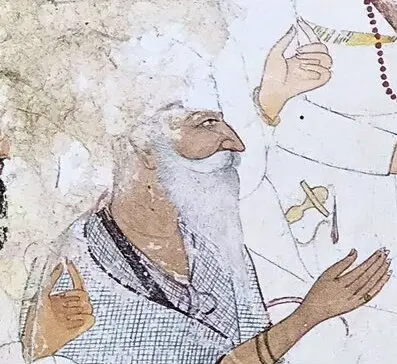
Jassa Singh Ramgarhia, a detail from a group painting of Sikh chiefs attributed to the workshop of Purkhu of Kangra. Commons gives 1760 or 1780 as possible dates.
Purkhu of Kangra, c. 1760 or 1780, uncertain. Public domain. Source
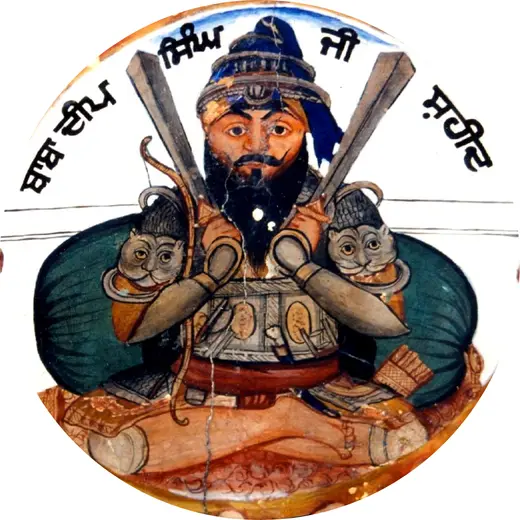
A later fresco of Baba Deep Singh at Gurdwara Baba Atal, Amritsar. Commons notes disagreement over whether the frescoes date from Sikh rule or the mid to late 1800s.
Gian Singh Naqqash, Jaimal Singh Naqqash, Mehtab Singh Naqqash and Hukum Singh, 19th century, disputed. Gurdwara Baba Atal, Amritsar. Public domain. Source
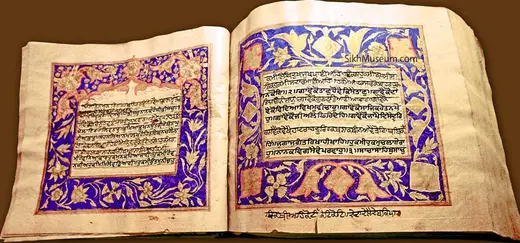
Pages from a manuscript of Sri Guru Granth Sahib Ji attributed to Baba Deep Singh, about 1715-1730, credited by the Sikh Museum site to Gurdwara Chhevin Padshahi, Punjab.
Attributed to Baba Deep Singh, c. 1715-1730. Gurdwara Chhevin Padshahi, Punjab (per the Sikh Museum site). Public domain. Source
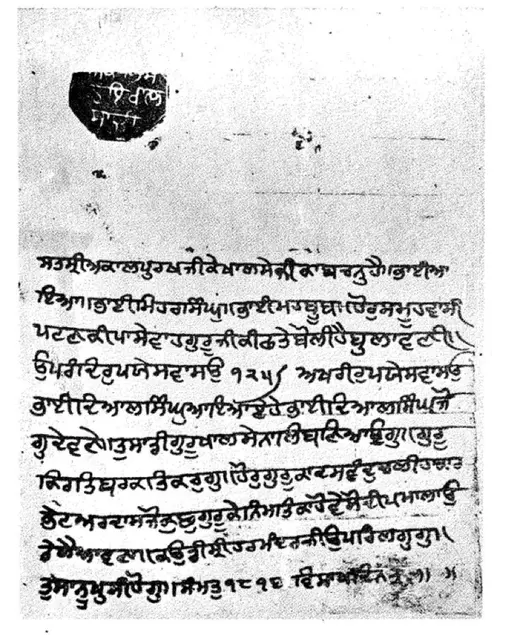
A letter issued in the name of the Khalsa on 12 April 1759 to two Sikhs of Patna, asking for donations to rebuild the Harmandir Sahib after the attack of 1757. Details come from Commons.
Sikh Khalsa [Guru Khalsa], 12 April 1759. Public domain. Source
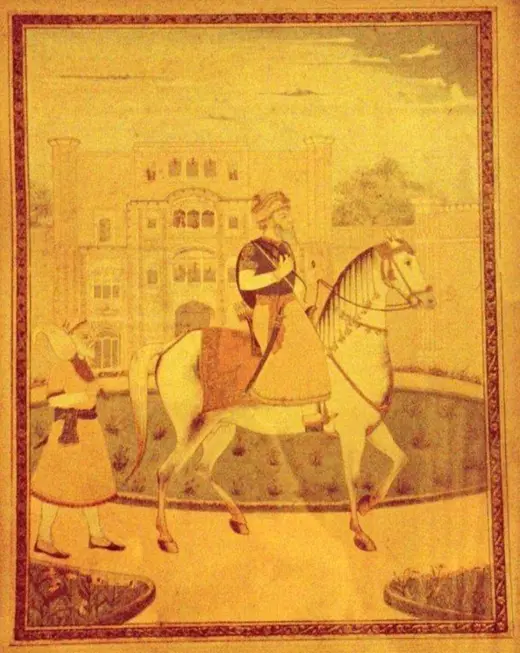
Jassa Singh Ahluwalia on horseback before his house, with an attendant, dated on Commons to the late 1700s. The source is a social media post, so treat the date with caution.
Unknown, Late 18th century, weakly sourced. Public domain. Source


