Scholar, custodian of the Harmandir Sahib and martyr; d. 1737
Bhai Mani Singh
A companion of Sri Guru Gobind Singh Ji from boyhood, Bhai Mani Singh took charge of the Harmandir Sahib at Amritsar and made peace between the Tatt Khalsa and the Bandais in 1721. He was martyred at Lahore in 1737 after a dispute over a tax for holding Diwali at Amritsar.
With Sri Guru Gobind Singh Ji
The Encyclopaedia says he came as a child to Sri Guru Tegh Bahadur Ji at Anandpur, under the name Mani Ram, and grew up with Guru Ji's son, the future Sri Guru Gobind Singh Ji. He stayed with Sri Guru Gobind Singh Ji at Paonta and copied sacred texts.
He took the vows when the Khalsa was formed on 30 March 1699 and was sent to take charge of the Harmandir Sahib. After the evacuation of Anandpur in December 1705 he took Mata Sahib Devan and Mata Sundari to Delhi. He rejoined Guru Ji at Talwandi Sabo in 1706 and, by the Encyclopaedia's account, prepared the final recension of Sri Guru Granth Sahib Ji there.[EoS]
At Amritsar
He returned to Amritsar under the authority of Mata Sundari, and a letter of his to her dated 20 April 1711 survives. When the Bandai and Tatt Khalsa factions confronted each other at Vaisakhi in 1721, he brought them to an agreed test at the sacred pool. Nawab Kapur Singh took the vows from him that year.[EoS][EoS][EoS]
Martyrdom
In 1737 he got Zakariya Khan's leave to hold Diwali at Amritsar in return for a tax. Learning that troops under Diwan Lakhpat Rai were to fall on the gathering, he told Sikhs to stay away, and no tax could be collected. He was tried, offered Islam, and was martyred, his body cut apart limb by limb. Gurdwara Shahid Ganj marked the site in Lahore until partition.[EoS]
Writings
The Encyclopaedia credits him with compiling the Dasam Granth and attributes to him the Gian Ratnavali, on Sri Guru Nanak Dev Ji, and the Bhagat Ratnavali, a commentary on Bhai Gurdas's eleventh Var.[EoS]
What the sources disagree on
Images
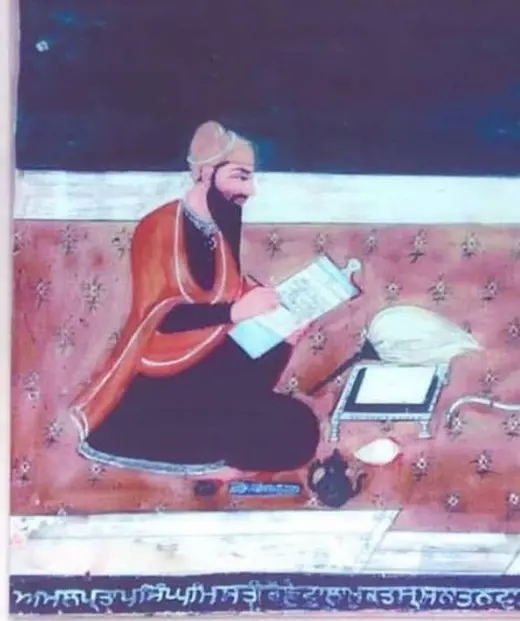
Bhai Mani Singh writing a manuscript, a detail from a painting which Commons places at Takht Damdama Sahib. An artist's imagining, with an uncertain date.
Unknown, 18th or 19th century, uncertain. Takht Damdama Sahib (as stated on Commons). Public domain. Source
