1708 to 1716
Banda Singh Bahadur
Sent north from Nanded by Sri Guru Gobind Singh Ji in 1708, Banda Singh Bahadur took Sirhind in 1710, ruled the land between the Yamuna and the Sutlej from Lohgarh, and held out against imperial armies until his capture in 1715. He and hundreds of his followers were put to death in Delhi in 1716.
The commission at Nanded
1708
The man later known as Banda Singh Bahadur began life as Lachhman Dev, born at Rajauri on 27 October 1670. The Encyclopaedia of Sikhism says the sight of a dying doe on a hunt turned him to asceticism at fifteen. As the bairagi Madho Das he learned yoga near Nasik and then set up his own monastery at Nanded on the Godavari.
Sri Guru Gobind Singh Ji came to the monastery on 3 September 1708. By the chronicler's account the ascetic ended the meeting at Guru Ji's feet, calling himself a banda, or slave. He took the vows of the Khalsa and the Encyclopaedia gives his new name as Banda Singh.
He left for Punjab carrying a drum, a banner and five arrows, the marks of his authority. Five Sikhs went with him: Baj Singh, Binod Singh, Daya Singh, Kahan Singh and Ram Singh. The Encyclopaedia's entry on the misls adds a bodyguard of twenty-five soldiers. His stated aim was to punish the Mughal commander at Sirhind, where two young sons of Sri Guru Gobind Singh Ji had been martyred.
Sri Guru Gobind Singh Ji passed away at Nanded later in 1708. Guru Ji had ended the line of living Gurus and vested the Guruship in Sri Guru Granth Sahib Ji, so Banda Singh's authority was that of a military leader. That distinction later split his followers.[EoS][EoS][EoS][EoS]
From Samana to Sirhind
1709 to 1710
Sikhs began joining him as soon as he reached Punjab. Among the first were Fateh Singh, a descendant of Bhai Bhagatu, and men from Bhai Rupa and Salaudi. The Encyclopaedia's misl entry estimates 4,000 to 5,000 horsemen and 7,000 to 8,000 foot within two months, and 30,000 to 40,000 men within a year.
He attacked Samana on 26 November 1709. It was the home town of the executioner of Sri Guru Tegh Bahadur Ji and of the two men who had offered to behead the young Sahibzade. Ghurham, Thaska, Shahabad and Mustafabad followed, then Kapuri and Sadhaura.
This long route gave Sikhs from the Doaba and Majha time to arrive before he moved on Sirhind. Wazir Khan, the Mughal governor, fell at Chappar Chiri on 12 May 1710, with Binod Singh commanding the Sikh left wing. Sirhind was captured on 14 May and plundered, and Baj Singh became its governor.[EoS][EoS][EoS]
Rule from Lohgarh
1710
Banda Singh now controlled the country between the Yamuna and the Sutlej. He made the old fort of Mukhlisgarh, in the foothills, his headquarters and renamed it Lohgarh. He adopted a royal style and began a new calendar counted from the capture of Sirhind.
His coins carried the names of Sri Guru Nanak Dev Ji and Sri Guru Gobind Singh Ji. His seal added two words: deg, the kettle of the langar, standing for charity, and tegh, the sword, standing for victory.
The Encyclopaedia credits him with abolishing the zamindari system and making cultivators owners of the land they worked. It also cites a report to Emperor Bahadur Shah that some 5,000 Muslims near Kalanaur and Batala had joined him and were free to pray in his camp.
In summer 1710 he crossed the Yamuna and took Saharanpur, then returned to Punjab. Batala and Kalanaur fell, a force gathered against him was beaten at Bhiloval, and he occupied Rahon in the Jalandhar Doab on 3 October. Only the city of Lahore held out in Majha and Riarki.[EoS]
The imperial response
1710 to 1714
Bahadur Shah came north from the Deccan. An order dated 10 December 1710 told his commanders to kill followers of Sri Guru Nanak Dev Ji wherever they were found. A large imperial force drove the Sikhs out of Sirhind and shut them up in Lohgarh, which the Encyclopaedia says was surrounded by 60,000 horse and foot.
Short of food, Banda Singh broke through the cordon on the night of 10 December 1710. Within a fortnight he was sending out hukamnamas calling people to keep fighting. Bilaspur was sacked, and Mandi, Kullu and Chamba submitted. In June 1711 he beat a Mughal force at Bahrampur near Jammu, but he was pushed back into the hills.
Bahadur Shah passed away on 28 February 1712, and the war over the throne gave the Sikhs some relief. Banda Singh retook Sadhaura and Lohgarh. Farrukh-Siyar, who took the throne in 1713, renewed the campaign and drove the Sikhs from the plains.[EoS]
The split in the ranks
1714
Some of Banda Singh's changes offended older Khalsa Sikhs. According to the Encyclopaedia he replaced the Sikh greeting with "Fateh Darshan", gave up the blue dress for red, and let followers treat him as Guru.
Many Sikhs left him during his last campaign and called themselves the Tatt Khalsa. Binod Singh and his son Kahn Singh led them, and Baba Deep Singh withdrew to Damdama Sahib in 1714. The Encyclopaedia says Binod Singh acted on the command of Mata Sundari, the widow of Sri Guru Gobind Singh Ji, yet was unwilling to fight Banda Singh. Those who stayed with Banda Singh came to be called the Bandai Khalsa.[EoS][EoS][EoS][EoS]
Gurdas Nangal and Delhi
1715 to 1716
The last stand came at Gurdas Nangal, about six kilometres from Gurdaspur. Under siege for eight months, the garrison ran out of food. The Mughal chronicler Khafi Khan describes men eating leaves, bark and ground bones. The army broke in and captured Banda Singh on 7 December 1715.
The prisoners were paraded in Lahore and reached Delhi on 27 February 1716. The Encyclopaedia counts 740 prisoners in chains, along with 700 cartloads of heads and 2,000 more on pikes. Two East India Company men, John Surman and Edward Stephenson, wrote an eyewitness letter on the executions dated 10 March 1716.
Banda Singh and about two dozen leaders were held in the fort. The other 694 were given to the city's kotwal and killed at a hundred a day at the Kotwali Chabutra.
Banda Singh was then brought to the tomb of the Sufi Qutb ud-Din Bakhtiyar Kaki, near the Qutb Minar, and offered the choice of Islam or death. He refused. Ajai Singh, his son of four, was killed in front of him, and he was tortured and was martyred on 9 June 1716.[EoS][Web][EoS]
What the sources disagree on
- The revenue of his territory
The entry on Banda Singh puts the annual revenue of his conquests at 36 lakh rupees. The entry on the misls puts Sirhind province alone at 52 lakh.[EoS][EoS]
- His claim to Guruship
Mainstream Sikhs hold that the line of living Gurus ended with Sri Guru Gobind Singh Ji. The Encyclopaedia reports that some Bandai Sikhs still regard Banda Singh as the eleventh Guru, and that his opponents said he allowed followers to treat him as one. It does not quote any statement of his own making the claim.[EoS][EoS]
Images
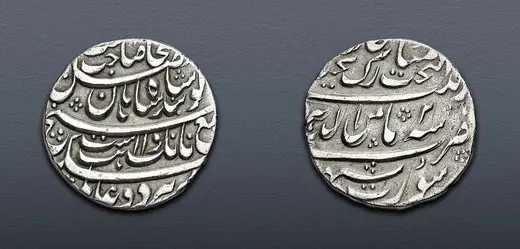
A silver rupee struck under Banda Singh Bahadur at Amritsar, dated Year 2 (1711) according to the auction house that sold it. This is a different coin from the one at the American Numismatic Society.
Mint of Banda Singh Bahadur. Image: Classical Numismatic Group, 1711, as catalogued. Sold at auction by Classical Numismatic Group (present owner unknown).CC BY-SA 2.5. Source
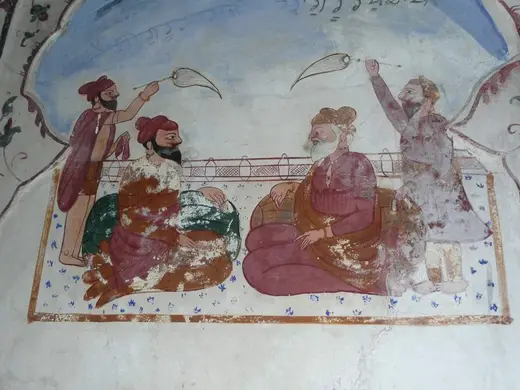
A wall painting at Gurdwara Dera Baba Banda Bahadur, Reasi, showing Banda Singh Bahadur and a boy read as his son. Probably 19th century, so an artist's imagining.
Unknown, Probably 19th century. Gurdwara Dera Baba Banda Bahadur, Reasi (as stated on Commons). Public domain. Source
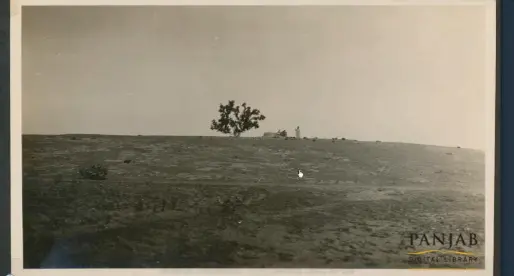
The site of Banda Singh Bahadur's last battle and capture at Gurdas Nangal, photographed by Dhanna Singh Chahal in 1934.
Dhanna Singh Chahal 'Patialvi', 1934. Public domain. Source
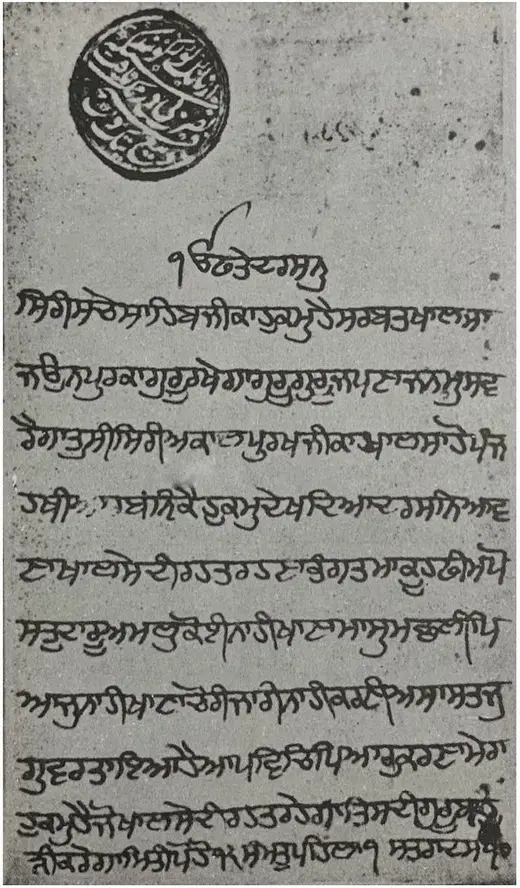
A hukamnama of Banda Singh Bahadur to the congregation of Jaunpur, dated 12 December 1710 (12 Poh 1769 Bk). It asks them to join his campaign.
Banda Singh Bahadur, 12 December 1710. Public domain. Source


