Artifact
Goindwal Pothis
also Goindval Pothis, Baba Mohan Pothis, Pothian Baba Mohan Valian, Sahansar Ram Valian Pothian
Two Gurmukhi manuscripts of hymns made at Goindwal in the early 1570s, the oldest surviving collection behind the Sikh scripture.[EoS][EoS][EoS]
- Date
- 1570-1572, with possible later additions
- Held by
- Descendants of Sri Guru Amar Das Ji (Bhalla family branches)
- Location
- Pinjore near Chandigarh, and Darapur near Urmur, Hoshiarpur district, Punjab, as last reported
- Provenance
- Documented
- Status: Private collection
- Two volumes survive in family hands. The Encyclopaedia of Sikhism (published 1992-98) places one with Bava Bhagat Singh Bhalla, who took it from Goindwal to Mardan in 1940 and later to Patiala, and says it has since moved to Pinjore. The other is at Darapur, and Punjabi University holds a photocopy of it. No newer report was found, so these locations may be out of date. A modern reference guide names Jalandhar as well, which could not be confirmed.
The volumes hold compositions of the first three Gurus and of eight earlier saints. The Encyclopaedia of Sikhism names the scribe as Sahansar Ram, a grandson of Sri Guru Amar Das Ji, and gives the work as running from September 1570 to 9 August 1572.
According to Sikh tradition, Sri Guru Arjun Dev Ji obtained them from Baba Mohan, son of Sri Guru Amar Das Ji, and used them when compiling the Adi Granth.
The two volumes are the same size and together run to 300 and 224 folios. The order of ragas and hymns differs from the later scripture, and so does some wording. The opening invocation is also in a different form.
The family that keeps the Pinjore volume shows it for darshan on full-moon mornings, and the Encyclopaedia says it is not available for scholarly study.
What is disputed
- Where the volumes are now
The Encyclopaedia of Sikhism gives Pinjore and Darapur. A modern reference guide says Jalandhar, Hoshiarpur and Patiala. No source that settles this could be reached.[EoS]
- An earlier pothi
The Puratan Janam Sakhi mentions a book passed from Sri Guru Nanak Dev Ji to Sri Guru Angad Dev Ji. The Encyclopaedia says linking it with Guru Har Sahai pothi rests on insufficient authority.[EoS]
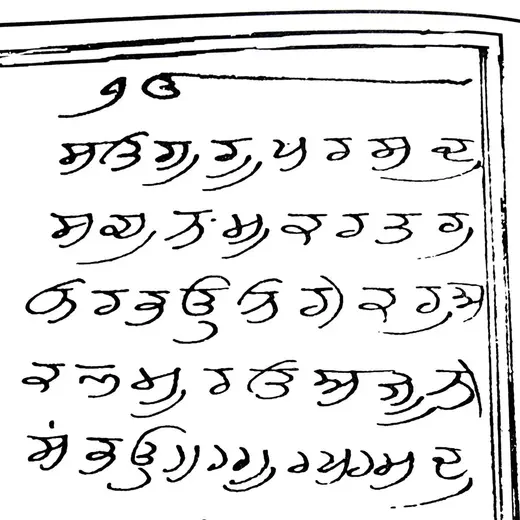
An early form of the Mul Mantar, labelled on Commons as from the Ahiapur Wali volume of the Goindwal Pothis, about 1570-1572. The source link is informal. The Encyclopaedia of Sikhism calls this the Darapur or Yahyapur volume.
Sahansar Ram, scribe, per the Encyclopaedia of Sikhism, c. 1570-1572. Public domain. Source
