Mughal emperor, 1526 to 1530
Babur
Founder of the Mughal dynasty in India. His invasions of the Punjab are the subject of Sri Guru Nanak Dev Ji's Babarvani hymns. Sikh tradition also tells of a meeting between the two, which Babur's surviving memoirs do not mention.
The campaigns in the Punjab
Babur inherited Farghana in Central Asia as a boy in 1494 and took Kabul in 1504. From there he looked towards India.
The Encyclopaedia of Sikhism's entry on the Babarvani sets out the expeditions that matter here. He reached Peshawar in 1519. In 1520 he crossed the Indus, took Sialkot unopposed and stormed Saidpur, now Eminabad, where the defenders were slain and the townspeople taken captive. In 1524 his army sacked Lahore.
His last advance began in late 1525. At Panipat on 21 April 1526 Ibrahim Lodi was killed, and Delhi and Agra passed to Babur. He beat the Rajputs at Khanua in March 1527 and died at Agra on 26 December 1530. His body was later moved to Kabul.[EoS][EoS]
The Babarvani hymns
McLeod notes that no other leading figure of the time is named in Sri Guru Nanak Dev Ji's compositions. Four hymns in Sri Guru Granth Sahib Ji are known as the Babarvani. Three are in Raag Asa at angs 360 and 417-18, and one is in Raag Tilang at angs 722-23. The name comes from a line saying that Babur's rule has spread and that even princes go hungry.
The hymns mourn Hindus and Muslims alike, and call his army a wedding party of sin. The Encyclopaedia reads them as showing Babur as an unknowing agent of divine judgement on the Lodis, while Guru Ji still asks God how such suffering could be allowed. It stresses that they are not a chronicle of events.[EoS][EoS][McLeod]
The meeting in Sikh tradition
The Puratan Janamsakhi places Sri Guru Nanak Dev Ji and Bhai Mardana among the captives at Saidpur. It says that Guru Ji's load stayed up with nothing holding it, and that the horse followed Bhai Mardana without reins. Mir Khan told Babur, who kissed Guru Ji's feet and offered a gift. Guru Ji asked only that the prisoners be freed and their goods returned, and Babur agreed.
The Miharban Janamsakhi has no such interview. It tells instead of an attack by Babur on Tilla Balgundai.[EoS][McLeod]
What the sources disagree on
- Did Babur meet Sri Guru Nanak Dev Ji?
The Puratan Janamsakhi says so, and the Encyclopaedia of Sikhism says Sikh tradition holds firmly to it. Babur's memoirs do not mention Guru Ji, though the Encyclopaedia will not rule a meeting out. McLeod treats the interview as a legendary wonder story, while accepting that Guru Ji saw some of the devastation. The memoirs' silence is also weaker evidence than it looks: Babur's translator, Annette Beveridge, notes a gap in his narrative in the years before 932 AH (1525-26).[EoS][McLeod][Src]
- Which invasion do the hymns describe?
The Janamsakhis attach all four hymns to Saidpur in 1520. McLeod argues that the two longer hymns point instead to the invasions of 1524 and 1525-26. The Encyclopaedia suggests that the mention of guns and elephants may refer to Panipat. McLeod adds that the hymns alone do not place Guru Ji at Saidpur.[McLeod][EoS]
- The number and dates of the expeditions
The Encyclopaedia's entries differ. Its entry on Babur gives 1517, 1519 and an entry into the Punjab in 1523, and its entry on the Babarvani gives 1505, 1519, 1520 and 1524 before the final march. Babur himself counts five expeditions. Beveridge lists those of 925, 926, 930 and 932 AH, and remarks that writers disagree on the dates.[EoS][EoS][Src]
Images
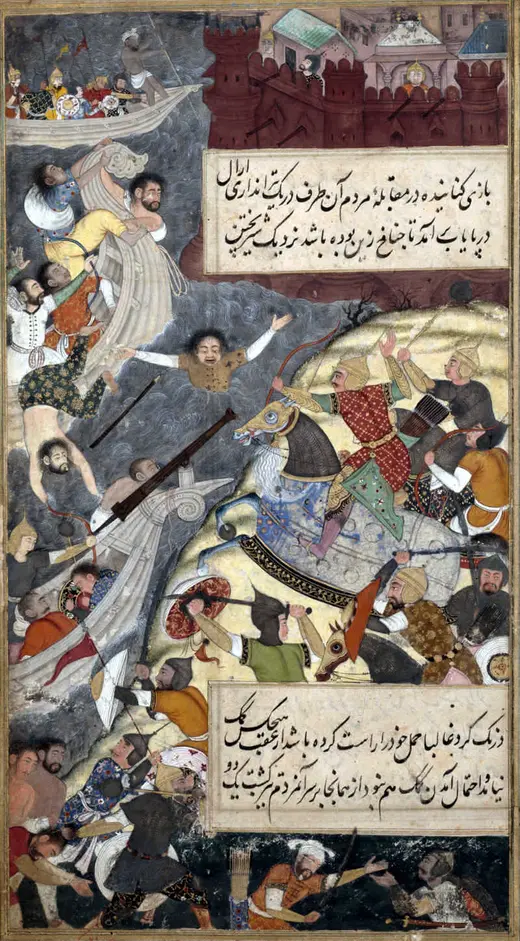
Babur crossing the Indus, a painting commissioned by Emperor Akbar about 1589. It was made some sixty years after Babur died, so it is an artist's imagining.
Unknown, About 1589. Aga Khan Museum. Public domain. Source
