Mughal emperor, 1556 to 1605
Akbar
The third Mughal emperor, who reigned during the time of the third, fourth and fifth Gurus. Sikh sources remember him as a friendly ruler. His call on Sri Guru Arjun Dev Ji in 1598 is the first event in Sikh history recorded in a Mughal chronicle.
Reign and religious policy
Akbar was born at Amarkot in Sindh during his father Humayun's flight, and on 14 February 1556 he was crowned at Kalanaur in the Punjab.
The Encyclopaedia of Sikhism credits him with ending the jizya and the pilgrim tax, curbing the ulama and holding debates among scholars of many faiths. It says he treated Sri Guru Amar Das Ji, Sri Guru Ram Das Ji and Sri Guru Arjun Dev Ji with reverence. Most of the detail behind that judgement comes from Sikh writers.[EoS][EoS]
The visit of 1598
Abu'l Fazl's Akbarnama gives a short notice of it. Leaving Lahore for the last time, the emperor crossed the Beas on an elephant near Goindwal while his troops used a boat bridge. That day he stopped at the house of Sri Guru Arjun Dev Ji, accepting the invitation because it came from devotion.
Abu'l Fazl calls Guru Ji a leader of the Brahmanical faith. The translator suggests he was writing second-hand, being absent from the camp. Grewal adds that the slip may also show how little he knew of Sikh teaching.[(eds)]
Stories in Sikh sources
The remaining accounts come from the Sikh side, and no Mughal record of them has been confirmed.
The Mahima Prakash says that Akbar pushed aside the silks laid out for him and went barefoot to Sri Guru Amar Das Ji at Goindwal. The chronicles add that he ate in the langar like any other visitor before seeing Guru Ji.
Sikh accounts also say that Brahmins complained at court about the langar, and that the future Sri Guru Ram Das Ji answered at Lahore that all are equal before God. One version of the founding of Amritsar has Akbar offering land that Sri Guru Amar Das Ji declined. It then passed to Bibi Bhani. Another version has the land bought from the owners at Tung.
A further account says that complaints against the scripture led Akbar to send for it while camped at Batala. Bhai Buddha and Bhai Gurdas brought the volume, the passages read out praised God, and he offered 51 gold mohars.[EoS][EoS][EoS]
What the sources disagree on
- Did Akbar visit Sri Guru Amar Das Ji?
Sikh chronicles say he did, and the Encyclopaedia of Sikhism repeats them, in one entry with the words 'is said to'. The Akbarnama passage on the 1598 crossing names Sri Guru Arjun Dev Ji and is silent on any earlier visit. One short passage is not a search of all Mughal records, so the story has not been confirmed or ruled out.[EoS][EoS][(eds)]
- The date of the 1598 visit
The Akbarnama translation by Shireen Moosvi gives 13 Azar, or 4 November 1598. The Encyclopaedia of Sikhism's entry on Akbar gives 24 November 1598.[(eds)][EoS]
- Did Akbar cut the revenue at Guru Ji's request?
The Encyclopaedia of Sikhism says that the emperor remitted revenue at Guru Ji's instance, and credits this to Abu'l Fazl. Sujan Rai Bhandari, writing in the 1690s, also links the two. The Akbarnama itself reports the reduction separately, as cancelling an increase of one-fifth imposed earlier, and does not mention Guru Ji. Grewal concludes that two separate events had merged within about a century.[EoS][EoS][(eds)]
Images
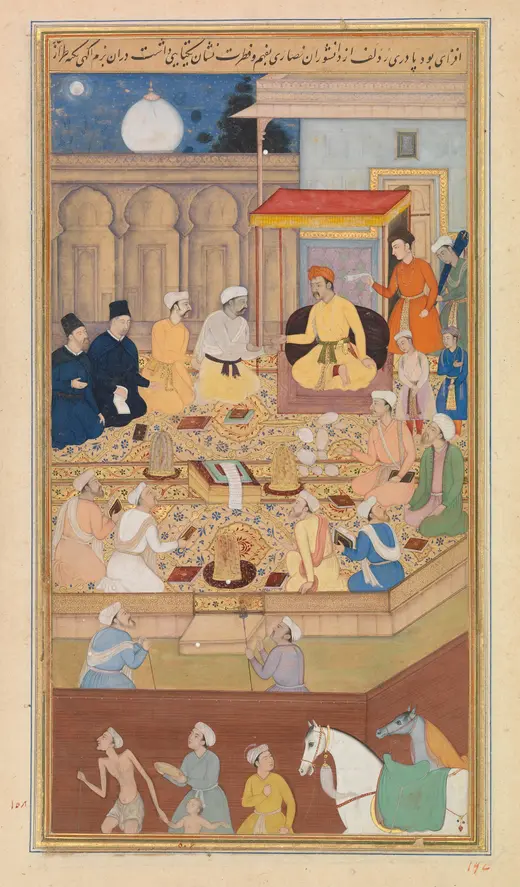
Akbar and the Jesuits, from an Akbarnama manuscript of about 1600 to 1603, painted by Narsingh in the emperor's lifetime. It illustrates his interest in debate between faiths.
Narsingh, About 1600 to 1603. Chester Beatty Library, Dublin, In 03.263b. Public domain. Source
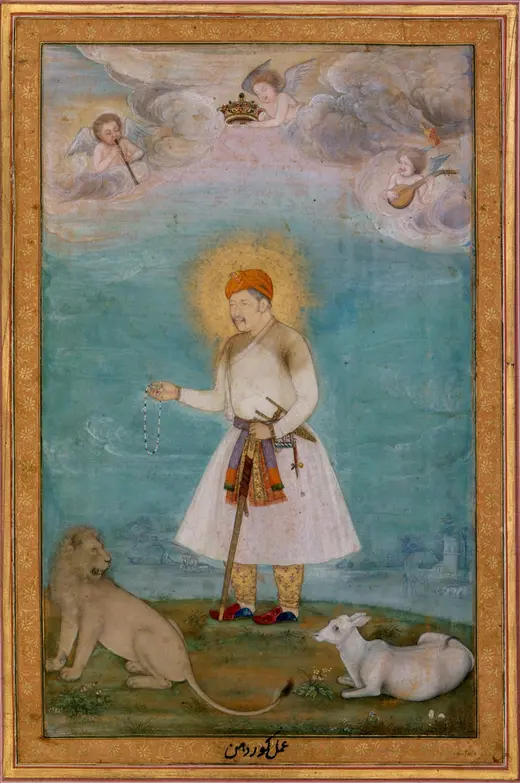
Akbar with a lion and a calf, by Govardhan, about 1630. It was painted some 25 years after Akbar died, so it is not a portrait from life.
Govardhan, About 1630. Metropolitan Museum of Art, New York. Public domain. Source
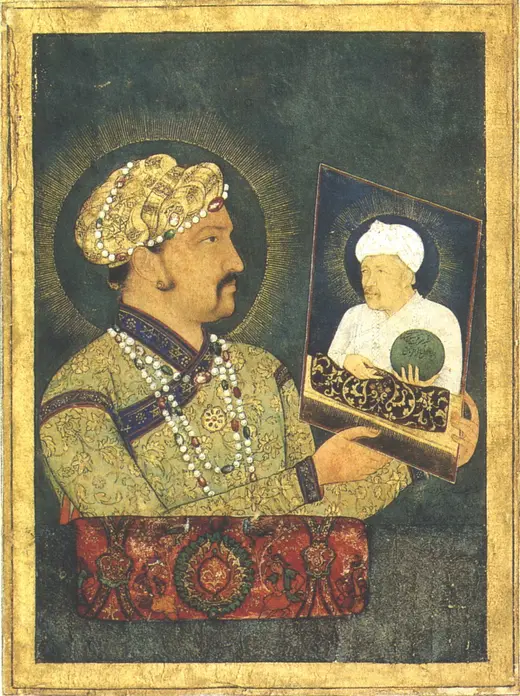
Jahangir gazing at a portrait of his father Akbar, a painting of about 1614 by Hashim and Abu al-Hasan, made in Jahangir's reign.
Hashim and Abu al-Hasan, About 1614. Musee Guimet, Paris. Public domain. Source


