Mughal emperor, 1605 to 1627
Jahangir
The fourth Mughal emperor. His own memoirs record his order against Sri Guru Arjun Dev Ji, who attained martyrdom at Lahore in 1606. He also held Sri Guru Hargobind Ji at Gwalior, and is later described as being on friendly terms with Guru Ji.
Accession and Prince Khusrau
Born Salim, he was crowned on 24 October 1605. His son Khusrau fled Agra on 6 April 1606, making for the Punjab. Jahangir followed him to Lahore.
The Encyclopaedia of Sikhism says that in these years he leaned on orthodox courtiers influenced by Shaikh Ahmad Sirhindi. That is a modern reading, and should be kept apart from what Jahangir himself wrote.[EoS][EoS][EoS]
The order against Sri Guru Arjun Dev Ji
His memoir, the Tuzuk-i-Jahangiri, is the most direct Mughal evidence, and it is openly contemptuous. He calls Guru Ji a Hindu at Goindwal in the dress of a holy man, who had drawn in simple Hindus and some Muslims. For three or four generations, he says, this trade had been kept going, and he had often thought of ending it or of bringing Guru Ji into Islam.
When Khusrau halted there, Jahangir writes, Guru Ji came out to him and marked his forehead with saffron. Jahangir had Guru Ji brought before him, handed his homes and children to Murtaza Khan, seized his property and ordered capital punishment. Guru Ji attained martyrdom at Lahore in 1606.
Later Sikh writers tell this differently. Grewal points out that Kesar Singh Chhibber, writing in 1769, does not name Jahangir at all and blames Prithi Chand and Chandu Shah. Ratan Singh Bhangu, in the 1840s, says that mullas and qazis swayed Jahangir, yet still shifts much of the blame elsewhere.[Src][(eds)][EoS]
Sri Guru Hargobind Ji
Jahangir sent Sri Guru Hargobind Ji to Gwalior fort. The Dabistan-i-Mazahib, written in the 1640s, gives the unpaid balance of the fine on Guru Ji's father as the reason. It also says that Guru Ji's soldierly style caused difficulties. The Encyclopaedia cites reports of the splendour in which Guru Ji lived.
After the release, relations seem to have improved. The Dabistan says that Guru Ji kept close to the imperial camp. Sikh chronicles describe a journey together to Kashmir in 1620, and Sikh tradition says that Jahangir handed Chandu Shah over to Guru Ji.
Jahangir died in October 1627 and was buried at Shahdara, outside Lahore.[(eds)][EoS][EoS]
What the sources disagree on
- What exactly did Jahangir order?
The Encyclopaedia of Sikhism's entry on Jahangir quotes him as ordering capital punishment with torture. The Rogers and Moosvi translations of the same passage have no such words. Moosvi renders it as capital punishment, using a term that can refer to the Mongol code, under which the blood of honoured persons was not to be spilled. Grewal accepts that Guru Ji was tortured, and asks whether this was the mode that Jahangir ordered. The Encyclopaedia's entry on the memoir has a different wording again.[EoS][Src][(eds)][EoS]
- The fine
Jahangir mentions no fine on Guru Ji. The Dabistan and the Jesuit writer Guerreiro both report a heavy one. The Dabistan says that Guru Ji could not pay it, and the Encyclopaedia of Sikhism says that Guru Ji refused to pay. Guerreiro also has a wealthy surety inflicting the torments, where the Dabistan blames the collectors.[Src][(eds)][EoS]
- The date
The Encyclopaedia of Sikhism gives 30 May 1606 for Guru Ji's martyrdom. Moosvi says that the traditional Sikh accounts point to June. The memoir's own entry is also dated differently: Moosvi says that it follows an event of 22 Muharram (30 May), while the Encyclopaedia's entry on the memoir dates it 22 Safar (19 June).[EoS][(eds)][EoS]
- How long was the stay at Gwalior?
The Dabistan says twelve years. The Encyclopaedia of Sikhism says a few months at some point between 1617 and 1619, and adds in its entry on Guru Ji that the length cannot be stated with certainty.[(eds)][EoS][EoS]
Images
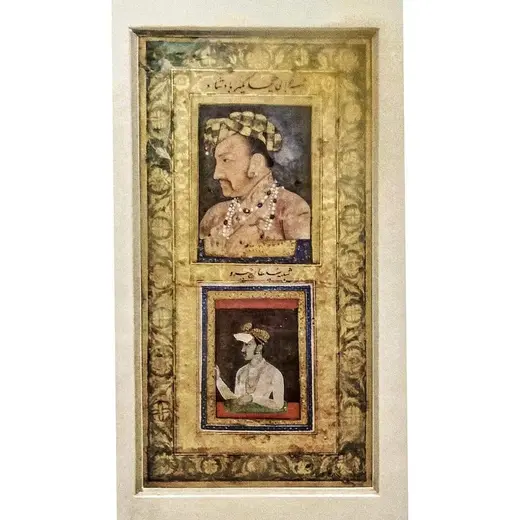
Miniature portraits labelled as Emperor Jahangir and his son Prince Khusrau, 17th century. The identification follows the description on Commons.
SpeakingArch (photograph); artist unknown, 17th century. Taj Museum, Agra.CC BY-SA 4.0. Source
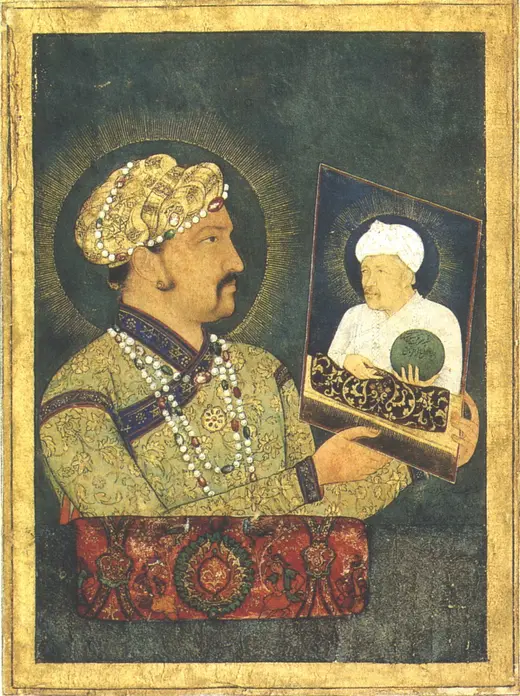
Jahangir gazing at a portrait of his father Akbar, a painting of about 1614 by Hashim and Abu al-Hasan, made in Jahangir's reign.
Hashim and Abu al-Hasan, About 1614. Musee Guimet, Paris. Public domain. Source

