Mughal emperor, 1658 to 1707
Aurangzeb
The Mughal emperor in the time of the last four Gurus. Sri Guru Tegh Bahadur Ji attained martyrdom at Delhi in his reign, and his forces and hill allies fought Sri Guru Gobind Singh Ji, who wrote him the Zafarnamah. Sikh and Persian sources give different reasons for these conflicts.
Accession and policy
Aurangzeb took the throne on 21 July 1658 after defeating his brother Dara Shukoh at Samugarh. The Encyclopaedia of Sikhism dates his harshest measures against non-Muslims to 1669 and 1679, the latter being the reimposition of the jizya.
An order preserved in the Ahkam-i-Alamgiri touches the Sikhs directly. It records a Sikh place of worship at Buriya being pulled down under imperial orders and a mosque built there, and Sikhs then raiding the mosque and killing the dervish placed in it.[EoS][(eds)]
Sri Guru Har Rai Ji and Sri Guru Har Krishan Ji
Dara Shukoh's flight through the Punjab in 1658 drew the Sikhs into the succession war. The Encyclopaedia says that Aurangzeb then summoned Sri Guru Har Rai Ji, who sent his son Ram Rai. The emperor kept Ram Rai at Delhi, and later called Sri Guru Har Krishan Ji there to settle the rival claims. Guru kian Sakhian, a Sikh source, says that he tested Guru Ji with two trays at court on 25 March 1664, and that Guru Ji then refused to see him again because he wanted a miracle. Guru Ji passed away at Delhi on 30 March 1664.[EoS][EoS][EoS]
Sri Guru Tegh Bahadur Ji
Sri Guru Gobind Singh Ji
The Encyclopaedia says that after the battle of Nadaun in 1691 Aurangzeb told his faujdars to restrain Guru Ji, and that in 1696 he sent Prince Muazzam to settle the Punjab. In 1705 hill chiefs and Mughal troops besieged Anandpur, and Guru Ji left on the night of 5-6 December.
Guru Ji then wrote the Zafarnamah, a Persian verse letter that accuses the emperor of breaking a sworn promise. Letters from the emperor's secretary show orders for Guru Ji to be brought to court under assurances of safety. Aurangzeb died on 20 February 1707, before any meeting.[EoS][EoS][(eds)]
What the sources disagree on
- Why was Sri Guru Tegh Bahadur Ji martyred?
Sikh sources dwell on the religious issue: freedom of belief and the Kashmiri Pandits. Grewal notes that most non-Sikh sources give another reason, Guru Ji's supposed militancy. Bhimsen, writing around 1708, lists Guru Ji among those who took to rebellion and claimed the title of king. Muhammad Qasim's Ibratnama speaks of Guru Ji's splendour and of followers claiming sovereignty, and sets Guru Ji beside the mystic Sarmad as a religious man who tasted martyrdom. Grewal cautions that these writers relied on vague hearsay.[(eds)][EoS]
- When was Sri Guru Tegh Bahadur Ji arrested?
The Encyclopaedia of Sikhism gives July 1675. Grewal's summary of Sujan Rai Bhandari, writing in the 1690s, gives imprisonment in 1670-71 or 1673-74.[EoS][(eds)]
- Who began the final contact with Sri Guru Gobind Singh Ji?
The Encyclopaedia of Sikhism says that Aurangzeb responded to the Zafarnamah by inviting Guru Ji. The orders in the Ahkam-i-Alamgiri instead say that Guru Ji had sent a petition through an agent, asking to come to court, and they do not name the Zafarnamah. Their translator thinks that these negotiations were the setting for the poem. A court report from Bahadur Shah's reign simply says that the late emperor summoned Guru Ji.[EoS][(eds)]
Images
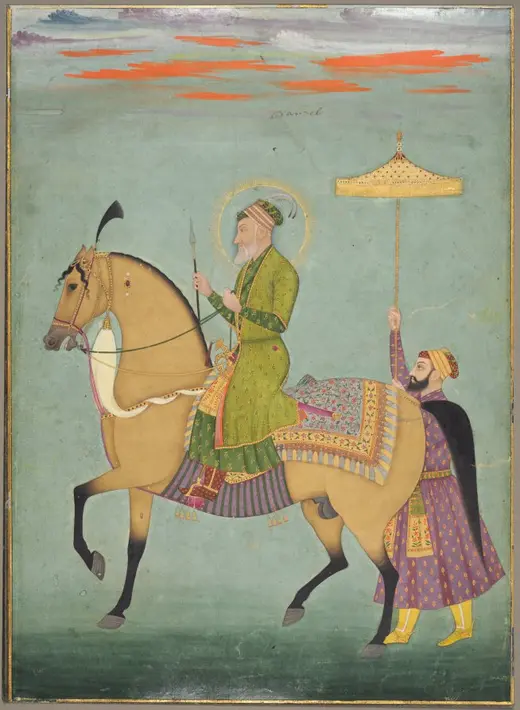
The Emperor Aurangzeb on horseback, by an unnamed artist, about 1690 to 1710.
Unknown, About 1690 to 1710. Cleveland Museum of Art. Public domain. Source
